
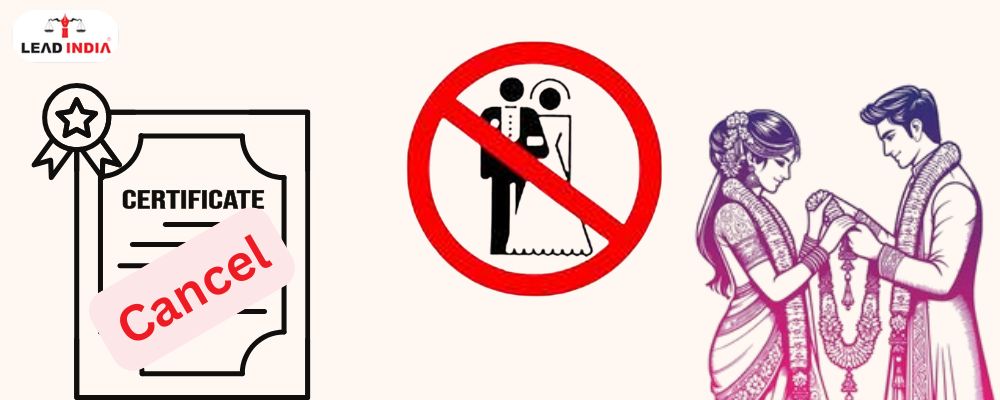
Marriage is considered a divine and lawful binding institution in India. Once a marriage is registered and a marriage certificate is issued, it becomes a recognized legal union. However, not all marriages work out as planned. Sometimes, people seek to end their marital relationship due to personal differences, incompatibility, or other serious issues.
Many individuals wonder whether it is possible to “cancel” a marriage certificate in India. The short answer is: No, a marriage certificate cannot be canceled. But if a marriage is no longer valid due to legal reasons or if the couple no longer wishes to stay married, the law offers two clear options: annulment or divorce.
This article provides a detailed explanation of how to legally end a marriage in India, whether through annulment (declaring a marriage null and void) or divorce (legally ending a valid marriage). We’ll also explain the legal grounds, the procedure involved, and your options under both the Hindu Marriage Act, 1955, and the Special Marriage Act, 1954.
Can You Cancel a Marriage Certificate in India?
First, it’s important to clarify this common misconception:
A marriage certificate cannot be canceled once issued. The only way to legally dissolve or nullify the marriage is through annulment or divorce.
A marriage certificate is a legal proof of marriage registration. Even if you never lived together as husband and wife, the certificate remains valid unless a court declares the marriage invalid or grants a divorce. Therefore, the idea of “canceling” a marriage certificate does not exist in Indian law. Instead, the law offers two routes:
- Annulment of Marriage – when the marriage is declared void or voidable.
- Divorce – when a valid marriage is legally ended through court decree.
Need A Legal Advice
The internet is not a lawyer and neither are you. Talk to a real lawyer about your legal issue
What Is an Annulment of Marriage?
An annulment means that a marriage is considered legally invalid from the beginning. In legal terms, it’s as if the marriage never took place.
Grounds for Annulment
The grounds for annulment vary slightly depending on whether the marriage was performed under the Hindu Marriage Act or the Special Marriage Act.
Under the Hindu Marriage Act, 1955
A marriage can be declared null and void under Section 11 and Section 12 of the Act. Some of the grounds include:
- One of the spouses was already married at the time of the second marriage.
- The parties are within prohibited degrees of relationship (e.g., close blood relatives) and the marriage is invalid.
- Lack of valid consent due to mental incapacity.
- One spouse was forced or deceived into marriage.
- Impotency or inability to consummate the marriage.
Under the Special Marriage Act, 1954
According to Section 24 and Section 25 of this Act, a marriage can be annulled on grounds such as:
- Lack of valid consent due to unsound mind.
- Inability to consummate the marriage.
- Mental illness or incurable mental disorder at the time of marriage.
- Concealment of material facts such as criminal history, prior marriage, or sexually transmitted diseases.
Procedure for Annulment
- Consult a family lawyer to assess your eligibility for annulment.
- File a petition for annulment in the appropriate family court.
- Submit required documents and evidence to support your claims.
- Attend court hearings where both parties will present their case.
- If the court finds the grounds valid, it will issue a decree of nullity, making the marriage void.
The duration of this process may vary depending on the nature of the case and the evidence provided.
What Is Divorce?
Unlike annulment, a divorce is the formal ending of a legally valid marriage. The law recognizes the marriage as valid until the court grants a divorce decree.
Divorce can be granted in two ways:
- Mutual Consent Divorce
- Contested Divorce
Divorce Under Hindu Marriage Act, 1955
Mutual Consent Divorce – Section 13B
- Both spouses agree to end the marriage.
- They must live separately for at least one year before filing.
- A joint petition is filed, followed by two court appearances.
- If both parties maintain their decision, the court grants the divorce.
Contested Divorce – Section 13
A contested divorce is filed by one spouse against the other based on specific grounds:
- Cruelty (mental or physical)
- Adultery
- Desertion for two or more years
- Conversion to another religion
- Mental disorder or incurable illness
- Renunciation of the world (e.g., becoming a monk)
- Presumed death (missing for over 7 years)
Divorce Under Special Marriage Act, 1954
Under this law, couples married in a civil ceremony (regardless of religion) can seek divorce through:
- Section 27: Contested divorce on grounds such as adultery, cruelty, desertion, mental illness, etc.
- Section 28: Divorce by mutual consent, after living separately for at least one year.
Difference Between Annulment and Divorce
| Basis | Annulment | Divorce |
| Definition | Declares the marriage invalid from the start | Legally ends a valid marriage |
| Marital Status | Treated as if marriage never existed | Treated as legally divorced |
| Grounds | Mental incapacity, fraud, impotency, etc. | Cruelty, adultery, desertion, mutual consent, etc. |
| Legal Provisions | Sections 11 & 12 of Hindu Marriage Act; Section 25 of Special Marriage Act | Section 13 & 13B of Hindu Marriage Act; Sections 27 & 28 of Special Marriage Act |
| Outcome | Marriage becomes null and void | Marriage is dissolved |
Is It Possible to Remarry Without Divorce?
No. If a person remarries without obtaining a legal divorce (and the first marriage is still valid), the second marriage is illegal and considered void under Indian law. This may also attract charges of bigamy under Section 494 and 495 of the Indian Penal Code (IPC), which is a criminal offense.
What About Separation?
Separation simply means the couple is living apart. It does not amount to divorce. However, living separately for one year or more is a requirement before applying for mutual consent divorce under both:
- Section 13B of the Hindu Marriage Act
- Section 28 of the Special Marriage Act
During this period, the couple may choose to reconcile or move forward with the divorce.
Irretrievable Breakdown of Marriage
In recent years, many divorce cases have cited the “irretrievable breakdown of marriage”—meaning the relationship is beyond repair.
However, Indian courts have clarified that this alone cannot be a legal ground for divorce unless it’s accompanied by other valid grounds like cruelty or desertion. The Supreme Court and High Courts have the power to dissolve marriages under Article 142 of the Constitution in such cases, but this is rare and done on a case-by-case basis.
Steps to File for Divorce or Annulment
Here’s a simplified breakdown of the process:
- Hire a family lawyer experienced in divorce or annulment.
- Collect relevant documents: marriage certificate, ID proof, evidence of grounds (emails, photos, medical records, etc.).
- File the petition in the appropriate Family Court.
- Attend court hearings as required.
- If the case is uncontested (mutual), the process is faster—6 to 18 months. If contested, it can take 2–5 years or more.
Can You Cancel a Registered Marriage?
Once a marriage is registered, the marriage certificate cannot be revoked or canceled by the registrar. Only a family court can declare a marriage void or grant a divorce. So, the idea of “canceling” a registered marriage is a legal misunderstanding. You must go through proper legal channels.
How Can a Lawyer Help?
Dealing with marriage dissolution can be stressful, both emotionally and legally. A good family lawyer can help you:
- Understand your rights and legal options.
- Draft and file annulment or divorce petitions.
- Represent you in court.
- Negotiate alimony, child custody, or maintenance.
- Protect your legal interests during proceedings.
Lead India offers experienced legal services to handle marriage annulments and divorces efficiently and with compassion.
Conclusion
To sum up, you cannot cancel a marriage certificate in India, but you can legally dissolve the marriage through annulment or divorce. The applicable laws, including the Hindu Marriage Act and the Special Marriage Act, provide clear procedures and grounds for ending a marriage.
Whether you’re seeking to declare your marriage null and void, or looking to file for divorce, it’s essential to consult a qualified lawyer to understand your situation, rights, and the legal steps ahead.
One can talk to lawyers from Lead India for any kind of legal support. In India, free legal advice online can be obtained at Lead India. Along with receiving free legal advice online, one can also ask questions to the experts online free through Lead India.
FAQs
1. Can a marriage certificate be canceled in India?
No. A marriage certificate cannot be canceled. However, the marriage can be annulled or dissolved through a court order.
2. How long does it take to annul a marriage in India?
It can take anywhere between 6 months to 2 years, depending on the case complexity and court backlog.
3. What is the procedure for annulment under the Special Marriage Act?
File a petition in the Family Court under Section 25, citing valid grounds such as lack of consent, mental incapacity, or non-consummation.
4. Can I get a divorce without waiting for one year of separation?
No. For mutual consent divorce, a one-year separation is mandatory under both the Hindu Marriage Act and Special Marriage Act.


 Talk to a Lawyer