
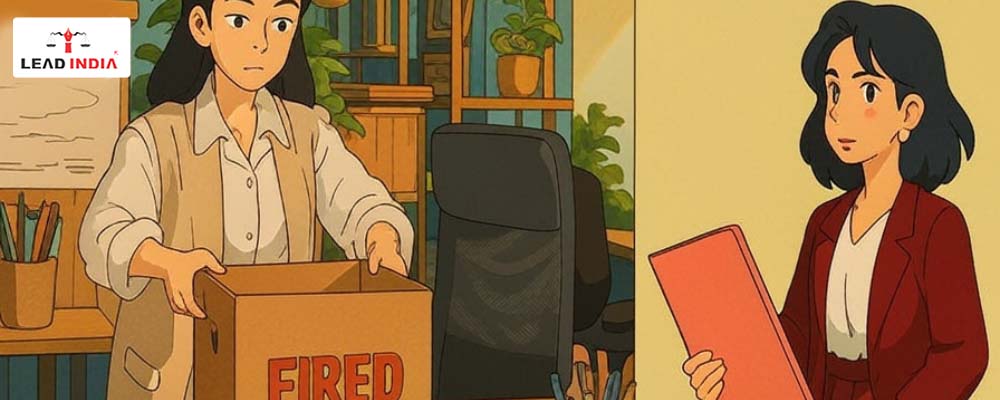
In recent years, the legal treatment of workplace rights and gender justice under Indian courts and Indian society have been intensified. A question that many argue is whether terminating a woman from service could amount to sexual harassment as per Indian law?
Although termination of a woman’s employment does not by itself lead to a finding of sexual harassment, the context, intent, and manner of the termination must be considered. It is these that would determine whether termination would violate any of the various protections afforded to the woman under the Sexual Harassment of Women at Workplace (Prevention, Prohibition and Redressal) Act 2013 (POSH Act).
This article studies the intricacies of the intersection of employment termination and sexual harassment law with reference to statutes, judicial interpretations, and landmark cases.
Need A Legal Advice
The internet is not a lawyer and neither are you. Talk to a real lawyer about your legal issue
What constitutes sexual harassment at the workplace?
Under POSH Act, 2013, sexual harassment is not mere physical molestation or sexual remarks. It includes:
- Demands for sexual favours
- Sexually coloured comments
- Unwelcome gestures, body language, or verbal remarks
- And crucially, retaliation after a complaint
“I never imagined that after reporting my boss’s behavior, I’d be suddenly let go, no explanation, no warning. I realized something wasn’t right at that point- An anonymous reflection of a true survivor.
Retaliation Is Also Harassment: What the Law Says?
Indian courts and the Vishaka Guidelines are clear that no woman should face negative consequences for reporting harassment.
If you’re fired, transferred, demoted, or even bad-mouthed after filing a complaint, it can amount to harassment under the law. This includes:
- Being punished for not complying with inappropriate behaviour
- Facing job threats after rejecting advances
- Getting fired soon after reporting a complaint
When Does Termination Become Harassment?
Termination isn’t always illegal. However, it goes too far if it’s used to silence or punish a woman.
Termination becomes legally questionable when:
- The woman was fired after rejecting sexual advances
- She was dismissed soon after lodging a harassment complaint
- The employer bypassed the Internal Complaints Committee (ICC)
- There was no proper explanation or due process
After I sent an email about my team leader’s repeated ‘jokes’, my appraisal tanked. Then came the termination. HR said it was performance-based; I had never even received a warning before. Anonymous IT employee
Real Court Cases That Support Women
These landmark judgments show that the law protects you:
- Punita Sodhi v. Union of India: The Delhi High Court held that firing a woman post-complaint without an ICC inquiry amounts to victimisation.
- A.K. Chopra Case: The Supreme Court clarified that even non-physical harassment or career threats count as sexual harassment.
- Rupan Deol Bajaj v. K.P.S. Gill: Although not a termination case, it illustrated the long-term psychological and professional harm caused by harassment, setting precedent for broader legal interpretation.
ICC: Your First Line of Protection
An Internal Complaints Committee must be established by any business with ten or more employees.
If a woman believes her termination was retaliatory, the ICC must investigate before any HR action.
The ICC can recommend:
- Reinstatement
- Compensation
- Disciplinary action against the harasser
If no ICC exists or it is bypassed, the employer can be penalized under the POSH Act, including fines or loss of business license.
Real-Life Scenario: Could This Happen to You?
Imagine this: You report your manager for inappropriate messages. Two weeks later, you receive a termination letter citing vague “behavioral issues”, with no prior warning. This isn’t fiction. It’s a pattern that appears in consultations far too often.
In such situations, you can:
- File a complaint with the ICC
- Approach the Labour Court or High Court
- Demand compensation, reinstatement, or disciplinary action
Termination May Also Violate Other Women-Centric Laws
Besides the POSH Act, Indian law offers other protections:
- Equal Remuneration Act 1976: Firing a woman solely based on her gender violates the principle of equal opportunity.
- Maternity Benefit Act 1961: It is forbidden to terminate someone while on maternity leave or soon after.
- Constitutional Remedies: Articles 14 (equality), 15 (no discrimination), and 21 (right to life with dignity) may be invoked through writ petitions in government jobs.
What the Supreme Court Says About Workplace Sensitivity?
In the Vishaka case (1997), the Supreme Court of India ordered:
- Workplaces must protect both direct and indirect avenues from threats, hostile environments, and employment-related retaliation.
- The court therefore laid down mandatory guidelines for all employers that would ensure the safety of women in the workplace.
Employers: How Not to Land in Legal Trouble?
Employers must act with transparency and fairness when dealing with women employees, especially in harassment-related matters. This includes:
- Constituting a functional and trained ICC
- Avoiding any disciplinary action without ICC’s inquiry if a harassment complaint is filed
- Maintaining written performance records to justify termination
- Following due process and avoiding bias in HR decisions
Final Take: Can Termination Be Sexual Harassment?
Yes, in case of retaliatory, discriminatory terminations, or terminations connected to a woman exercising her rights under the provisions of the POSH Act. A woman who has been dismissed for rejecting an advance, for speaking out about the harassment, or for filing a complaint is being victimized or subject to quid pro quo harassment.
There is a growing acknowledgment by Indian courts of such patterns and, in such cases, they have ruled largely in favour of women, awarding heavy damages against erring employers.
One can talk to lawyer from Lead India for any kind of legal support. In India, free legal advice online can be obtained at Lead India. Along with receiving free legal advice online, one can also ask questions to the experts online free through Lead India.
FAQs
1. Can a woman sue her employer for firing her after a complaint of sexual harassment?
Yes. If retaliation is opined in the termination, thus violating the provisions of the POSH Act, she may go to the Internal Complaints Committee, Labour Court, or High Court for redress.
2. Is termination after rejecting a senior’s advances considered sexual harassment?
Yes. This is a form of quid pro quo harassment where employment benefits or threats are tied to compliance with unwelcome behaviour.
3. Does the employer need to involve the Internal Complaints Committee before terminating a woman post-complaint?
Absolutely. The POSH Act mandates that any employment action tied to a complaint must first be reviewed by the ICC.


 Talk to a Lawyer