
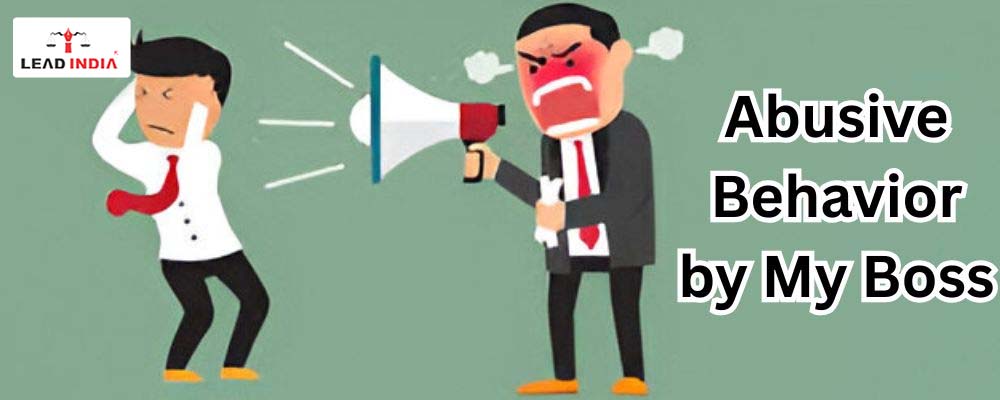
In India, laws of an amalgam of labour laws, employment contracts, and civil and criminal laws lay down government relations between an employer and an employee. Most employees yearn to know if they can take any legal action against their bosses when their bosses tend to indulge in wrong behaviors. The answer is yes. However, it varies from one type to severity and context of abuses, leading to different legal options under which the employee can file his case.
This article thus explores the different forms of abusive behavior by a boss, applicable Indian laws against workplace harassment, landmark judgment, and legal remedies available to employees against it.
What Exactly Includes Abusive Behavior at Work?
In all those real-life cases we have taken into care abusive behavior, it has manifested itself in many forms:
- Verbal abuse (like shouting, humiliating, and insulting)
- Physical intimidation or assault
- Sexual harassment (unwelcome physical or verbal behaviour)
- Mental harassment (constant criticism, threats, unfair treatment)
- Discrimination (gender, caste, religion)
- Creating a toxic, hostile work environment
Not every unpleasant behaviour qualifies as “illegal abuse.” But if it crosses the legal threshold, you have every right to take action.
Need A Legal Advice
The internet is not a lawyer and neither are you. Talk to a real lawyer about your legal issue
What are Indian Laws on Employees Against Workplace Abuse?
Based on numerous cases we have handled; here’s how different laws protect employees:
Indian Penal Code (IPC), 1860/ Bhartiya Nyaya Sanhita (BNS), 2023
- Section 323 of IPC/Section 115 (2) of BNS: Physical assault
- Section 500 of IPC/Section 356 (2) of BNS: Defamation
- Section 506 of IPC/Section 351(2) of BNS: Criminal intimidation
- Section 509 of IPC/Section 79 of BNS: Insult to modesty (especially for women)
- Section 354 of IPC/Section 74 of BNS: Assault with intent to outrage modesty
When physical or serious verbal abuse happens, criminal complaints under IPC/BNS are powerful tools.
Sexual Harassment of Women at Workplace (POSH Act, 2013)
The Act strongly advocates stringent measures against any form of sexual harassment in the workplace such as physical contact and advancements or a demand or solicitation of sexual favours or unwelcome communications through electronic devices with a sexual touch, as elaborately defined.
First-hand Tip: We often advise clients to lodge an ICC complaint before proceeding externally, as courts appreciate internal exhaustion of remedies.
Industrial Disputes Act 1947
For employees categorized as “workmen,” mental harassment can be challenged as unfair labour practice before Labor Courts.
Your Fundamental Rights (Constitution of India)
- Article 21: Right to live with dignity
- Article 14: Right to equality
- Article 19(1)(g): Right to profession
If workplace harassment seriously affects your dignity, these rights can be invoked even beyond normal labour remedies.
Employment Agreements and Company Policies
- We often review employment contracts for clients and find that many contain conduct and grievance redressal clauses.
- Breaching these terms strengthens the employee’s case both contractually and legally.
Real Cases That Shaped Employee Protection in India
Vishaka v. State of Rajasthan (1997):
- The case laid down the Vishaka Guidelines, requiring that sexual harassment in the workplace be prevented long before the enactment of the POSH Act.
- First-hand Insight: In sexual harassment cases, courts often ask if Vishaka principles were followed. Non-compliance seriously damages the employer’s defense.
Medha Kotwal Lele v. Union of India (2013):
- The Supreme Court made it clear that ignoring sexual harassment complaints violates fundamental rights.
- Real-life Learning: We have seen that if a company does not have an ICC or fails to act, courts impose heavy penalties.
Saurabh Kumar Mallick v. Comptroller and Auditor General of India (2009):
- Mental harassment was officially recognized as serious workplace abuse, even without physical assault.
- Practical Lesson: Mental cruelty claims need consistent documentation, emails, texts, diary notes.
Samar Ghosh v. Jaya Ghosh (2007):
- Although about matrimonial cruelty, the mental cruelty principles apply strongly to workplaces too.
- First-hand Tip: If your boss’s constant humiliation is affecting your mental health, it can form strong legal grounds for action.
How Can You Take Legal Action Against an Abusive Boss?
Here is what we usually advise clients based on real-life legal strategies:
Use Internal Complaint Mechanisms First
File complaints with:
- Internal Complaints Committee (ICC) for sexual harassment
- Grievance Redressal Committees for other forms of abuse
Courts expect employees to exhaust these before moving to external remedies.
File a Police Complaint (FIR)
If there is physical assault, criminal intimidation, or sexual harassment, lodge an FIR at the local police station.
Example:
- Threats = Section 506 IPC/Section 351 (2) BNS
- Assault = Section 323 IPC/Section 115 (2) BNS
File a Civil Suit for Compensation
- If your reputation suffers due to defamation or emotional trauma, you can sue for monetary damages.
- Real-world Tip: Parallel civil suits often increase pressure on abusive employers to settle.
Approach the Labor Court
Workmen facing unfair labour practices like humiliation or wrongful termination can move the Labor Court for:
- Reinstatement
- Monetary compensation
- Punitive action
File Complaints to Human Rights Commissions
In serious dignity or discrimination cases, complaints can be filed to:
- National Human Rights Commission (NHRC)
- State Human Rights Commissions
First-hand Tip: The public scrutiny of the employer due to the complaints often results in quick settlements.
What Challenges Might You Face While Filing a Complaint?
In our experience helping employees through these battles, the common challenges are:
- Fear of Retaliation: Risk of job loss or career damage
- Lack of Evidence: Mental harassment is harder to prove without records
- Long Legal Timelines: Civil and criminal courts take time
- Internal Bias: Grievance committees may favour management
Pro tip: Document everything like dates, abusive emails, WhatsApp messages, witness names.
How Employees Can Safeguard Their Rights in Abusive Workplaces?
Practical steps you should start immediately:
- Write It Down: Maintain a private logbook of incidents.
- Save Communication: Preserve emails, texts, and recordings (where legal).
- File Complaints Early: Timely complaints strengthen your case.
- Get Legal Advice: Early consultation prevents costly mistakes.
- Seek Counselling: Protecting your mental health is as important as fighting legally.
Conclusion
First-hand advice after handling many workplace abuse cases:
- Never tolerate mental or physical abuse at the workplace thinking “this is normal” or “I might lose my job.”
- Your safety, dignity, and mental peace are far more important than any paycheck.
- In India, you have multiple strong legal remedies available. Awareness, action, and proper documentation can empower you to take a stand, and succeed.
- No job is worth your dignity. Your spirit cannot be broken by your boss. Your rights are protected, use them.
One can talk to lawyer from Lead India for any kind of legal support. In India, free legal advice online can be obtained at Lead India. Along with receiving free legal advice online, one can also ask questions to the experts online free through Lead India.
FAQs
1. Can I file a complaint against my boss for mental harassment without physical assault in India?
Yes, you can. Indian laws recognize mental harassment, emotional abuse, and toxic workplace environments as serious issues. You can lodge an internal complaint, approach the labour court, or even file a police complaint if your dignity or mental health is severely impacted.
2. What pieces of evidence should be collected to establish evidence of the abusive behaviour of my boss?
Evidence would be an abusive email or WhatsApp chats, witness accounts, diary entries recording incidents with dates, and audio/video recordings (as legally permitted). Your evidentiary basis in court depends on accurate documentation.
3. Do I need to go to ICC first in the case before the concerned officer is approached?
In cases related to complaints about sexual harassment under the POSH Act, the Committee is chiefly approached first. However, cases involving physical assault, criminal intimidation, or grievous threats can be filed as an FIR at the police station directly, bypassing the internal remedy procedure.


 Talk to a Lawyer