
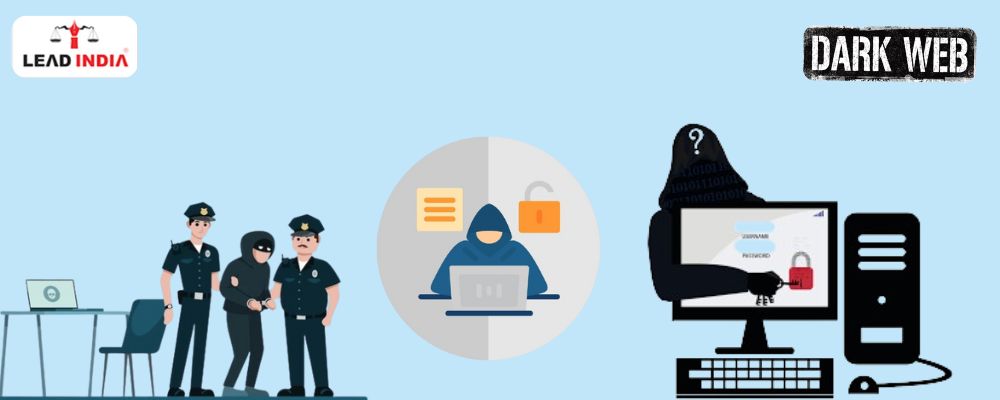
The Dark Web in the Internet is totally not indexed by any regular search engines. It has achieved its reputation for both legal and illegal purposes. Although it is often said to be illegal in India as well as most other countries, the legality of the Dark Web depends on the user and their intentions.
In this article, we will outline the legal position on Dark Web access in India, the potential punishments for illegal acts, and the most significant case laws to illustrate enforcement patterns.
The Dark Web: More Than Just a Digital Maze
The Internet can be organised into three levels:
- Surface Web: the visible web which can be accessed via public searching by our search engines, like Google.
- Deep Web: where content cannot be indexed by public searching engines but it can be accessed by anyone. This includes academic databases and private email accounts.
- Dark Web: where hidden sites can be accessed via tools like Tor which offer complete anonymity. The hidden sites often end in .onion and they could offer anything from legal resources to illegal marketplaces.
The Dark Web is obviously famous for hosting legal sites like whistleblower sites, but it has also managed to infamy for websites that host either:
- Drug trafficking and illegal weapon sales
- Human trafficking and terrorism-related communications
- Sale of stolen data and illegal hacking tools
- Child pornography and exploitation video content
In our day-to-day lives, one may never encounter this side of the internet. But for many, with anonymity comes the Dark Web where crimes can flourish.
Need A Legal Advice
The internet is not a lawyer and neither are you. Talk to a real lawyer about your legal issue
Is Accessing the Dark Web a Crime in India? The Legal Gray Area
In India, accessing the Dark Web is not illegal. Regardless, what you do there can lead to serious consequences. In India, it is not illegal to use any anonymizing tool, such as Tor or VPNs, but if the use of such tools is made in the commission of a crime, then the person would be punished with rigorous punishment.
Laws Governing Dark Web Crimes in India
1. Information Technology Act, 2000
The IT Act captures cybercrimes that occur on the Dark Web. Below are some sections that may apply in such a case:
- Section 66 Hacking: Punishment Imprisonment up to 3 years and/or a fine which may extend to ₹5 lakh.
- Section 66E Violation of privacy: Punishment Up to 3 years imprisonment and/or 2 lakh rupees fine.
- Sections 67, 67A, 67B Publishing obscene materials (child porcelain included): Punishment 3-7 years of imprisonment, and fines of up to 10 lakh rupees.
- Section 69A Blocking public access to information: Punishment Up to 7 years imprisonment.
These sections indicate that while there is no prohibition on using the Dark Web, if you conduct crimes like hacking or publishing illegal content, it will definitely get you in trouble.
Real-Life Example: The Bengaluru drug syndicate case from 2020 is one example of a case of illegal distribution of a drug using the Dark Web. The authorities were able to track it back to an Indian Tor history in transactions and by utilizing records of cryptocurrency transactions there were able to narrow down a group of suspects. This case shows that law enforcement has become competent at monitoring illegal activity with the Dark Web.
2. Indian Penal Code (IPC), 1860/Bhartiya Nyaya Sanhita (BNS), 2023
Many activities on the Dark Web overlap with traditional criminal offenses under the IPC.
- Section 420 IPC/Section 318(4) BNS: Cheating
- Section 120B IPC/Section 61 (2) BNS: Criminal conspiracy
- Sections 463/468/471 IPC/Sections 336 (1)/ 336 (3)/ 340 (2) BNS: Forgery and using forged documents
Personal Account: client who was with a law enforcement agency said they dealt with a case where a fraudster accessed the Dark Web to sell stolen bank account information. The individual was arrested for cheating under Section 420, and the examination included using blockchain forensics to investigate the cryptocurrency transactions made by the offender.
3. NDPS Act, 1985
If drugs are bought and sold on the Dark Web, then the NDPS Act shall operate:
- Section 27A: Financing illicit trafficking in narcotic drugs and psychotropic substances.
Punishment: The punishment is a fine of up to ₹2 lakh and a sentence of imprisonment of any kind that can last up to 10 or 20 years.
Incident: In 2020, the Narcotics Control Bureau (NCB) discovered a drug trafficking network operating on the Dark Web that was under control from Bangalore. Digital evidence was a powerful given that the NCB identified bitcoin purchases and an internet history from the tor browser amongst the evidence when arresting the accused. The encrypted communications enabled trafficking easily and presented significant barriers to law enforcement.
4. POCSO Act, 2012
Accessing, downloading, or forwarding any type of content relating to child sexual abuse on the Dark Web will get punishment severely under the POCSO Act.
Punishment: A minimum sentence of five years in jail, with the possibility of a life sentence depending on the severity of the offense.
Key Case Laws: How Indian Courts are Handling Dark Web Crimes
1. Nikhil Kulkarni v. State of Maharashtra (2015)
- Facts: A 23-year-old engineering student was caught trafficking drugs via the Dark Web using cryptocurrency. They tracked his activity through blockchain analysis and arrested him.
- Legal outcome: He was charged under the NDPS Act and IT Act.
2. Bengaluru Drug Case (2020)
- Facts: The NCB cracked an amount of drug-trafficking activity on the Dark Web. The syndicate sourced drugs from various clandestine suppliers internationally and distributed drugs using courier services.
- Legal Outcome: The suspects were charged as per Section 420 of the IPC and taken into custody under the NDPS Act. Investigations revealed the suspects used cryptocurrency and encrypted messengers to affect the drug trade.
Law Enforcement Challenges: Why Tracking Dark Web Crimes Is So Difficult?
1. Anonymity Tools
The use of VPNs and Tor cause huge barriers to law enforcement being able to successfully trace any activity.
2. Lack of Technical Resources
Police stations as well as law enforcement agencies in India lack adequate training or physical infrastructure to most effectively investigate cybercrime activity.
How to Avoid Legal Trouble on the Dark Web?
1. Stay Informed About the Law
Be aware of cyber laws. Schools and colleges should include cyber law awareness programs to avoid engaging in illegal activities.
2. Consult a Cybercrime Attorney
If you inadvertently encounter illegal content, it is better to consult a lawyer.
3. Follow Cyber Hygiene
Next, be careful. Do not download anything suspicious and be sure to not open any source you don’t trust.
Conclusion
In India, just accessing the Dark Web is not illegal. But if you are using the Dark Web to engage in illegal activities then you will be punished severely under many laws. The legal system will not tolerate the abuse of digital anonymity to commit crimes. Enforcement is changing, and being assisted with better tools for surveillance, blockchain tracing, and global cooperation.
It is clear, if you are seeking the Dark Web, it is not illegal to go on the Dark Web but depending on what you do on it will involve serious issues. Be sure to follow good cyber hygiene and stay updated with the latest cyber laws.
One can talk to lawyers from Lead India for any kind of legal support. In India, free legal advice online can be obtained at Lead India. Along with receiving free legal advice online, one can also ask questions to the experts online free through Lead India.
FAQs
1. Is accessing the Dark Web legal in India?
Dark Web is not illegal in India to access it. Using the Dark Web to commit illegal acts, such as buying drugs or weapons or kind of committing cybercrimes, is against the laws of India, included in the Information Technology Act and the Indian Penal Code (IPC)/Bhartiya Nyaya Sanhita (BNS).
2. What should you do if you accidentally access illegal content from the Dark Web?
If you accidentally access any type of illegal content from the Dark Web, your best course of action is to go to a cybercrime lawyer. Don’t delete or hide anything. A lawyer can help you minimize your legal risk.
3. Can a government block the Dark Web in India?
A government cannot block the Dark Web itself. However, the Government of India can use Section 69A of the IT Act to block access to illegal sites. That means that the government has the ability to effectively block URLs that host illegal content, including those on the Dark Web.


 Talk to a Lawyer