
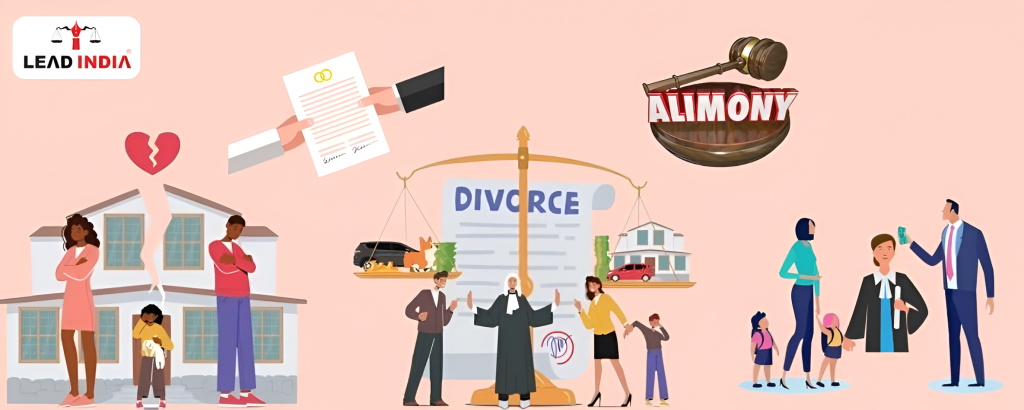
Going through a divorce is hard as it puts a strain on an individual both emotionally as well as legally. If you are separated or contemplating divorce in India, you probably have a good idea as to what you would want to ask about your rights to maintenance (alimony), financial support, as well as custody of your children.
Indian laws have clear provisions for repealing agreements and providing remedies for spouses (especially dependent spouses) and safeguarding children; regardless of whether the marriage was solemnized under Hindu, Muslim, Christian or secular law, this article will clarify a lot.
Need A Legal Advice
The internet is not a lawyer and neither are you. Talk to a real lawyer about your legal issue
Which Laws Protect You During Divorce in India?
The law you fall under depends on your marriage type:
| Law / Act | Who It Applies To |
| Hindu Marriage Act, 1955 | Hindus, Sikhs, Jains, Buddhists |
| Special Marriage Act, 1954 | Inter-faith or civil marriages |
| CrPC Section 125/BNSS Section 144 | Quick maintenance relief for wives, children, parents |
| Muslim Women Act, 1986 | Divorced Muslim women |
| Guardians and Wards Act, 1890 | Custody for all religions |
Helpful Tip: Before you file for divorce, you need to make sure that you know the specific law as per the date of your marriage when it was registered. It will affect your grounds for divorce and maintenance claim.
Grounds for Divorce
Law is not as simple as just walking into a court and saying you want a divorce. The law requires appropriate grounds, such as:
- Cruelty (physical or emotional abuse)
- Adultery
- Desertion (no contact for 2 or more years)
- Mental illness
- Religious conversion
- Presumed death after 7 years
Case Example: A client was initially denied divorce because of lack of evidence of cruelty. We gathered documented medical reports, messages, and witness testimony, which helped secure a favourable outcome under Section 13 of the Hindu Marriage Act.
Maintenance and Alimony How Courts Decide What You Get or Pay?
One of the biggest concerns for clients is financial stability after separation. Maintenance laws exist to ensure neither spouse is left destitute.
Types of Maintenance
- Interim Maintenance: Money paid while the case goes on.
- Permanent Alimony: One payment or monthly payment after divorce.
- CrPC Section 125/BNSS Section 144: Fast relief for wives, children, and parents.
Lawyer Advice: All the clients are advised to prepare income proof such as salary slips, bank statements, and property documents. Courts decide maintenance based on financial status, needs, and lifestyle during marriage.
Key Judgments
- Rajnesh v. Neha (2020): Maintenance is a legal right, not charity.
- Bhuwan Mohan Singh v. Meena (2015): Financial hardship is no excuse to avoid paying.
- Rinku Baheti (2024): Court rejected exaggerated claims, granting a realistic amount.
- Danial Latifi v. Union of India (2001): Muslim husbands must make “fair provision” beyond iddat period.
Child Custody: How do Judges Decide Where Children Will Live?
Child custody disputes tend to be emotional and stressful. In making custody decisions, the primary focus of the court is on the welfare of children. This is beyond that of parental rights.
Child Custody Types
- Physical Custody: The child will have to live with only one parent.
- Joint Custody: Both the parents will share time with the child and they will make all decisions together.
- Visitation Rights: Non-custodial parent needs to get the scheduled meetings.
Case Example: A father approached me worried he would lose custody just because he earned less than his wife. We at the law firm proved his involvement in the child’s education and emotional well-being, securing joint custody despite lower income.
Can Husbands Claim Alimony Too?
Yes, though rare. Under Section 25 of the Hindu Marriage Act, men can seek maintenance if genuinely unable to earn.
Case Example: A client who is a stay-at-home husband get financial support when his wife, a high-earning professional, filed for divorce. The court granted him monthly maintenance after reviewing evidence of genuine dependency.
Rights in Invalid or Void Marriages: You’re Still Protected
Maintenance might still be available even when the marriage is declared null & void (e.g., bigamy).
Case Example: The Supreme Court in Sukhdev Singh v. Sukhbir Kaur (2025) upheld the maintenance claim of a lady who was unaware that her husband was already married.
Conclusion
Divorce is more than a legal process; it is life-changing.
- Be proactive. The sooner you seek legal advice, the stronger your position can be.
- Keep good records. Document income, expenses, and child-related expenses.
- Be children’s advocates. The best resolution of custody disputes is through agreement.
- Be sure to action your maintenance claim promptly. Courts take time, so do not delay.
If you are involved in divorce cases concerning child custody and maintenance matters, you should speak to a family lawyer immediately. Know your rights; think strategically for your future free from worries.
One can talk to lawyer from Lead India for any kind of legal support. In India, free legal advice online can be obtained at Lead India. Along with receiving free legal advice online, one can also ask questions to the experts online free through Lead India.
FAQs
1. How long does maintenance last after divorce in India?
The court decides the duration based on factors like income, age, remarriage, and dependency of the claimant. It may be temporary, lifelong, or end on remarriage.
2. Can a husband refuse to pay alimony ordered by the court?
No. If a husband fails to comply with a maintenance order, the court can enforce payment through property attachment, salary deduction, or even imprisonment.
3. Is mutual consent divorce faster in India?
Yes. Mutual consent divorce under Section 13B of HMA usually takes 6 months or less, unless waived by the court under special circumstances.
4. Can maintenance be increased or decreased later?
Yes. Either spouse can approach the court for modification of maintenance if there is a change in financial circumstances or genuine need.


 Talk to a Lawyer