
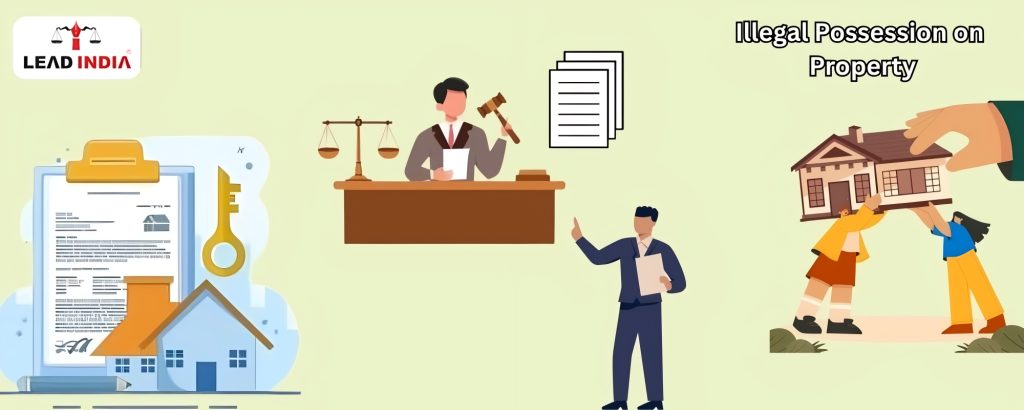
Land is among the most valuable assets in India, and it is the one that is most contested. With urbanization and population growth, property disputes are becoming more common. Encroachment or illegal possession is a regular concern for landowners, individuals, and governments.
Encroachment is illegal use or occupation of land. Illegal possession is when someone keeps a property but has no legal ownership. There are civil as well as criminal remedies for the property owners as per the Indian law.
This article explains the step-by-step legal process to remove encroachment or illegal occupation, supported by laws, procedures, and real court rulings.
Need A Legal Advice
The internet is not a lawyer and neither are you. Talk to a real lawyer about your legal issue

Types of Property Encroachment
Encroachment comes in many forms. These are the most common we handle:
- Private Land Encroachment: A neighbour quietly extends their wall or shed onto your registered land.
- Government Land Encroachment: A shopkeeper occupies the footpath or government land behind their business.
- Adverse Possession Claims: Someone claims your land as their own after staying there for 12+ years without permission.
- Benami Property Cases: People use a relative’s name to hide illegal ownership and avoid taxes or disputes.
A Real Case When a Tenant Refused to Vacate?
A tenant in Noida stopped making rent payments and wouldn’t leave. Despite multiple verbal requests, the tenant claimed he had rights over the property. The client was helped to send a legal notice, followed by a civil eviction suit, and within four months, the property was restored through court decree.
What Legal Remedies Are Available to You?
Civil Remedies Under the Civil Procedure Code
- Suit for Possession (Section 6, Specific Relief Act, 1963): Even if you’re not the legal owner but were in peaceful possession, you can file this suit.
- Time limit: within 6 months of being dispossessed. Proof of ownership is not required, only the possession is required.
- Title Suit (Declaration and Injunction): Used to prove your legal ownership and stop the encroacher from continuing possession or construction.
- Evidence required: sale deed, mutation records, tax receipts.
Also includes temporary and permanent injunctions under CPC and Specific Relief Act. - Eviction or Ejectment Suit: Ideal for removing a tenant or licensee who refuses to vacate. Keep rent receipts and agreements ready.
Criminal Remedies Under Indian Penal Code/Bhartiya Nyaya Sanhita
- Criminal Trespass (Sections 441 to 447 IPC/Sections 329(1), 329 (3) BNS): Entry or presence inside other’s property without the authority with intent to intimidate or insult or to do an offence.
- Punishment: Imprisonment of up to 3 months or fine or both.
- Misappropriation and Cheating (Sections 403, 405, 415 IPC/Sections 314, 316 (1), 318 (1) BNS): If the property was removed through fraud, and breach of trust or by deception.
- Make a complaint to the police: Go to the police station and file an FIR where there are threats or some kind of force. If the police refuse, file a complaint before the Magistrate as per Section 200 CrPC/Section 223 BNSS.
What If the Encroachment is on Government Land?
The citizens as well as the resident groups were guided to give complaints to:
- Tehsildars or Collectors
- Municipal authorities
- Forest or urban development departments
Authorities can issue notices, conduct inspections, and demolish illegal constructions. This process is way more faster when it involves public interest and safety.
When Authorities Fail: Use Constitutional Remedies
- Writ Petition Under Article 226: Filed in High Court when government officials or police fail to act.
- Article 32 Petition in Supreme Court: For urgent or fundamental rights violations in public interest land matters.
In a recent school land encroachment case, the concerned parents were guided to file a writ petition. The High Court directed the immediate removal of illegal vendors nearby the school play area.
Step-by-Step Action Plan to Reclaim Your Property
- Step 1: Collect evidence: Gather sale deed, mutation records, property tax receipts, photographs, and witness statements.
- Step 2: Send a legal notice: Issue a notice through a lawyer asking the encroacher to vacate the land.
- Step 3: Commence a civil suit: If they refuse to leave, commence an action in civil court in order to get possession of your property, injunction, or declaration order.
- Step 4: Police complaint (if appropriate): If there is a threat or there has been fraud, immoral acts of violence, then you can file an FIR to assist and mediate in this situation. If the police are not able to or unwilling to assist, you can approach the Magistrate.
- Step 5: For government land, approach local authorities: Write to the Tehsildar, Collector, or Municipal office. They will inspect and act as per law.
- Step 6: Enforce the court decree: Once the court grants possession, execute it with help of the court and local police.
Important Court Judgments That May Help You
- Krishna Ram Mahale v. Shobha Venkat Rao (1989): Even a trespasser can’t be evicted without due legal process.
- Maria Margarida Sequeira v. Erasmo Jack de Sequeira (2012): Possession is legally protected unless removed by court procedure.
- Premji Ratansey Shah v. Union of India (1994): Ownership (title) is superior to possession. The rightful owner can recover land.
- State of U.P. v. Hari Om Sharma (2021): Public interest justifies eviction from government land even if claims of possession exist.
Challenges We Face During Property Eviction Cases
- Civil cases may take months or years
- Police may avoid involvement in land matters
- Encroachers may have political support
- False adverse possession claims can delay justice
Preventive Measures to Protect Your Land
- Keep all land documents updated and registered
- Fence or mark boundaries clearly
- Install visible signboards on vacant land
- Keep property tax payments record updated
- Maintain inspection records and photos yearly
Clients are often advised to maintain a yearly inspection file with timestamped photos, which has proven useful in disproving adverse possession claims.
Conclusion
Many people delay action out of fear, hoping the encroacher will go away. That usually makes things worse.
- Never use force, it weakens your case
- Gather documents and act legally from the start
- Civil court, FIR, or writ petitions are your tools
- Take the help of a property lawyer, it makes the process faster and cleaner
If you are dealing with Illegal Possession of your land or you suspect some encroachment of the property, do not delay. With the right legal advice, property owners may be able to recover what is theirs in a peaceful and legal manner.
One can talk to lawyer from Lead India for any kind of legal support. In India, free legal advice online can be obtained at Lead India. Along with receiving free legal advice online, one can also ask questions to the experts online free through Lead India.
FAQs
1. What documents are most important to prove property ownership in court?
Certified copy of sale deed, mutation record, property tax receipts, and layout plan are key documents to establish ownership in encroachment cases.
2. How long does one need to occupy the land before they can claim adverse possession in India?
In general, uninterrupted continuous, open, hostile possession for 12 years will allow for an adverse possession claim, but it is not automatic, you must prove your case in Court.
3. Am I entitled to interim relief (to stay or injunct the encroachment) while my case is pending?
Yes, you are able to apply to the court for a temporary injunction, under Order XXXIX of the CPC, to restrain the defendants from further construction or alienation.


 Talk to a Lawyer