
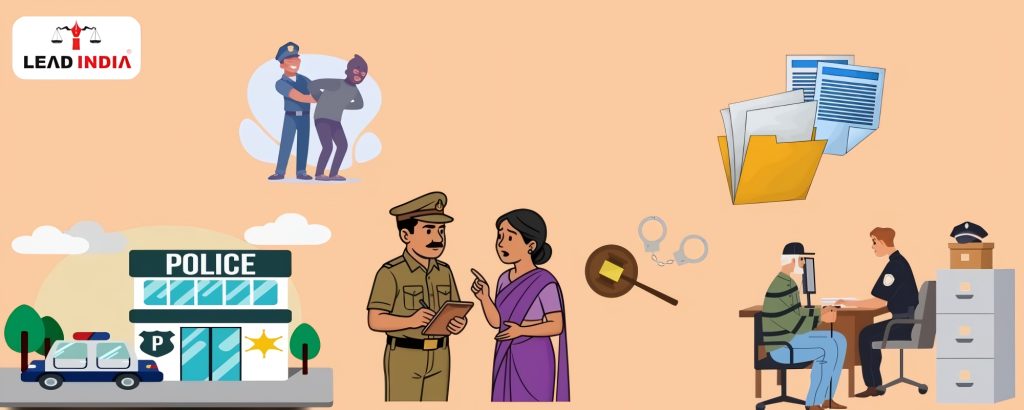
An FIR is perhaps the first and most crucial step in securing justice in any criminal offense. As soon as an FIR is lodged, the criminal justice system gets activated; an FIR has also been statutorily recognised under Section 154 of the Code of Criminal Procedure, 1973/Section 173 of the Bhartiya Nagarik Suraksha Sanhita, BNSS (2023). It is a right vested in every citizen where a cognizable offence takes place (i.e., theft, rape, assault, murder, etc.).
Nonetheless, quite ironically, there are many who know not how to go about filing an FIR, or what to do when the police refuse to file one. This guide shall walk you through the essentials of an FIR, landmark decisions, and subsequent courses of action to take if an FIR is rejected.
Need A Legal Advice
The internet is not a lawyer and neither are you. Talk to a real lawyer about your legal issue

What is an FIR?
- A First Information Report or FIR is your first and the first step to getting any justice. It informs the police of a cognizable offence which requires urgent action like theft, rape, or assault.
- Under Section 154 of the CrPC/Section 173 of the BNSS the police must record it when you report such crimes.
Who Can Actually File an FIR?
- You don’t have to be the victim.
- You can file an FIR if you saw the crime.
- You heard about it from someone reliable.
- You find a crime that can be prosecuted.
- Even a child can file one, with help from a guardian.
Example: A woman once came to our legal firm after witnessing an assault on her housemaid. She was not related, but she filed the FIR, and then the action was taken in just 24 hours.
How to Help Someone File Their First FIR: A Step-by-Step Walkthrough
Here’s how getting it done actually works, for which it is outlined below:
- Step 1: Go to the correct police station: Select the one that is closest to the crime scene. If you are not sure, you can go to any police station, they have a duty to guide you.
- Step 2: Tell the officer what happened: Be clear, honest, and straight. If you’re nervous, write it down or use a witness to get it narrated. The police would need to enter it into the FIR register as per the
- Step 3: Don’t Just Sign, Read It First: Once the officer writes it down, read it carefully. In one case, the client spotted a missing detail that could’ve weakened her case. Insist on accuracy.
- Step 4: Sign or Give Thumb Impression: Only after verifying, sign it. If you can’t read or write, a thumbprint works, but the officer must explain the content to you.
- Step 5: Demand a Free Copy: This is your legal right as per Section 154(2) CrPC/Section 173 BNSS. Don’t leave without it.
Not Every Crime Qualifies: What About Small Disputes or Minor Offences?
If it’s a non-cognizable offence (like public nuisance or minor fights):
- Police record your complaint, not an FIR.
- They forward it to a magistrate.
- Only if the magistrate allows, police can start an investigation.
Filing an FIR Online – Yes, It’s Possible in Many States
Busy or unable to go to the station? You can obtain an e-FIR in states like Delhi, Maharashtra, Odisha, Karnataka, and Tamil Nadu.
How it works:
- Go to the State Police Website.
- Look for “e-FIR” or “Online Complaint”.
- Fill the form, attach documents, and submit.
- Save the acknowledgement.
For Cyber Crimes – Here’s the Right Way
If your social media is hacked, or someone’s stalking you online:
- Visit: www.cybercrime.gov.in
- Choose the complaint category.
- Upload your ID and supporting documents.
- File and track your complaint.
Even if you aren’t tech-savvy, ask a friend or legal aid centre to help.
What If Police Refuse to Register the FIR?
- Option 1: Go Higher: Write to the Superintendent of Police (SP) under Section 154(3) CrPC/Section 173 BNSS. We helped a college student do this, and the FIR was filed in 2 days.
- Option 2: Go to the Magistrate: File a complaint under Section 156(3) CrPC/Section 175 BNSS. A judicial magistrate can order the police to take any action.
- Option 3: File a Writ Petition: If it’s a serious denial, approach the High Court under Article 226 of the Constitution.
Case Laws That Changed the FIR System in India
- Lalita Kumari v. Govt of UP (2014): Police can’t delay FIR in cognizable offences. It’s mandatory.
- Aleque Padamsee v. Union of India (2007): Even a phone call or even an email can lead to an FIR.
- Ramesh Kumari v. State (2006): The refusal of police to file an FIR violates your rights.
What If Someone Files a False FIR Against You?
You can fight back. Filing a false FIR is a crime under:
- Section 182 IPC/Section 217 BNS: Lying to the police officer
- Section 211 IPC/ Section 248 BNS: False charges to harm someone
- Section 499 IPC/ Section 356 (1) BNS: Defamation
Your remedies:
- File for quashing under Section 482 CrPC/Section 528 BNSS
- File a civil defamation or damages suit
Tips from the Ground: What Every Citizen Should Know?
- Always get a copy of your FIR.
- Note the name, badge number, as well as designation of the officer.
- Don’t get intimidated at the station, take a lawyer if needed.
- Avoid false claims, they can land you in legal trouble.
- Document everything, video or audio if required.
Special FIR Rules for Women
- Women can file FIR at any police station, and not just where crime happened.
- FIRs in cases like rape or harassment must be taken seriously and sensitively.
- You can request a woman officer or even record your statement at home under Section 157 CrPC/Section 176 BNSS.
Juveniles and FIR: Handle with Care
For victims or offenders who are under 18:
- The Juvenile Justice Act, 2015 applies.
- Police must maintain confidentiality.
- Identity must not be revealed to the media or public.
FIR in SC/ST Cases: Immediate Action Mandatory
For crimes against Scheduled Castes or Tribes:
- The act of SC/ST (Prevention of Atrocities) 1989 makes the FIR filing mandatory.
- Delay by police can result in action against them.
Conclusion
Whether you are a victim or a witness, by filing an FIR or giving evidence at court, you may have the courage to stop another crime occurring tomorrow – the process can seem daunting, but the law is with you.
If police deny your FIR, escalate. If someone files false charges, defend. If you’re scared, seek legal support. Justice begins with one step, make it count.
One can talk to lawyer from Lead India for any kind of legal support. In India, free legal advice online can be obtained at Lead India. Along with receiving free legal advice online, one can also ask questions to the experts online free through Lead India.
FAQs
1. Do the police have an absolute obligation to register an FIR in respect of a cognizable offence?
Yes, the police have an obligation to file an FIR upon a report of a cognizable offence as iterated by the Supreme Court in Lalita Kumari v. Government of UP.
2. Can a woman file an FIR at any police station in India?
Yes. Women can file FIRs at any police station, irrespective of the jurisdiction, especially in matters of rape, harassment, or domestic violence. Preferably, a female officer should record the woman’s statement.
3. How do I track the status of FIR after it is registered?
You are able to track the status of an FIR online through the State Police, or by calling the police station where it was registered. Alternatively, you could also approach the investigating officer appointed and seek an update on the status.


 Talk to a Lawyer