
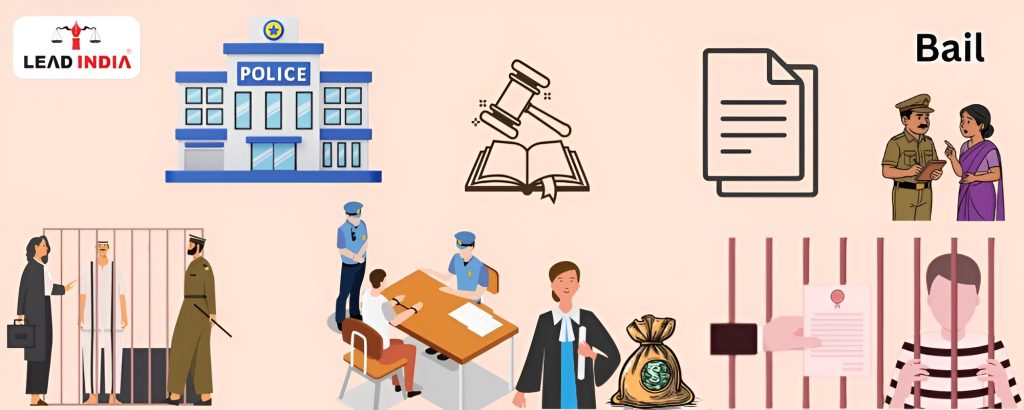
Under Indian law, the right to seek bail is predicated on the principle that an accused is innocent until proven guilty. Bail is a conditional release of a person arrested for a crime.
The very purpose of the bail is to ensure the person is not detained for a long time merely because an investigation or trial is pending against him, or he is accused of a crime. In India, while the right is placed mostly under Article 21 (protection of life and liberty) of the Constitution of India, it is guaranteed by statutory provisions under the Bhartiya Nagarik Suraksha Sanhita, 2023, (BNSS) which replaced the Code of Criminal Procedure (CrPC.), reported precedents from the Supreme Court and High Courts, and guidelines issued by the Supreme Court and respective High Courts.
This article is on various types of bail, procedure stepwise, important case laws, changing trends, and practical tips.
Need A Legal Advice
The internet is not a lawyer and neither are you. Talk to a real lawyer about your legal issue

The Legal Backbone of Bail: Know Your Rights Before You Need Them
- The bail system in India is governed by the Bhartiya Nagarik Suraksha Sanhita, 2023, (BNSS) and replaces the older CrPC.
- The most common mistake accused persons make before they hastily rush to court is knowing whether their case is bailable or non-bailable.
BNSS Key Sections (Old CrPC Reference):
- Section 479 BNSS (Section 436 CrPC): Bailable offences
- Section 480 BNSS (Section 437 CrPC): Non-bailable offences
- Section 482 BNSS (Section 438 CrPC): Anticipatory bail
- Section 483 BNSS (Section 439 CrPC): Powers of higher courts
- Section 187(3) BNSS (Section 167(2) CrPC): Default bail
The Four Faces of Bail: Which One Fits Your Situation?
The first thing is to decide which type of bail to pursue.
- Regular Bail: After arrest, to get released from police or judicial custody
- Anticipatory Bail: Before arrest, the fear of being taken into custody
- Interim Bail: Temporary Release until the main bail plea is decided
- Statutory/Default Bail: When police exceed the time period for investigations
Step-by-Step: How the Clients Actually Get Bail?
From the outside, bail looks like just filing a petition. In reality, each step matters.
Step 1: Understand the Offence: If it is bailable, relief is a right. If not, we prepare for a courtroom battle.
Step 2: Prepare an Effective Bail Application: You need to provide background about yourself, information about your criminal history (if any), if you will cooperate, and disclosure of sureties willing to commit to the bail conditions.
Step 3: Advocate in Court: You need to convince the Judge that you will not flee prosecution once bailed, will not interfere with witnesses, if those witnesses will be called, and that you have local and community roots.
Step 4: Assure Court’s Concerns: Courts will consider severity of the offence, potential length of punishment upon conviction, and likelihood of engaging in conduct that would lead to misuse of bail.
Step 5: Furnish Bail Bond and Sureties: Even a minor error here can delay release, ensure bonds are ready beforehand.
Step 6: Walk Out Free: The most satisfying moment is when the release order reaches the lock-up.
Special Cases: When the Court Shows More Leniency?
- Women and Minors: Courts are generally compassionate
- Serious Illness: Medical records often tip the scales in your favour
- Economic Offences: Expect stricter scrutiny and higher surety demands
Hard Lessons from Landmark Bail Judgments
Some cases have shaped how we argue today:
- Balchand v. State of Rajasthan (1977): “Bail is the rule, jail is the exception”
- Gurbaksh Singh Sibbia (1980): Defined anticipatory bail principles
- Sanjay Chandra v. CBI (2012): Bail is not pre-trial punishment
- Satender Kumar Antil (2022): Reduced unnecessary arrests
What’s Changing: The New Bail Mindset in Courts
Most people have noticed that Judges lean more towards protecting liberty. Police being reminded they cannot arrest unless absolutely necessary. Faster hearings thanks to virtual courts.
Challenges You Should Expect
- Even with a strong case Bail hearings may still get adjourned
- Undertrial numbers keep prisons overcrowded
- Different courts may rule differently in similar cases
Practical Tips to Clients
- Do not wait, if you expect trouble, prepare your anticipatory bail early
- Line up sureties with proof of income and property papers
- Follow every bail condition strictly, even a small slip can send you back to jail
- Always keep a certified copy of your bail order handy
Conclusion
Being granted bail does not mean the end of the case, it simply means you are going to fight the proceeding on your own terms, with your freedom in place. Once you are in a courtroom, being prepared is an asset.
One can talk to lawyer from Lead India for any kind of legal support. In India, free legal advice online can be obtained at Lead India. Along with receiving free legal advice online, one can also ask questions to the experts online free through Lead India.
FAQs
1. Can I apply for bail without being present in Court?
Yes, in some cases, like anticipatory bail or if you are at a healthcare facility (hospital) your lawyer can represent you and file a power of attorney. Some Courts also have an option for virtual hearings.
2. What happens if my bail application is rejected by the lower court?
You can appeal to the Sessions Court or High Court under Section 483 BNSS (439 CrPC). It is important to present stronger grounds or additional evidence in the appeal.
3. Is the seriousness of the offence final matter in deciding bail?
No. The Court will also consider your behavior; risk of absconding; past incidences of criminal behavior; whether or not you cooperated with the investigation. Even if you had very serious charges, if all of the other thoughts were positive the Court could grant you bail.


 Talk to a Lawyer