
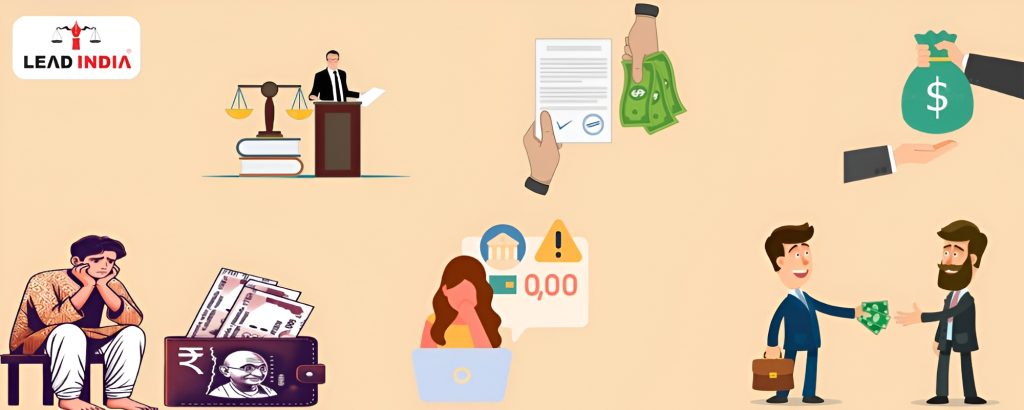
society: they do so out of trust. But problems ensue when the borrower refuses to pay back the amount, which results in financial and emotional distress. Many people hesitate to sue due to personal relations, but the law provides very clear and effective remedies to have your money repaid.
In India, recovery of money is a right established by law, and whenever genuine proof exists, the courts always protect the lender. From civil suits and summary suits to cheque bounce cases and even criminal remedies in cases of fraud, there are multiple legal options available.
This article explains the step-by-step legal process for recovering money in India, supported by important case laws, procedures, timelines, and preventive measures to avoid future disputes.
Need A Legal Advice
The internet is not a lawyer and neither are you. Talk to a real lawyer about your legal issue
Which Laws Protect You When Someone Doesn’t Repay?
Indian law gives you multiple remedies to recover money:
- Civil Procedure Code, 1908 (CPC): It is for civil or summary suits.
- Indian Contract Act, 1872: It is for enforcing loan agreements.
- Negotiable Instruments Act, 1881: It is for cheque bounce cases.
- Indian Penal Code, 1860/Bhartiya Nyaya Sanhita, 2023: It is for fraud or cheating.
Most of the time, we send a legal notice first and then proceed to civil or criminal remedies.
Civil Suit: The Standard Way to Get Back Your Money
A civil money recovery suit is the most common method.
- File in the court where the borrower resides or where the loan was given.
- It has to be filed within three years of the repayment due date.
- Documents like agreements, bank transfers, or promissory notes make the case strong.
From experience, oral loans can be proved, but written proof speeds up the case and makes it more reliable.
Summary Suit: A Faster Remedy
A summary suit under Order 37 CPC is quicker than a regular civil suit and is allowed if there is clear documentary evidence such as cheques or promissory notes.
The borrower cannot delay the case unnecessarily. Unless they show a strong defence, the court passes a decree in favour of the lender.
There was a case where summary suits where clients recovered money in under a year, compared to several years in normal civil suits.
Cheque Bounce Case: A Strong Legal Option
If the borrower issued a cheque that bounced:
- You need to send a legal notice within 30 days of the cheque dishonour.
- If not repaid within 15 days, file a complaint under Section 138 NI Act.
- The borrower might face any kind of imprisonment up to two years or a fine up to twice the amount of the cheque.
In practice, most borrowers settle soon after receiving a cheque bounce notice because of the fear of criminal liability.
Fraud or Cheating: When It Becomes Criminal
If the borrower never intended to repay, you can file a criminal complaint.
- Section 420 IPC/Section 318 (4) BNS: Cheating.
- Section 406 IPC/Section 316 (2) BNS: Criminal breach of trust.
However, courts require proof that fraudulent intention existed at the time of borrowing. In one case, a borrower had taken loans from multiple people simultaneously. The court treated this as cheating and ordered prosecution.
Mediation and Arbitration: Avoiding Court
In cases where family or business relationships are tested, mediation and/or arbitration are a good idea. These approaches are less time-consuming, less costly, and less adversarial than court procedures.
From experience, mediation works well when the lender and borrower are relatives or long-term business partners.
Debt Recovery Tribunal: For Banks and Financial Institutions
Through the Debt Recovery Tribunals (DRT), banks, and NBFCs recover loans under the Recovery of Debts and Bankruptcy Act, 1993. This is not available for private lenders.
What You Should Do Before Going to Court?
- Send a legal notice through a lawyer.
- Preserve all documents such as bank transfers, agreements, WhatsApp chats, or emails.
- Attempt settlement or mediation where possible.
Based on my cases, nearly 70% of borrowers repay or settle after receiving a strong legal notice.
Key Supreme Court Judgments Every Lender Should Know
- ICDS Ltd. v. Beena Shabeer (2002): Guarantor is equally liable as the borrower.
- Krishna Janardhan Bhat v. Dattatraya Hegde (2008): Presumption of liability under NI Act can be rebutted.
- Sampelly Satyanarayana Rao v. IREDA (2016): Post-dated cheques for repayment are valid under Section 138 NI Act.
Challenges Lenders Must Be Prepared For
- Civil cases may take several years unless filed as summary suits.
- Oral loans without documents are hard to prove.
- Legal action may damage personal relationships.
Preventive Measures Before Lending
- Always sign a loan agreement or promissory note.
- Use bank transfers or UPI instead of cash.
- Take collateral or guarantor for larger loans.
- Mention repayment date and interest clearly.
Even a simple written acknowledgment or WhatsApp message from the borrower has helped many of my clients succeed in recovery cases.
Conclusion
Recovering money can be stressful, but Indian law provides multiple options: civil suits, summary suits, cheque bounce cases, and criminal complaints in cases of fraud.
The right remedy depends on your documents and circumstances. What matters is acting promptly within the limitation period and keeping proper proof.
From handling numerous such cases, you can see that the lenders who act early, preserve documents, and take legal advice almost always succeed in recovery.
One can talk to lawyer from Lead India for any kind of legal support. In India, free legal advice online can be obtained at Lead India. Along with receiving free legal advice online, one can also ask questions to the experts online free through Lead India.
FAQs
1. Can I recover money if I only have WhatsApp chats or bank transfer proof?
Yes, through electronic evidence such as chats, SMS, as well as online transfers are admissible in the Indian courts and you can support your claim.
2. How long does it usually take to recover money through court in India?
A regular civil suit may take 3–5 years, while a summary suit or cheque bounce case can be resolved in 6–18 months, depending on court workload.
3. Do I need a lawyer to file a money recovery case in India?
Yes, legal drafting and representation are crucial for recovery suits, cheque bounce complaints, and criminal cases. A lawyer ensures your documents and claims are properly presented.


 Talk to a Lawyer