
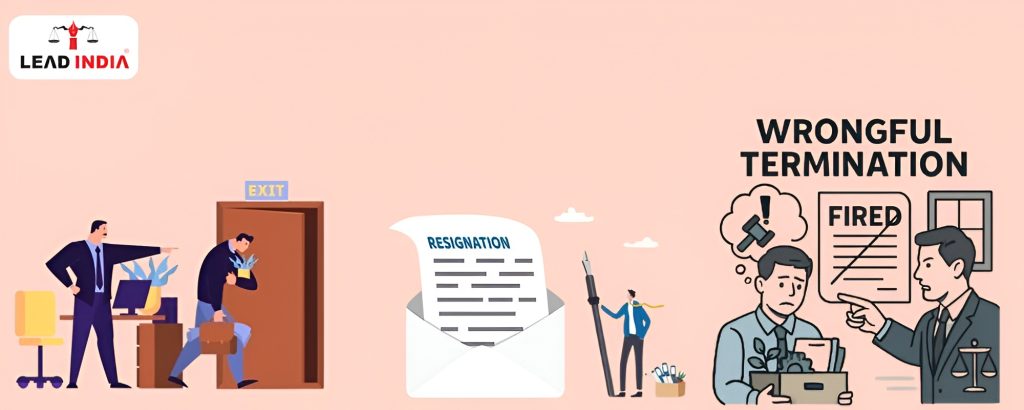
Sudden dismissal is never easy, but when it happens unfairly, it can be devastating. In India, many employees are subject to wrongful termination or forced to resign under duress, which is referred to as forced resignation. Such acts for unlawful termination interrupt career progression and threaten livelihood, the very constitutional for the deprivation of which one would land under Article 21 of the Constitution of India.
From factory workers to corporate employees to governmental bodies, the law provides several protective layers against dismissal not justified in law. Indian courts have repeatedly held that an employee must be dismissed only through due process, and any resignation tendered under duress cannot be held valid.
This article discusses the legal structure, the remedies, landmark cases, and pragmatic alternatives that one can resort to if facing wrongful termination or forced resignation in India.
Need A Legal Advice
The internet is not a lawyer and neither are you. Talk to a real lawyer about your legal issue
What Is Wrongful Termination or Forced Resignation?
- Wrongful termination occurs when your dismissal violates the contract or labour laws.
- Forced resignation occurs when the employer coerces or intimidates you into resigning, usually on the premise of a choice between “quietly resigning” or being fired.
First-hand insight: In practice, HR generally gave employees a few hours to decide. Most employees felt trapped, but under the law, this is regarded as a kind of dismissal by the employer and not voluntary resignation.
Legal Protections: What the Law Says About Termination in India?
Your Constitutional Shield
- Article 14: No arbitrary dismissal.
- Article 21: Right to livelihood = right to life.
- Article 311: Civil servants cannot be dismissed without due process.
Your Statutory Rights
- Industrial Disputes Act, 1947: Protection for “workmen.”
- Shops and Establishments Acts: Rules for private sector employees.
- Maternity Benefit Act, 1961: Protects women from dismissal during maternity.
- Indian Contract Act, 1872: Private contracts must be honoured.
Practical note: Most of the private sector employees are not usually covered in compliance with the Industrial Disputes Act. Therefore, the remedies available to them for the wrongful dismissal or termination are usually civil proceedings for damages rather than reinstatement.
When Can You Challenge a Termination or Resignation?
You may have a strong case if your employer:
- Fired you without notice or compensation.
- Retaliated because you raised complaints or joined a union.
- Dismissed you due to pregnancy, disability, or caste/religion bias.
- Ignored the terms of your employment contract.
- Forced you to resign under duress or harassment.
Real-life example: The court cases where one of the female employees was asked to resign during pregnancy, reinstated her and also granted back wages, citing the Maternity Benefit Act.
Your Legal Remedies if You’ve Been Wrongfully Terminated
1. Approach Labor Courts for Reinstatement
If you’re a “workman” under the IDA, labour courts can order reinstatement with back wages.
2. Claim Compensation for Damages
In private employment, courts usually grant monetary damages rather than reinstatement.
From experience: Courts are more inclined to grant compensation in IT, banking, and corporate cases instead of reinstating the employee, as the relationship of trust is often considered broken.
3. File a Writ Petition
Government or PSU employees can challenge dismissal directly before the High Courts under Article 226.
4. File Civil Suits
Private-sector staff can file suits for breach of contract if not covered by IDA.
5. Explore Criminal Action
If resignation was obtained through threats or blackmail, you can file a case under the IPC/BNS for criminal intimidation.
6. Involve Labor Authorities
The Labour Commissioner can step in quickly, often leading to conciliation before full litigation.
Key Court Judgments That Protect Employees
- DTC v. Mazdoor Congress (1991): Struck down “hire and fire” policies.
- Punjab National Bank v. Virender Kumar Goel (2004): Resignation under coercion = illegal termination.
- Raj Kumar v. Union of India (1968): Resignation must be voluntary.
- Man Singh v. State of Haryana (2008): An arbitrary dismissal violates Article 14.
Practical takeaway: Courts have a hold on numerous cases that forced resignation is an illegal termination.
Step-by-Step Guide: What to Do If You’re Wrongfully Terminated?
- Do not sign under anyone’s pressure; take time, seek advice.
- Collect evidence, emails, letters, and HR chats.
- File a complaint with, Labour Commissioner or the Labour Court.
- Challenge forced resignation, prove coercion with the circumstances.
- Seek interim relief, courts can stay your termination.
- Consult an employment lawyer; the sooner you act, the stronger your case.
From experience: A petitioner who moves quickly, for example, within a few days or weeks after termination, goes a long way towards reinstatement or compensation, compared to those complaining after a few months.
Challenges You May Face in Fighting Back
- Litigation can take years.
- You must prove coercion, which is not always easy.
- Employers may retaliate with blacklisting.
- Corporate employees often get damages, not reinstatement.
First-hand note: Many clients ask if fighting is worth it. In reality, settlements are common once the employer sees you are serious and legally prepared.
Conclusion
Wrongful termination and forced resignation are not workplace issues but abrogation of one’s right to dignity and livelihood. Indian law confers you remedy, but the essence is to seek redress quickly, preserve evidence, and get legal help.
As employment lawyers, we often remind clients: “Don’t let fear force you into silence. The law is on your side if you assert your rights in time.”
One can talk to a lawyer from Lead India for any kind of legal support. In India, free legal advice online can be obtained at Lead India. Along with receiving free legal advice online, one can also ask questions to the experts online for free through Lead India.
FAQs
1. Can an employer terminate me during probation without reason?
Yes, most companies include probation clauses allowing termination with short notice. However, even probationers are protected against arbitrary or discriminatory dismissal.
2. What compensation can I expect for wrongful termination in India?
Compensation may include back wages, damages for loss of future earnings, and gratuity or benefits due. Courts calculate it based on your salary, service length, and the circumstances of termination.
3. Can I file a complaint if my employer blacklists me after termination?
Yes. Blacklisting is unlawful, and you can approach labour authorities or courts to stop such practices.


 Talk to a Lawyer