
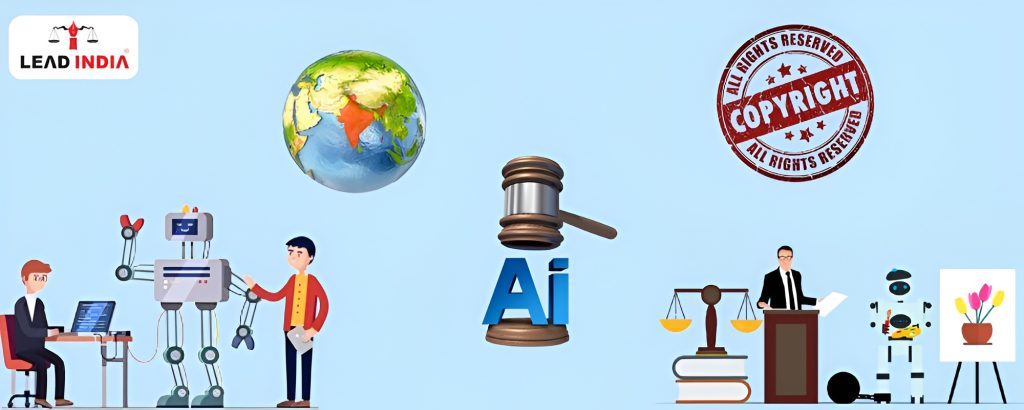
Artificial Intelligence (AI) is changing the way businesses, artists, and a few lawyers operate. IA may generate images and music, as well as produce legal content-it’s part of daily life now. From generating images and music to drafting legal content, AI tools are now part of daily life. But a key question arises, can AI-generated works get copyright protection, and who owns them?
According to the Indian Copyright Act, 1957, originality means human skill, judgment, and intellectual effort. Since the content is created by AI, with algorithms and datasets, but with no human creativity, it is thereby challenging traditional copyright law. Hence, it seriously jeopardizes the creators, companies, and AI vendors in India and elsewhere in the world.
Need A Legal Advice
The internet is not a lawyer and neither are you. Talk to a real lawyer about your legal issue
Can a Machine Be Called an Author?
During one consultation, a startup founder asked me if their AI-generated ad jingle could be copyrighted. It needs to be explained:
- In India: Section 2(d)(v) of the Copyright Act attributes authorship of computer-generated works to the person “who causes the work to be created.” Pure AI work doesn’t fit neatly.
- In the U.S. (Thaler v. USPTO, 2022): Courts rejected AI as an author.
- Globally: Most systems demand a human element.
Always document the human role in AI projects, editing, reviewing, or shaping output, so copyright ownership is defensible.
Who Owns AI-Generated Content? Real Examples
Indian Context
There was a case where an artist used an AI tool to modify her digital paintings. When she tried to file for copyright, questions arose: was she the author, or was the AI?
- Delhi HC in Navigators Logistics v. Kashif Qureshi: Works without human skill/judgment aren’t copyrightable.
- Suryast (RAGHAV) Case: AI alone was rejected as author, but accepted under co-authorship with a human.
International Views
- UK: Ownership lies with the person arranging creation.
- U.S.: AI authorship strictly rejected.
- EU: Still debating partial recognition.
Practical Takeaway: If you rely heavily on AI, keep human contribution visible. It may save you in litigation.
Who Is Liable If AI Infringes Copyright?
A client once came worried that their AI tool had unknowingly used copyrighted music in a YouTube video. They asked- “Am I liable, or the AI company?”
Here’s how it is explained liability under Indian law:
- Section 51, Copyright Act: Anyone who reproduces or distributes copyrighted work without permission is liable.
- Possible parties:
- Developers: for training AI on copyrighted material.
- Users: for instructing the AI.
- AI Companies: for providing infringing tools.
- Cases to Watch:
- Federation of Indian Publishers v. OpenAI (Delhi HC, 2024): Accusation of unauthorized book use.
- Getty Images v. Stability AI (UK, 2023): Dataset misuse claim.
Advice: Always read the AI platform’s terms of use. Some shift liability to users, which can surprise clients later.
Does Fair Use Protect AI Training?
Many clients assume “fair use” protects AI training. That’s not always true.
- In India (Section 52): Fair dealing allows limited use for research, criticism, or private use. Courts apply the four-factor test (Civic Chandran v. Ammini Amma, 1996).
- AI Problem: Training on millions of copyrighted works may not qualify as “limited use.”
- Global Reference: Authors Guild v. Google (2015) upheld digitization as fair use, but that was for search, not commercial AI tools.
- Practical Insight: If you’re a business, don’t assume AI training falls under fair use. Courts may decide against you.
Case Law Matrix: Quick Reference
| Case | Jurisdiction | Principle | AI Relevance |
| Thaler v. USPTO (2022) | U.S. | AI can’t be an author | Rejects authorship |
| Navigators Logistics | India | No human skill = no copyright | Excludes AI-only works |
| Suryast (RAGHAV) | India | Human-AI collaboration valid | Co-authorship possible |
| Getty v. Stability AI (2023) | UK | Dataset misuse = infringement | Dataset liability |
| FIP v. OpenAI (2024) | India | Pending | May shape dataset law |
| Authors Guild v. Google (2015) | U.S. | Large-scale digitization = fair use | AI training reference |
Six Major Risks to Advise Clients About
- Authorship Uncertainty: Hard to prove ownership in AI works.
- Data Sets Without Permission: A Copyright Infringement.
- Difference in Jurisdictions: U.S., UK, and India Do Treat AI Differently.
- Fair Use Ambiguity: Training may or may not qualify.
- Detection: Tracking AI Plagiarism is next to impossible.
- Detection Challenges: Difficult to track AI plagiarism.
Practical Risk Mitigation: What to Tell the Clients?
- Keep Humans Involved: Always edit, review, or co-create with AI.
- Check Dataset Licenses: Avoid tools with unclear training sources.
- Contractual Protection: Add clauses in agreements shifting liability.
- Audit AI Outputs: Especially for commercial use.
- Consult Lawyers Early: Saves costlier litigation later.
Conclusion
In experience advising startups and publishers, the biggest mistake is assuming AI is “safe” by default. It isn’t.
- In India, the law still demands a human element.
- Globally, courts are reluctant to recognize AI authorship.
- Until the law evolves, businesses must use AI carefully, with compliance and human oversight.
If you are a business, creator, or tech startup, speak with a copyright lawyer before relying on AI outputs commercially. Prevention is cheaper than defending a lawsuit.
One can talk to lawyer from Lead India for any kind of legal support. In India, free legal advice online can be obtained at Lead India. Along with receiving free legal advice online, one can also ask questions to the experts online free through Lead India.
FAQs
1. Can businesses in India claim copyright over purely AI-generated works?
No. Under the Indian Copyright Act, 1957, originality must involve human skill and judgment. The pure AI works cannot be copyrighted in the country India.
2. If I use AI tools for content marketing, how can I usually prevent copyright infringement?
Always look after whether the AI platform uses its licensed datasets, add human edits to outputs, and as well as consult a lawyer before the commercial use.
3. What happens if two parties claim ownership of the same AI-generated work?
This may result in litigation. Courts in India will likely favor the party that can prove human contribution or contractual ownership.


 Talk to a Lawyer