
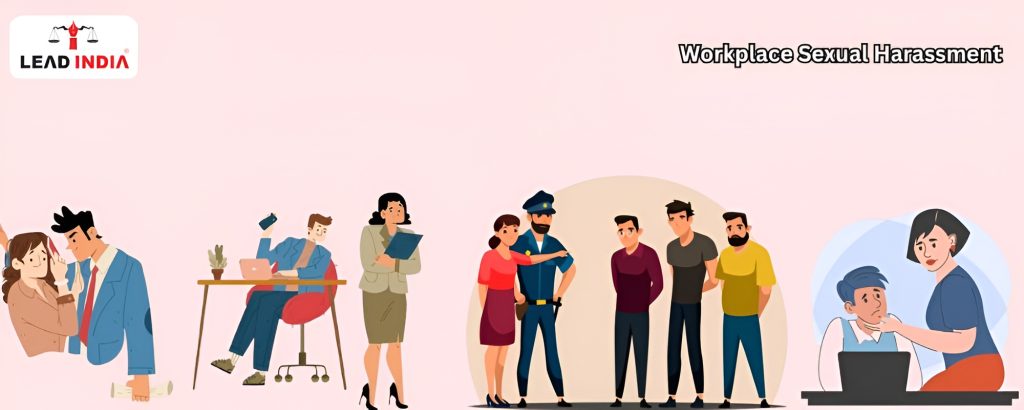
In order to protect women’s dignity as well as equality and to ensure a safe work environment, the Parliament of India has passed the Sexual Harassment of Women at Workplace (Prevention, Prohibition and Redressal) Act, 2013 or the POSH Act.
This Act fulfils the provisions of the Constitution of India and also specifically Article 14 of the Indian Constitution, Article 15 of the Indian Constitution, Article 19(1)(g) of the Indian Constitution and Article 21 of the Indian Constitution.
The POSH Act goes further than protective as well as remedial measures; it imposes criminal liability on the employers for not maintaining the safe workplace environments.
What Counts as Sexual Harassment at Work?
There was a client who was hesitant to report “just jokes” from her boss, he realized how misunderstood harassment is. The POSH Act defines it as:
- Unwelcome physical contact or advances
- Sexual remarks disguised as “jokes”
- Pressure for favours in exchange for promotions
- Inappropriate messages, images, or any type of pornography
- Any verbal or any kind of non-verbal behaviour that makes a woman very much uncomfortable
From experience, many cases begin with “harmless” remarks, but the law recognizes that dignity is compromised the moment behaviour is unwelcome.
Does POSH Apply to All Workplaces? Yes
One of the first questions that everyone asks is: “As an intern, a freelancer, or an employee working from home, do I even come under the ambit of this law?”
The answer is yes.
- Includes every female worker the permanent staff, temporary staff, contract staff, interns, trainees, as well as the daily wage earners.
- Workplace refers to more than just an office it includes hospitals, schools, courts, sports stadiums, and even taxis provided by employers.
- Work-from-home is included: online harassment during remote work is also covered
How to File a Complaint under POSH: Step by Step
When the law firm guide clients through this process, let’s break it down simply:
- Write the Complaint: It must be filed within three months of the incident. If you are too traumatized to write it, the law ensures someone can assist you.
- Submit to ICC/LCC: Internal Complaints Committee if your office has 10+ employees, or Local Complaints Committee if not.
- Inquiry Within 90 Days: You and the respondent both get a fair hearing.
- Reliefs During Inquiry: The transfer, leave, or safe any type of arrangements can be requested.
- Action and Punishment: If proved, the harasser may face any type of termination, salary deductions, or any kind of disciplinary penalties.
There is seen women gain courage once they know there is a fixed timeline and legal backing for every step.
What Employers Must Do?
In several corporate consultations, the compliance is not optional. Under the law, they must:
- Set up a trained ICC at every branch with 10+ staff
- Conduct awareness sessions regularly
- Display posters about penal consequences of harassment
- File annual POSH compliance reports
Failure to do so can invite fines and reputational harm.
Why the POSH Act Truly Matters?
That is the true significance of this law:
- Restores women’s faith in workplaces
- Builds accountability on management
- Promotes respect and equality
- Improves trust and productivity across teams
The Hard Truth: Why POSH Still Struggles in Practice?
Despite the law, the ground challenges are:
- Small firms where no one has heard of ICCs
- Committees set up only on paper, not functional
- Women afraid of stigma or career damage if they complain
- Social attitudes that normalize inappropriate behaviour
Landmark Cases relating to Workplace Sexual Harassment
- Vishaka v. State of Rajasthan (1997): The case brought the issue of sexual harassment at the workplace to light which laid down the first workplace harassment guidelines.
- Medha Kotwal Lele v. Union of India (2012): Exposed noncompliance demanding stricter compliance.
- Saurabh Kumar Mallick (2008): It extended the definition of the word “workplace” to include any kind of places related to employment.
- Shanta Kumar v. CSIR (2018): Distinguished harassment from petty fight.
- Dr. Punita K. Sodhi v. Union of India (2010): Emphasized that sexual harassment matters must be dealt with immediately and with solemnity.
These cases prove that each victim’s courage changes the law for thousands of others.
POSH Act and Your Constitutional Rights
Every time a woman uses this Act, she is exercising:
- Article 14: Right to equality
- Article 15: Right against sex-based discrimination
- Article 19(1)(g): Right to profession without fear
- Article 21: Right to dignity and life
What More Needs to Be Done?
- Better Training: ICC members often lack sensitivity
- Regular Awareness: So, women know they can complain safely
- Support for Unorganized Sector: Domestic workers, gig workers, and daily wagers remain unprotected
- Male Allies: Men must be part of awareness programs
- Digital Complaints: Easier reporting via secure online systems
Conclusion
The POSH Act, 2013 is more than compliance, it is your right to dignity at work. Women who once felt very much helpless now, they can have access to the law and are then re-energised to work and as well as reclaim their self-worth.
If you face workplace harassment, do not remain silent anymore. File a report with your ICC or an employment lawyer who can guide you through the POSH complaint as well as safeguard your rights.
One can talk to lawyer from Lead India for any kind of legal support. In India, free legal advice online can be obtained at Lead India. Along with receiving free legal advice online, one can also ask questions to the experts online free through Lead India.
FAQs
1. Does the POSH Act apply to men?
No, the POSH Act, 2013 specifically protects women employees. However, male employees can seek remedies under other laws such as the Indian Penal Code or workplace policies.
2. Can anonymous complaints be filed under POSH Act?
The Act requires a written complaint by the aggrieved woman, but ICCs are encouraged to maintain strict confidentiality. Employers are not bound to act on anonymous complaints, but they can choose to look into allegations if the information is reliable.
3. Can a POSH complaint be filed against a client, customer, or a third party?
Yes. A woman can complain under the Act if a client, customer, or a third-party service provider harasses her in a workplace-related setting.


 Talk to a Lawyer