
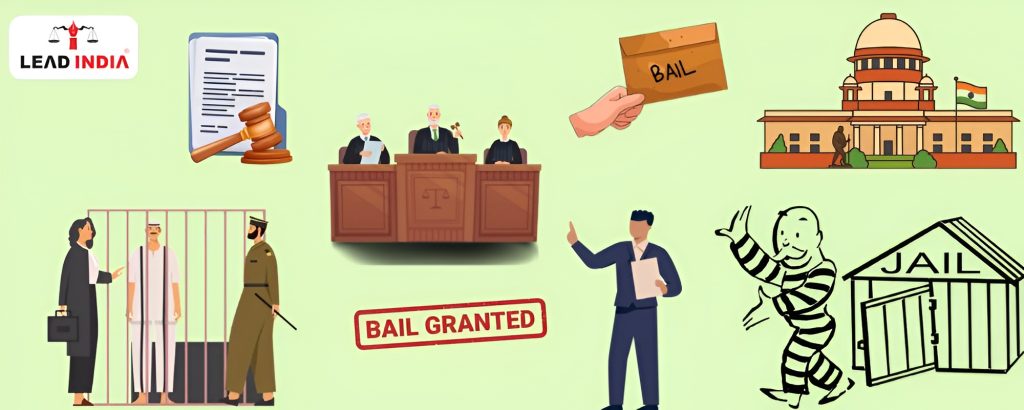
In Indian criminal law, the principle “Bail not Jail” is the cornerstone of the judiciary. The Constitution embraces personal liberty through Article 21 by declaring that no person shall be imprisoned except by a legal procedure established by the law. It is very important to see bail as something more than a simple procedural relief; it is a constitutional protection that grants an accused person the right to be treated with dignity and to enjoy liberty until he or she is proved guilty.
The Supreme Court of India has made its point very clear through its rulings that hares, while granting or refusing bail, must take into account and weigh both the rights of the accused person and the interests of the society. The principle of “innocent until proven guilty” is for everyone and it is the courts’ duty to ensure that the accused does not avoid justice by fleeing or by tampering with evidence.
The article describes the meaning, types, and process of bail law in India, including the criteria provided by the Supreme Court in historical judgments.
What is Bail?
The word “bail” comes from bailer, meaning to deliver. In legal terms, it means temporary release from custody after arrest on the promise to appear for trial. It is not an acquittal, but a conditional liberty that balances freedom with the court’s need to ensure attendance.
When and How Can You Apply for Bail?
Once an FIR (First Information Report) is lodged against a person, the accused may opt to apply for a particular type of bail which can be granted according to the circumstances:
- Anticipatory Bail (Section 438 CrPC/ Section 482 BNSS): It is availed to save oneself from being arrested as well as being imprisoned beforehand.
- Regular Bail (Sections 437 & 439 CrPC/ Sections 480 & 483 BNSS): It is availed after being arrested, before trial, or during the investigation phase.
- Interim Bail: It is a temporary bail that can be availed until the next hearing for bail.
Practical Tip: You need to be ready with the FIR, ID proofs, and surety details. In case of an emergency, even a delay of one day can result in unnecessary custody.
Types of Bail Explained with Real Examples
- Regular Bail: Filed after arrest. For example, if booked in a business fraud case, once in custody, you can seek regular bail before the Magistrate or Sessions Court.
- Interim Bail: A temporary safety net often granted while you are waiting on your bail hearing. In one instance a client was granted interim bail on health reasons until his reports were verified.
- Anticipatory Bail: Protects against false or improper motives as per Section 438 CrPC/Section 482 BNSS.
Conditions Courts Look at Before Granting Bail
Bailable Offences (Section 436 CrPC/Section 478 BNSS)
- In bailable offences bail is a right. The court must release once surety is provided.
- Example: If charged with a minor financial crime that has a penalty of less than three years, bail would be automatic on bond.
Non-Bailable Offences (Section 437 CrPC/Section 480 BNSS)
Here, bail is usually discretionary in nature. It may be granted if:
- The accused is a woman, senior citizen, or ill person.
- Evidence is weak or FIR filing was delayed.
- There is totally no risk of absconding.
When Can Bail Be Cancelled?
Even after bail is granted, it’s not a free ticket. Courts can revoke bail under Sections 437(5) and 439(2) CrPC/ Sections 480 and 483 BNSS if the accused:
- Threatens witnesses,
- Tampers with evidence, or
- Commits another other offence while they are released on bail.
How the Supreme Court Decides Bail: Key Judicial Criteria
The Supreme Court has laid down certain principles to make sure the fairness in bail considerations. Courts will often consider the following criteria:
1. The Nature & the Seriousness of the Charge
In the aftermath of the case State of U.P. v. Amarmani Tripathi (2005), the court correspondingly declared that the crucial factors for the ruling were the weight and the power of the case. For example, murder or terrorist case will receive more attention and deliberation than the case of property.
2. A Prima Facie Case
The supreme court noticed a similar tendency wherein balance of danger risk with the presumption of the innocence was ruled by the judge in the case of Gudikanti Narasimhulu v. Public Prosecutor, A.P. (1978).
3. Risk of Flight
Practically, judges consider residence, family, employment, to judge if a defendant is likely to abscond.
In Gudikanti Narasimhulu v. Public Prosecutor, A.P. (1978), Justice V.R. Krishna Iyer found that the judge must balance the seriousness of flight risk with the presumption of innocence.
4. Risk of Tampering with Evidence
If after release there is a possibility of harming witness or tampering with evidence presented at trial, the judge may deny bail. In particular, the Court ruled in State of Bihar v. Rajballav Prasad (2017), neither should the defendant face pre-trial release due to disrupting the fairness of a trial.
5. History of Crime
Courts are careful when the accused is a repeat offender or has prior convictions. A single mistake or wrongful implication should not be the cause of wrongful imprisonment.
6. Delay in Trial
Hussainara Khatoon v. State of Bihar (1980) was a case reporting a long wait for years of some under-trials and their subsequent release. The court pronounced in favor of a speedy trial as a matter of Article 21.
7. Age, Health, and Gender
Courts take a humanitarian approach. The highest judgment in Dataram Singh v. State of U.P. (2018) suggested that bail cannot be denied on the basis of serious allegation only.
Step-by-Step: How the Bail Is Granted?
- Filing the Application: The application must include the grounds for the bail application, the necessary details of the sureties, and the Compilation of the First Information Report.
- Hearing in the Court: The defence and the prosecution are given their chances to address the situation.
- Order of the Court: If satisfied, the entire bail application will be granted, likely with conditions, such as a surety or travel conditions, etc.
- Executing the Bond: The bond needs to be executed, usually to the police officer or in the court.
- Compliance: All of the conditions of bail need to be followed every time, or the bail could be cancelled for any type of non-compliance if seen.
Practical note: In case of you are in transit or travelling while you are on bail, you need to mandatorily obtain prior written permission from the court.
Landmark Supreme Court Judgments on Bail
- Gurbaksh Singh Sibbia v. State of Punjab (1980): This case states that the liberty is paramount; and the anticipatory bail must be granted liberally.
- Sanjay Chandra v. CBI (2012): This case states that the pre-trial detention should be exceptional, and it must be especially in economic offences.
- Arnesh Kumar v. State of Bihar (2014): This case states that the police must avoid unnecessary arrests as per Section 498A IPC/Section 85 BNS.
Conclusion
Bail is a privilege, not a right; it is aiming at the rebalance of liberty and administration of justice. The assumption of innocence is valid until proved otherwise for each accused. The function of a just court must be to shelter the society and the individual equally.
One can talk to lawyer from Lead India for any kind of legal support. In India, free legal advice online can be obtained at Lead India. Along with receiving free legal advice online, one can also ask questions to the experts online free through Lead India.
FAQs
1. What is the difference between bail and bond?
A bail is the court’s allowance to set an accused free, while a bond is the written commitment or cash (with or without surety) or promise to show up for trial when the court asks for it.
2. What does a surety do?
A surety is a person who accepts the obligation of seeing to it that the accused will adhere to the bail conditions. If he/she runs away, the surety may lose the bond amount.


 Talk to a Lawyer