
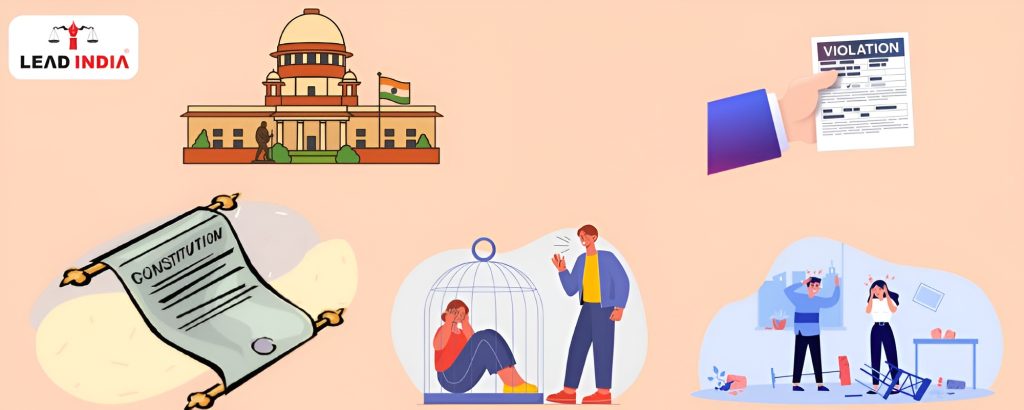
India’s Constitution is commonly deemed the foundation of Indian democracy. It provides a list of basic rights, such as equality before the law, freedom of speech, right to life, and non-discrimination. But rights lack meaning if they do not provide a remedy. So, the creators of the Constitution gave the judiciary, the Supreme Court in particular, the authority and duty to enforce and protect these rights.
Dr. BR Ambedkar called Article 32 the “heart and soul of the Constitution” because it gives the citizen the right to approach the Supreme Court in the even their constitutional rights are denied or violated.
This article is meant to show the Supreme Courts assumptions of this duty of enforcement and protection, including the constitutional framework, and the significant judgements that decided how to undertake their responsibilities.
The Legal Backbone: How Article 32 Empowers Every Citizen
1. Your Direct Right to Approach the Supreme Court
Article 32 states: “The right to move the Supreme Court by appropriate proceedings for the enforcement of the rights conferred by this Part is guaranteed.”
That single line gives you the power to go straight to the Supreme Court if any fundamental right, from equality to liberty, is violated.
The law firm has helped clients file writ petitions where even a single arbitrary government order was struck down within days. The Court can issue writs such as habeas corpus (to free someone unlawfully detained) or mandamus (to compel an authority to act).
First-hand note: When you stand before the Registrar’s counter at the Supreme Court with a freshly drafted Article 32 petition, there’s a real sense that justice is within reach.
2. Article 226: The High Court’s Parallel Power
While the Supreme Court is your ultimate remedy, the High Courts under Article 226 can issue similar writs, not just for fundamental rights but “for any other purpose.”
In practice, most lawyers advise clients to begin with the High Court, it’s quicker, less expensive, and geographically accessible. Yet, Article 32 remains your constitutional right, guaranteed at the national level.
3. Judicial Review: The Constitution’s Safety Valve
In the landmark case of Kesavananda Bharati v. State of Kerala (1973), the Court stated that the principles of judicial review and fundamental rights comprise the “basic structure” of the Constitution, which can never be taken away by way of amendment or other parliamentary actions. It is this doctrine that restricts even Parliament from enacting a law that would take away your fundamental freedoms.
The Vision of the Framers: Justice Without Delay
During a debate in the Constituent Assembly, Dr. Ambedkar, when the constitution was being drafted and debated, cautioned that rights would remain merely meaningless or sham guarantees, unless capable of being enforced. “It is the very soul of the Constitution and the very heart of it.”
Real courtroom insight: In the Article 32 hearings, where the Chief Justice personally intervened to release unlawfully detained citizens within hours. It’s proof that this mechanism works, not just in textbooks, but in real life.
Which Rights Can You Protect in the Supreme Court?
Under Article 32, you can enforce these six pillars of liberty:
- Right to Equality (Arts. 14-18): Protection from unfair treatment or discrimination.
- Right to Freedom (Arts. 19-22): Free speech, movement, and liberty.
- Right Against Exploitation (Arts. 23-24): Protection from forced labour or trafficking.
- Right to Freedom of Religion (Arts. 25-28): Practice your faith freely.
- Cultural and Educational Rights (Arts. 29-30): Safeguard the rights of the minority.
- Right to Constitutional Remedies (Art. 32): The right to move the Supreme Court itself.
Public Interest Litigation: Justice for the Voiceless
Earlier, only the victim could file a case (locus standi). But through Public Interest Litigation (PIL), anyone can now approach the Supreme Court on behalf of marginalized citizens.
Notable PILs:
- M.C. Mehta v. Union of India: It mentioned about the clean air/environment.
- Vishaka Guidelines: It mentioned about the Safety of women at the workplace.
Take away: PILs make constitutional justice a collective duty, not an individual privilege.
Limitations: When the Supreme Court Might Say “No”
Despite having high powers, the Supreme Court do not accept every petition under Article 32.
It will reject if:
- The issue involves ordinary legal rights (not fundamental rights).
- The petitioner hasn’t proved a direct, personal violation.
- A more suitable forum, like the High Court under Article 226, exists.
- The petition appears politically motivated or filed for publicity.
Lawyer’s tip: Always approach the Court with a clean case and genuine grievance. False petitions can only attract heavy costs.
What Happens When You File an Article 32 Petition?
Whenever a client have a constitutional grievance, the procedure unfolds in this way:
- Drafting of the Petition: Identify which of the fundamental right is violated or infringed.
- Filing Before Registrar: The petition is filed with affidavits and documents.
- Preliminary Hearing: The bench decides if it merits notice to the respondent.
- Hearing & Orders: The Court may issue interim relief, stay orders, or final directions.
- Follow-up: In rights-based cases, compliance is monitored through periodic hearings.
The first time you see your client’s name appear on the Supreme Court cause list, it’s an emotional moment. Justice feels tangible.
Conclusion
The Supreme Court of India serves more than a judicial process; it is the constitutional conscience of the country. When power is abused or liberty is curtailed, it is through Article 32 that citizens can access justice.
From Romesh Thappar to Navtej Johar, we see case after case wherein the Court animates constitutional values and principles into living rights. Article 32 is not merely about giving over paperwork; it is also about the moment of optimism when the institutions have let you down.
If you think that your basic rights have been breached, then do not hesitate to get in touch with a constitutional lawyer and think about a writ petition under Article 32. This is the most powerful mechanism that you have for getting justice back.
One can talk to lawyer from Lead India for any kind of legal support. In India, free legal advice online can be obtained at Lead India. Along with receiving free legal advice online, one can also ask questions to the experts online free through Lead India.
FAQs
1. What should I put in my petition to give it the best chance of being accepted?
Clearly state the ways in which your right was violated, cite the Article number, submit all evidence supporting your claim, and make sure there are no political or personal motives. The best chance of a petition being accepted and the subject of the Supreme Court hearing is a concise and factual petition accepted by documents and filed through an experienced Advocate-on-Record.
2. Do I need a lawyer to file Article 32 petition?
Yes. All petitions must be filed through Advocate on Record with the Supreme Court except when the case is very urgent. Then petition can be filed through e-mail or fax.


 Talk to a Lawyer