
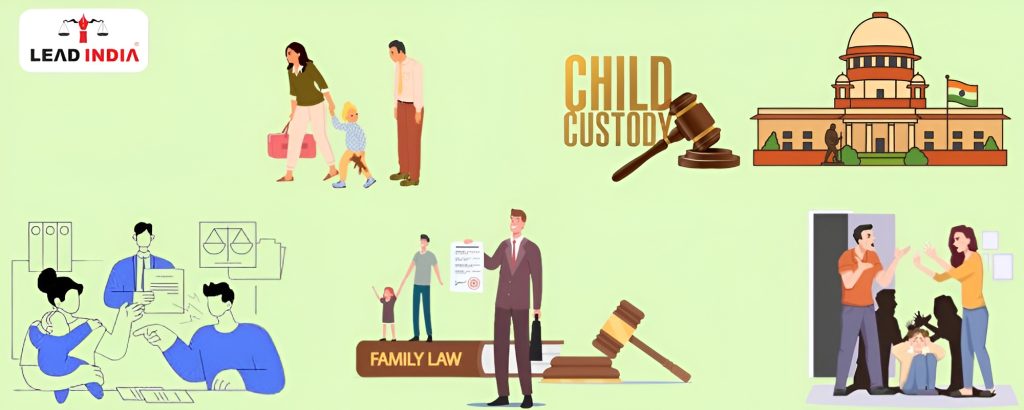
When parents choose to separate or divorce in India, Child Custody is recognized as one of the most sensitive topics they will conflict about. It will become more than a legal dispute; it will go to the emotional core of families. Child custody is an issue most of the time that comes along with divorce, separation, or family disputes, yet it directly influences the child’s safety and welfare either physically or emotionally.
The foremost principle of Indian custody law is the child’s welfare and best interests. Courts disregard parental rights and financial comfort and instead concentrate on which arrangement would be the most conducive to the child’s overall development, especially in terms of health, education, and emotions.
The Guiding Light: Child’s Welfare Over Everything Else
Indian courts have made one principle crystal clear, the welfare of the child comes before parental rights.
Child Custody decisions revolve around emotional, educational, and physical well-being. The goal is not to decide who “owns” the child, but who can best nurture their growth and peace.
The Legal Compass: Key Acts That Shape Custody Decisions
1. Guardians and Wards Act, 1890 – The Universal Framework
This secular law applies to all religions. Courts can appoint a guardian when it benefits the child’s welfare. This Act is used when grandparents step in to raise a child after both parents become unfit, it gives them legal standing to protect that child’s future.
2. Hindu Marriage Act, 1955 (Section 26) – For Divorcing Parents
During divorce, the courts can decide both custody as well as maintenance. In one of my cases, a mother in Delhi gained interim custody after proving she could provide a more emotionally stable environment, even though the father was financially stronger.
3. Hindu Minority and Guardianship Act, 1956 – Beyond Statutory Labels
Though this Act names the father as the natural guardian, courts have repeatedly stated that the child’s welfare outweighs tradition. There was a Mumbai judge who told a father, “You may be the guardian by law, but she is the guardian by love.”
4. Special Marriage Act, 1954 – Protecting Interfaith Families
Inter-religion marriages often face additional social pressure. Under Section 38, courts can grant custody and maintenance orders ensuring that faith differences never compromise a child’s rights.
5. Personal Laws – Faith Meets Fairness
Under Muslim Law (Hizanat), the mother’s custody continues until a son turns seven or a daughter reaches puberty, yet the father remains the guardian. Courts, mostly prioritize welfare over any kind of religious prescription, something that is seen applied across Muslim, Christian, as well as Parsi families.
6. Juvenile Justice Act, 2015 – Shielding Vulnerable Children
In cases of neglect or abuse, courts rely on this Act to protect a child’s dignity and safety. There was a case where a relative who sought guardianship of a neglected child; this law made that possible.
Understanding the Kinds of Custody
1. Physical Custody: Parent takes care of child’s daily needs while Child lives with that Parent.
2. Legal Custody: Parents (or both Parents together) has legal power to decide for the child significant matters of life.
3. Joint Custody: An option gaining more and more popularity in custody, where Parents share the time of parenting and Parenting responsibility is divided.
4. Sole Custody: Sole custody is generally awarded when one Parent is deemed by the Court to be disturbed or unfit to Parent the Child as a result of violence, addiction or neglect.
5. Third party Custody: This custody option is mostly rare; especially when the friends or any family members like grandparents take the custody temporarily.
How Courts Decide: Factors That Really Matter
The Courts assess:
- Age and Gender: Infants and toddlers are usually placed with mothers unless evidence says otherwise.
- Child’s Opinion: For children above nine or ten, the court may even speak to them privately.
- Parental Conduct: Past abuse, instability, or moral neglect weigh heavily.
- Emotional Bond: Judges notice how a child reacts in court, who they turn to for comfort.
- Living Environment: Safety, schooling, and support system matter more than luxury.
From Filing to Final Order The Custody Journey Explained
Step 1 Filing a Petition: A Parent or guardian can only approach the Family Court as per the Guardians and Wards Act or under any Personal Laws. This step initiates legal proceedings for custody and this is the first step.
Step 2 Interim Orders: Once a petition is filed, any temporary custody orders will allow Child’s safety while the Court proceedings continue.
Step 3 Mediation And Counseling: Many cases could have been settled in the weeks rather than years before, depending on how the mediation process works for the family.
Step 4 Final Custody Hearing: Ultimately, unless the parties reach a resolution while intervening mediation, the Family Court will ultimately review documents and finances presented in advance of parenting proposals, and sometimes even psychological evaluation and treatment or recommendations of parents, and authoring final orders for custody.
Step 5 Modification: Custody isn’t fixed forever; it changes if life circumstances change.
Lessons from Landmark Supreme Court Rulings
- Gaurav Nagpal v. Sumedha Nagpal (2009): Welfare of the child is the final test, not the rights of parents.
- Roxann Sharma v. Arun Sharma (2015): Children below five usually remain with the mother.
- Nil Ratan Kundu v. Abhijit Kundu (2008): Financial capacity isn’t everything; emotional bonding counts.
- Athar Hussain v. Syed Siraj Ahmed (2010): Religious law cannot override welfare.
The Role of a Good Custody Lawyer
In custody cases, lawyers often become emotional anchors. A seasoned Child Custody Lawyer in India will:
- They frame evidence around the child’s welfare, not bitterness.
- They prepare precise documentation and argue strategically in Family Court.
- They mostly encourage mediation where the reconciliation benefits the mostly child.
- They make sure that each and every step respects the child’s dignity as well as emotional comfort.
Practical Advice for Parents Going Through Custody Battles
- Give Your Child First Priority: Avoid using them to settle scores.
- Stay Calm in Court: Judges observe your behaviour. Politeness builds credibility.
- Maintain Documentation: Keep expenses, school reports, and communication logs.
- Respect Court Orders: Even temporary ones show responsibility.
- Consider Mediation: It helps the child see peace between parents.
- Protect Privacy: Keep personal matters off social media.
Conclusion
In India, child custody laws are created with sensitivity. The goal is to take care of the child’s welfare, not create conflict between the parents. The combination of the Guardians and Wards Act, personal laws, and the Supreme Court of India, work as a policy to achieve a balance between rights and responsibilities.
If you are in a custody battle, remember, your behaviour and willingness to cooperate matter more than any affidavit could. Every professional at Lead India Law can help parents deal with their custody issues with more compassion, in a manner that provides their child with proper love, care and attention rather than litigation.
One can talk to lawyer from Lead India for any kind of legal support. In India, free legal advice online can be obtained at Lead India. Along with receiving free legal advice online, one can also ask questions to the experts online free through Lead India.
FAQs
1. Is it possible for both parents to have custody of the child in India?
Yes. Joint custody is seen favourably by a growing number of Indian courts, which allows for both parents’ participation in the child’s upbringing and important decisions in their lives.
2. Can custody orders be changed later?
Yes. Custody is not permanent. Courts may modify orders if circumstances change, such as relocation, remarriage, or changes in the child’s health or schooling needs.


 Talk to a Lawyer