
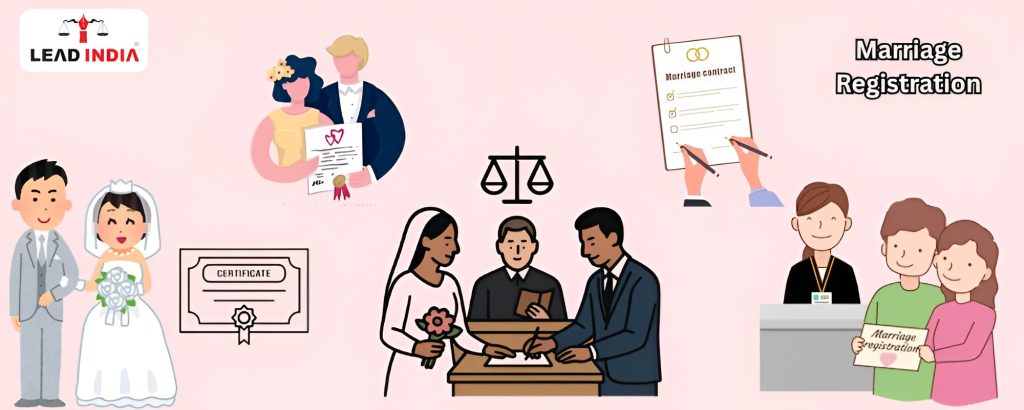
When couples get married, most of them believe that performing religious rituals or a ceremony is enough. The confusion usually starts later, when a practical problem arises, visa application, property transfer, insurance claim, maintenance case, or even a court dispute, and they are suddenly asked:
“Do you have a marriage certificate?”
At this stage, people realise that marriage registration is not just paperwork. It is a legal necessity that protects your rights. Let us understand this step by step, in simple and practical terms.
Is Marriage Registration Mandatory in India?
In India, marriage registration is a legal mandate, though its actual implication is different when it comes to practice. In Seema v. Ashwani Kumar, the Supreme Court ordered all States and Union Territories to ensure that marriages are registered compulsorily, so that child marriage, bigamy, fraud, and Women’s exploitation could be prevented.
On this issue, the courts further declared that marriage which is performed under personal law is valid and does not become invalid due to non-registration. The non-registration, however, usually results in very difficult situations when it comes to proving the marriage. To sum up, registration does not establish the marriage but rather enforces and increases your legal right.
Which Marriage Law Applies to Your Situation?
One of the most common doubts couples’ faces is which law their marriage should be registered under. The answer is not straightforward and depends on the religion and marriage type of the couple.
In case that the partners are all Hindus, Buddhists, Jains, or Sikhs and the marriage has been done through religious practices, then the registration is carried out as per the Hindu Marriage Act.
If the marriage is inter-religious, inter-caste, a court marriage, or involves a foreign national, registration is done under the Special Marriage Act. Under this law, the marriage itself is solemnized and registered through a civil legal process before a Marriage Officer.
Who Registers a Marriage and Where?
The Marriage Registration is done by the officials like Sub-Divisional Magistrate (SDM), Marriage Registrars, Tehsildars, and municipal officers, etc. In most cases, the area could be defined as the venue of the marriage or the residence of one or both spouses. So, the matter of choosing the right jurisdiction is very important because if you file the application in the wrong place, the mistake may cause a delay or even outright rejection.
How Marriage Registration Works Under the Hindu Marriage Act
As per the Hindu Marriage Act, one male applicant must be at least 21 years old while the female applicant must be at least 18 years old to obtain marriage permission.
Once a couple applies for their marriage license, they must jointly approach their respective Marriage Registrars with their respective marriage documents. Copies of documents verifying both the applicants’ ages, addresses, photographs taken during the marriage ceremony, and a copy of the marriage ceremony must be submitted along with proof of attendance by two to three witnesses. After the Registrar verifies all documents, the couple is required to appear in person before the Registrar along with their witnesses. The registrar will then enter the official marriage registry and give a certificate of marriage to the couple if everything is in order.
Most states stipulate a marriage processing period of 7 to 30 days, which may vary according to document verification and state laws.
How Marriage Registration Works Under the Special Marriage Act
Registration as per the Special Marriage Act is viewed with utmost anxiety, especially by the inter-religious or the inter-caste couples, but the process is legally well-defined.
The procedure starts with the submitting of a Notice of Intended Marriage to the Marriage Officer. At least only one party must have resided in the district for a minimum of 30 days. The notice is displayed publicly for thirty days, during which objections can be raised only on valid legal grounds.
If an objection is received, the Marriage Officer conducts an inquiry to determine whether it is legally sustainable. Personal, social, or family objections have no legal value. If there is no valid objection, the marriage is solemnized before the Marriage Officer in the presence of all the three witnesses, after which the marriage certificate gets issued.
The minimum time required as per this Act is 30 days, as well as it may take longer if at all the objections arise.
Documents Required for Marriage Registration
Common Documents
- Aadhaar Card / Passport / Voter ID
- Birth certificate or school certificate
- Address proof
- Passport-size photographs
- Marriage photographs
- Affidavit of marital status
- Identity proof of witnesses
Additional Documents (If Applicable)
- Divorce decree (if previously divorced)
- Death certificate of former spouse
- Passport & visa (for foreign nationals)
Is Online Marriage Registration Possible?
Historically in India, many states are now providing online services for couples wishing to register their marriage. Most of these sites provide online applications, where couples can upload their scanned documents and book an appointment to present their application. But it is mandatory for all couples to meet the registrar (marriage officer) and have their witnesses present at the time of application, before the issuance of their marriage certificate.
Why Marriage Registration Is So Important
Through the registered document, couples can establish themselves legally married and authorised to obtain a divorce, apply for a visa to immigrate, inherit property, obtain health insurance, and establish a bank account in their spouse’s name. As a registered marriage provides a couple with a legal basis to prove they are married, it can help stop an individual from attempting to commit bigamy, thereby protecting the rights of both men and women and providing women with legal options in case of being wronged by their husband.
What Happens If You Do Not Register Your Marriage?
The couples who skip the Marriage Registration mostly face the difficulties later. Proving the marital status becomes very much complicated, maintenance as well as alimony claims become harder, inheritance disputes arise, as well as visa or foreign travel applications might also get rejected. In the legal disputes, lack of a marriage certificate can only significantly weaken your case.
What You Should Practically Do Now
- Register your marriage as early as possible
- Choose the correct Act based on your situation
- Keep all documents and photographs safely
- Do not delay registration thinking it is unnecessary
- Take legal advice if your marriage involves inter-religion or foreign nationals
How We Help with Marriage Registration
Most of the couples approach us after facing many confusions, objections, or the delays in the marriage registration. Our job is to guide you through the right legal procedures, ensure proper documentation, protect your rights, as well as complete the registration very smoothly. We mostly focus on making sure that your marriage is not only socially recognised but it is also legally secure.
One can talk to lawyer from Lead India for any kind of legal support. In India, free legal advice online can be obtained at Lead India. Along with receiving free legal advice online, one can also ask questions to the experts online free through Lead India.
FAQs
1. Is my marriage illegal if it is not at all registered?
No. A validly solemnized marriage does not become illegal solely due to non-registration, but proving it becomes difficult.
2. Can parents object to a marriage under the Special Marriage Act?
Only legal objections are permitted. The personal or family objections have no legal standing.
3. Is physical appearance compulsory after online application?
Yes. Both spouses as well as the witnesses needs to be appeared before the authority.
4. When should marriage be registered?
Ideally, immediately after marriage to avoid future legal complications.


 Talk to a Lawyer