
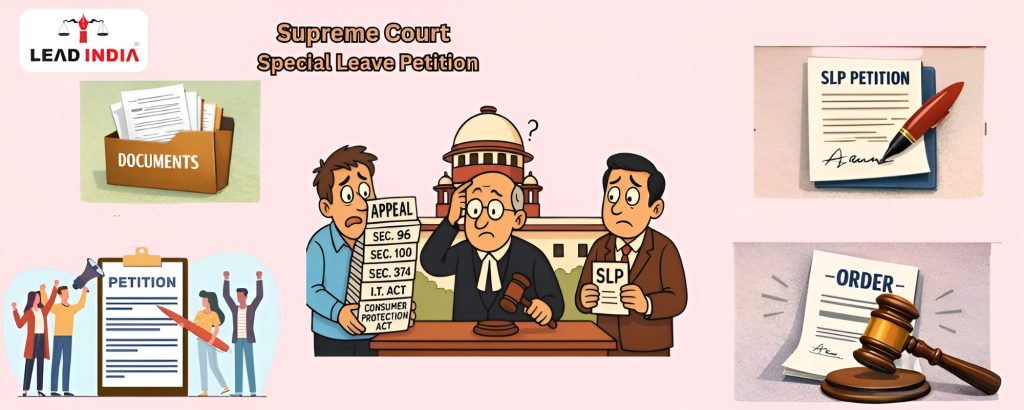
When people lose a case in the High Court or before a tribunal, the first thought that comes to mind is:
- “Can I go to the Supreme Court now?”
- “Is there any last legal remedy left?”
It’s perfectly understandable to be confused by this. Many people think that every appeal will be heard by the Supreme Court. However, the Supreme Court doesn’t hear appeals like a normal court. Most of the time, cases get into the Supreme Court with a Special Leave Petition (SLP).
If you know the guidelines for when filing an SLP will work, when an SLP will not work and how SLPs are processed, you will save yourself and your team the hassle of unnecessary litigation, litigation costs and frustration.
What Is a Special Leave Petition in Practical Terms?
In India, an SLP is a formal request submitted to the Supreme Court for special permission to appeal a prior decision made by the High Court, tribunal or quasi-judicial authority. An SLP is filed under Article 136 of the Constitution of India.
Unlike a normal appeal, you do not have an automatic right to file an SLP. Prior to granting permission to file an SLP, the Supreme Court will review the reasons for filing the SLP to make a determination on whether your case warrants further hearings. If the Supreme Court determines that the SLP is justified, the SLP will then become a civil or criminal appeal. In practice, this means that a large number of SLPs are dismissed at the very first stage without issuing notice to the other side.
When Does a Case Really Deserve an SLP?
A litigant believes that an unsuccessful case equates with the necessity to file an SLP against the courts. This notion usually results in disappointment with the outcome. The Supreme Court focuses more on the significant injustices and the escalation of new law than on “normal disputes” previously heard through the legal system.
An SLP will become significant if the judgment was rendered unfairly, lacked a good legal basis, or violated previously opined case law. If the only difference between the parties involved is the evidence or facts surrounding the matter, the Supreme Court will not intervene unless there was a clear and egregious error in finding or determining the evidence or facts presented in the lower courts.
How Can You Tell If Your Case Is Fit for the Supreme Court?
Before considering an SLP, there should be an honest evaluation of the nature of your case. If the High Court disregarded established precedent or misapplied a legal principle in its decision, or if the case, regardless of the number of individuals named as defendants, has a wide-ranging public interest in the outcome of the matter, an SLP may be appropriate.
Conversely, if the only grievance concerns an adverse decision or a re-evaluation of the evidence or facts, and there is no significant legal issue presented, the Supreme Court will likely refuse to intervene. Therefore, a realistic legal opinion at this point is a requisite.
What Types of Matters Reach the Supreme Court Through SLP?
In the practice, the SLPs are filed in a wide range of the cases, that includes civil disputes like property or contract matters, the criminal cases that involve conviction, acquittal or the bail, service as well as employment disputes, tax and the revenue matters, and decisions of tribunals.
However, the Supreme Court most consistently avoids the interfering in routine factual disputes. Its main focus remains on the questions of law, constitutional interpretation, as well as serious injustice.
Who Is Allowed to File an SLP?
An SLP can be filed only by a person who is genuinely aggrieved by the judgment. This includes parties to the case, their legal heirs, or government authorities where applicable. The petitioner must show that the impugned judgment has caused direct legal harm.
Strangers or third parties with no direct connection to the dispute generally cannot maintain an SLP.
Time Limit for Filing an SLP
Time limitation is one of the most common areas where litigants make mistakes. In the civil matters, the SLP needs to be usually be filed within 90 days from the date of judgment. If at all the review petition was filed as well as dismissed, the time limit is 60 days from the date of dismissal.
In the criminal matters, the limitation period is 60 days from the date of judgment. Although the Supreme Court has the power to condone delay, explanations must be convincing. In practice, long or casual delays significantly reduce the chances of admission.
Documents Required for Filing an SLP
To file an SLP, you need:
- Certified copy of the impugned judgment/order
- Special Leave Petition with legal grounds
- Statement of facts
- List of dates and events
- Affidavit of the petitioner
- Vakalatnama in favour of Advocate-on-Record
- Prescribed court fees
- Delay condonation application (if applicable)
Many SLPs get delayed due to registry objections, not merits.
How an SLP Is Filed in Actual Practice
The first practical requirement is engaging an Advocate-on-Record, as only an AOR is authorised to file matters before the Supreme Court. Drafting then becomes the most decisive stage. A strong SLP focuses on legal questions and injustice, not on repeating arguments already rejected by lower courts.
Once filed, the petition is scrutinised by the Registry. Any defects must be cured within time. After this, the matter is listed for admission. This stage is crucial because the Court may dismiss the SLP outright without issuing notice. Only if leave is granted does the petition convert into a regular appeal and move towards final hearing.
Grounds on Which the Supreme Court Usually Interferes
The Supreme Court mostly entertains the SLPs whenever there is a clear perversity in judgment, a serious miscarriage of the justice, the very important legal or constitutional question, or the conflicting decisions that only require authoritative settlement. The routine disputes or the dissatisfaction with the findings rarely succeeds.
What Happens If the SLP Is Dismissed?
Dismissal of an SLP does not always mean that the Supreme Court has approved the High Court judgment. A non-speaking dismissal simply means that the Court did not find the case fit for interference.
In limited situations, a review petition may be filed if there is an apparent error on record. A curative petition is available only in the rarest of rare cases to prevent gross injustice. Both remedies are exceptional and should not be seen as routine follow-ups.
Why Most SLPs Get Rejected
In practice, SLPs are commonly rejected because they raise no substantial question of law, suffer from unexplained delay, attempt to re-argue facts, or are filed as a routine last resort. The Supreme Court discourages such litigation.
What You Should Practically Do Before Filing an SLP
- Do not file SLP just because you lost
- Do not delay in consulting a Supreme Court lawyer
- Assess legal questions honestly
- Prepare for the possibility of dismissal
- Avoid unnecessary expense and false hope
Early legal assessment often saves years of litigation.
How We Assist You in Supreme Court Matters
Whenever the clients approach us after they lose in the High Court or the tribunal, our primary focus is not on the false assurances but mainly on the honest legal assessment. We mostly guide you on whether the SLP is worth filing, ensure strong as well as precise drafting through the most experienced Advocate-on-Record support, and also help you understand the risks at each and every stage.
Our approach is basically simple, the responsible advice, clear strategy, as well as protection of your legal rights without creating any kind of unrealistic expectations.
One can talk to lawyer from Lead India for any kind of legal support. In India, free legal advice online can be obtained at Lead India. Along with receiving free legal advice online, one can also ask questions to the experts online free through Lead India.
FAQs
1. Can the High Court judgment be challenged in the Supreme Court?
No. It is only the cases that involves serious legal issues or the grave injustice that are entertained.
2. Is the SLP an appeal as a matter of right?
No. It is mostly a discretionary remedy as per Article 136.
3. Does dismissal of an SLP mean the High Court judgment is correct?
Not necessarily. The non-speaking dismissal has basically no precedential value.
4. Is it compulsory to file the review before filing the SLP?
No. Filing the review petition is mostly optional unless it is specifically required by law.


 Talk to a Lawyer