
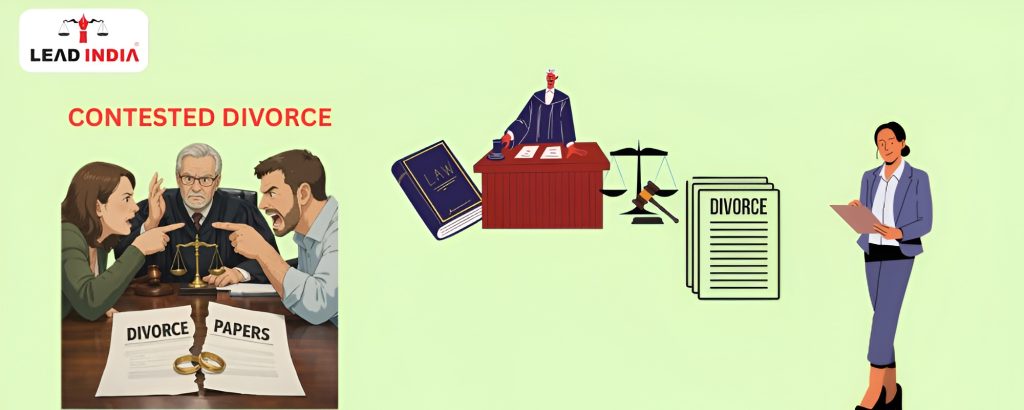
When people face serious marital problems for the first time, the biggest confusion is this:
“Can I get a divorce if my spouse is not agreeing?”
This confusion is very natural. Most of the spouses assume that the divorce is possible only when both the parties’ consent to it. In actuality, the Indian law clearly allows the contested divorce, where one of the spouse can seek divorce even if the other strongly opposes the case, provided that the legal grounds are proved in court.
Knowing how contested divorce works helps you:
- protect your legal rights,
- avoid common procedural mistakes,
- and prepare mentally and legally for what lies ahead.
This article explains the contested divorce process in India.
When Does a Divorce Become Contested?
A contested divorce occurs when one spouse wants to dissolve the marriage and the other disagrees. Additionally, a divorce can become contested when there are disagreements about property, child custody, maintenance (alimony), or the allegations of cruelty, adultery, desertion, or incarceration. The Family Courts will categorize any divorce where mediation or a settlement has not occurred and one spouse wants to oppose the action as contested.
As soon as your spouse expresses, “I don’t agree to divorce,” you have initiated a contested divorce action.
Which Law Applies to Your Contested Divorce?
The law for your contested divorce is determined by how your marriage was solemnized or registered. If your marriage was performed according to the traditions of Hindus, Sikhs, Jains, or Buddhists, then the Hindu Marriage Act will apply. If you married under the Special Marriage Act (i.e., you married in a court or inter-faith), then that legislation will apply. If your wife married you according to Christian beliefs, then the Indian Divorce Act is applicable. For Muslims and Parsis, Islamic and Parsi personal laws respectively will be applicable.
All contested divorce matters are heard by Family Court and must follow the same civil procedures and comply with family law.
On What Grounds Can a Contested Divorce Be Granted?
Although unhappily married people often wonder how to obtain a divorce even if they are not going to get along with each other, courts do not grant divorce simply because a couple is unhappy together. The only time a judge grants a contested divorce is if the person requesting the divorce can prove the statutory grounds for a divorce as determined by the law. The statutory grounds for a contested divorce may include: cruelty (especially mental cruelty), infidelity, desertion for a legally specified period of time, conversion of religion, serious mental illness, venereal disease, presumption of death, and failure to resume cohabiting with the other spouse after a judicial separation.
In actual court practice today, mental cruelty, prolonged separation, and false criminal charges are the three most commonly used grounds for divorce.
How a Contested Divorce Case Proceeds in Reality
Step 1: Filing the Petition of Divorce
The procedure starts whenever one of the spouses files the divorce petition in the Family Court having the jurisdiction.
The petition usually includes:
- Marriage details
- Specific incidents supporting divorce grounds
- Previous complaints or cases, if any
- Reliefs like the divorce, maintenance, custody as well as protection
Poorly drafted petitions mostly fail later, even if the grievance is very genuine.
Step 2: Court Notice to the Other Spouse
After the filing, the court sends the notice/summons to the other spouse.
Most of the people believe that avoiding court will stop the case. But, this is not true. If the notices are ignored repeatedly, the court can then proceed the ex parte after proper service.
Step 3: Reply by the Respondent
The other spouse files the written statement, usually when denying all the allegations.
At this particular stage, the respondents often:
- Make counter-allegations
- File maintenance or custody applications
- Threaten parallel criminal cases
This is where most of the contested divorces become more emotionally intense.
Step 4: Interim Maintenance & Child Custody
When the case is pending, the courts may decide:
- Interim maintenance for spouse
- Litigation expenses
- Interim child custody or visitation rights
These orders are temporary but extremely important, as contested cases often take years.
Step 5: Mediation & Settlement Attempts
The family Courts must attempt for mediation or reconciliation. If settlement is possible, the case can end here. If not, the matter proceeds to full trial. Statements made in mediation cannot be used against you later.
Step 6: Framing of Issues by Court
The judge identifies the exact questions to be decided, such as:
- Was cruelty committed?
- Is desertion proved?
- Is divorce legally justified?
Only evidence relevant to these issues matters in court.
Step 7: Evidence Stage (Most Crucial Phase)
This stage decides the outcome of the case.
Petitioner’s evidence includes:
- Affidavits
- Cross-examination
- Messages, medical records, complaints, witnesses
Respondent’s evidence includes:
- Rebuttal witnesses
- Documentary proof
- Cross-examination of petitioner
Courts carefully examine:
- False allegations
- Contradictions
- Digitally manipulated chats or recordings
Many cases fail due to weak or exaggerated evidence.
Step 8: Final Arguments
Lawyers present final arguments linking:
- Evidence
- Legal provisions
- Judicial precedents
Most strong written arguments mostly influence the final decision.
Step 9: Judgment and Divorce Decree
The court usually delivers a reasoned judgment.
- If grounds are proved: Divorce is granted
- If not proved: Case is dismissed
A certified decree is very much essential for appeal or remarriage.
How Long Does a Contested Divorce Take?
In India, there isn’t no timeframe for the duration of a contested divorce case. However, in reality, the contested divorces tend to take approximately 2 to 5 years to get resolved. Issues regarding child custody, multiple divorce filings, or criminal cases being heard in conjunction with contested divorce cases will typically cause further delay in reaching a resolution. The majority of time lost while waiting for a resolution takes place during the discovery phase of the proceedings.
In certain circumstances, there are several ways that through cooperation and to implement effective legal strategies; it may be possible to significantly reduce the number of unnecessary adjournments generally associated with contested divorce cases.
Key Judicial Principles on Contested Divorce
The courts of India have consistently adjudged that mental cruelty to include persistent acts of harassment, fabricated allegations, mistreatment and protracted periods of separation, which cause emotional pain. The courts have also said that mere act of filing the false criminal complaint can usually raise the level of cruelty. While the marriage being irretrievably broken may not stand alone as a statutory reason for getting a contested divorce, it may be only considered one relevant factor by the court in determining the final outcome of contested divorce litigation.
These principles usually provide clarity for the Family Courts in India as well as it helps shape contested divorce law in India.
Your Rights During a Contested Divorce
During a contested divorce, both spouses have the right to fair legal representation, interim maintenance where applicable, child custody or visitation, a fair trial, and the right to challenge false evidence. If the final judgment is unfavorable, the law also provides the right to appeal before a higher court.
Can a Contested Divorce Later Become Mutual?
Yes. At any stage of case, if both the spouses agree to settle, then the contested divorce can be converted into the mutual consent divorce. The courts fully encourage those settlements, as it saves most of the time, money, as well as emotional stress for both parties.
What Should You Practically Do If You Are Facing a Contested Divorce?
- Do not file cases or replies emotionally
- Preserve messages, call logs, and documents
- Avoid social media posts during litigation
- Do not ignore court notices
- Consult the family lawyer before responding to the allegations
Early legal advice usually decides whether the particular case becomes manageable or it turns into any prolonged litigation.
How We Help in Contested Divorce Matters
A contested divorce is not is an emotionally taxing phase of the life. Our primary job is to guide you with utmost clarity, draft the strong pleadings, protect you from different false allegations, handle maintenance as well as custody issues strategically, and also explore the settlement wherever it is legally beneficial.
Our focus is simple to protect your rights, dignity, and long-term interests while navigating the legal process effectively.
One can talk to lawyer from Lead India for any kind of legal support. In India, free legal advice online can be obtained at Lead India. Along with receiving free legal advice online, one can also ask questions to the experts online free through Lead India.
FAQs
1. Can I get a divorce the if my spouse completely refuses it?
Yes, but it is provided that you prove valid legal grounds before the Family Court.
2. Does the filing of a contested divorce guarantee divorce?
No. The divorce is usually granted only after trial as well as proof of grounds.
3. Can the false criminal cases usually affect my divorce case?
Yes, but the false cases can themselves become the ground for the divorce.
4. Is the contested divorce expensive as well as time-consuming?
Yes, it basically involves higher cost as well as longer duration than the mutual divorce.
5. Can the child custody be decided during the case?
Yes, the courts pass both interim as well as final custody orders.
6. Can I appeal in the court if the divorce is denied?
Yes, the law mostly provides the right to appeal before the higher court.


 Talk to a Lawyer