
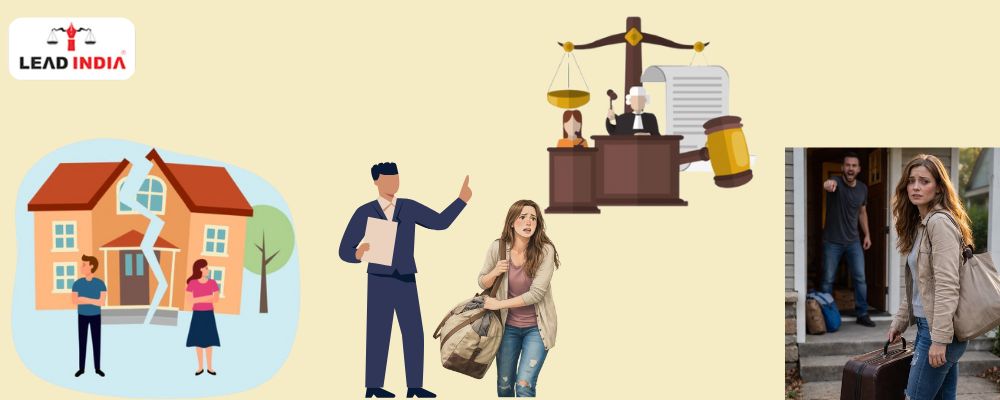
When a woman is suddenly forced out of her own matrimonial home by her husband or her in-laws, the first as well as the most disturbing question that comes to her mind is:
“Can my husband legally throw me out of the house?”
Closely followed by:
“Do I have any right to go back if the house is not in my name?”
This confusion is completely natural. In practice, most women approach a lawyer only after they are already staying at their parental home, relatives advise them to “adjust for now”, they are told that the house belongs to in-laws, and they are made to believe it is only a family matter
Understanding what the law actually says at this stage is extremely important. Acting late often weakens legal protection, whereas acting early gives immediate relief and security.
What the Law Says About a Wife Being Thrown Out
Indian law does not treat forcing a wife out of her matrimonial home as a private family dispute. It treats it as a serious legal violation.
A married woman has her own legal right to reside in her matrimonial or shared household, irrespective of whoever owns the property. This particular protection primarily comes from Protection of Women from Domestic Violence Act, 2005, which was mostly enacted specifically to prevent women from being rendered homeless due to the marital abuse.
One of the most important points to know and understand is The law protects a woman’s right to residence, not ownership.
You are not required to prove that the house belongs to you. You only need to establish that it was the house where you lived after marriage.
What Domestic Violence Really Means in Law
Many women hesitate to take legal action because they believe domestic violence only refers to physical beating. This belief is legally incorrect.
In India, domestic violence includes not only physical abuse but also abuse that is emotional, verbal, and economic. Examples of this would include forcing a woman out of her home, forbidding her entry, locking her out of the house, or creating an environment that compels her to leave the home.
Even if a woman has not sustained an actual physical injury, the actual denial of shelter is considered as cruelty (economic abuse). Furthermore, courts have consistently ruled that a husband cannot deny his wife shelter simply because of marital discord.
What You Should Do Immediately After Being Forced Out
The actions taken immediately after being forced to leave will be very important to the outcome of any subsequent legal action.
The most important thing is always is to be sure about your personal safety first. If there is any kind of indication that there may be further threats of violence, intimidation, or the coercion, you should leave immediately as well as seek refuge in a safe location such as your parents’ home, a trusted friend, or the registered women’s shelter.
At the same time, it is also important to preserve all of the evidence that will be necessary in your case. Evidence can be more than just the medical reports. evidence can include texts, voicemails, e-mails, photographs, security camera images (CCTV), as well as the eyewitness testimony from neighbours or family members.
One critical mistake many women make is signing documents under pressure. Often, separation letters, undertakings, or consent papers are presented as “temporary arrangements.” Any document signed without legal advice can later be used against you in court.
Legal Remedies Available to You Without Delay
Indian laws provide a variety of remedies that women can use to obtain help after being thrown out of their homes against their will.
Women have a right to live in a “shared household” as Long as the Husband has not legally evicted her or obtained an eviction order against her. The Domestic Violence Act allows for this “right to reside in a shared household.” The courts can issue orders for her to be able to enter the “shared house,” including ordering the husband (or in-laws) from preventing her from re-entering, directing the husband to give her alternative accommodation if he cannot provide a place to live in together due to fears for her safety, and many more.
There also are order options of restraining orders to prevent future harassment, threatening behaviour, intimidation, or any other type of harmful behaviour and making it a criminal offence to violate such orders.
In addition to the above, if she is financially dependent on her husband, the court may award her “interim maintenance” until she can establish herself as a financially independent woman.
Maintenance can be claimed under the Domestic Violence Act, Section 125 of the Criminal Procedure Code or corresponding provisions under the Bharatiya Nagarik Suraksha Sanhita, as well as under personal matrimonial laws.
Where force, threats, or physical intimidation are involved, a police complaint can also be filed. The police are legally bound to act if a cognisable offence is disclosed.
Can Help Be Taken Without Going to Court Immediately?
Yes. The law provides support mechanisms even before formal court proceedings begin.
A woman may contact a Protection Officer appointed under the DVA or the Women’s Cell / Mahila Thana, which are organisations that provide assistance in Preparing a Domestic Incident Report; arranging temporary Housing; coordinating Medical Assistance and facilitating Legal Aid.
Although there may be court activity associated with later proceedings, immediate assistance does not require that a complete court case be filed on day one.
What If the House Is in the Name of In-Laws?
This is one of the most common reasons women are illegally thrown out.
Courts have clearly held that ownership of the property does not defeat a wife’s right to residence, as long as the house qualifies as a shared household.
- In S.R. Batra v. Taruna Batra (2007), certain observations led to confusion, but later judgments clarified that this case cannot be used to deny genuine residence rights.
- The Supreme Court finally settled the issue in Satish Chander Ahuja v. Sneha Ahuja (2020) by holding that a wife’s right to residence under the Domestic Violence Act is independent of ownership. The concept of shared household must be interpreted broadly to prevent women from being rendered homeless.
This judgment is now the governing law.
Common Misunderstandings That Delay Legal Action
Many women delay action due to myths such as:
- the house is not in my husband’s name
- only physical violence matters
- police will not help in family disputes
- divorce must be filed first
None of these beliefs reflect the law. Delay often weakens evidence and allows the other side to create a false narrative of voluntary separation.
What Courts Usually Examine in Such Cases
In considering applications filed under the DVA, courts normally consider if a valid marriage exists; if the home is a shared household; how the woman was forced out of the home; financial dependency; and immediate safety issues.
If the evidence sets out immediate hardships, courts have the authority to provide urgent interim relief, sometimes at the first hearing.
Why Acting Quickly Is Legally Important
Delay can dilute evidence, allow manipulation of facts, and weaken the claim of forced eviction. Prompt legal action ensures quicker residence or accommodation orders, faster maintenance relief, and protection from continued harassment.
The law is designed to respond swiftly, but only when it is invoked in time.
How a Lawyer Can Assist You Effectively
A lawyer mostly helps by drafting one precise domestic violence complaint, by seeking urgent interim residence as well as the protection orders, coordinating with police and the protection officers, and also securing maintenance and compensation.
In many cases, courts grant interim relief within weeks when the case is properly presented.
What You Should Practically Do Right Now
If you have been forced out of your matrimonial home:
- Do not remain silent due to social pressure.
- Do not attempt forced re-entry without legal backing.
- Do not sign any document without advice.
- Preserve evidence carefully.
- Speak to a lawyer at the earliest stage.
- Early action protects both your legal rights and personal dignity.
Final Word
Forcing a wife out of her matrimonial home is not a personal failure or a private family issue. It is a legal wrong recognised and addressed by Indian law.
Most of the women who are facing such situations are not at all expected to suffer quietly. The law mostly provides immediate, enforceable remedies to protect shelter, dignity, as well as financial security.
One can talk to lawyer from Lead India for any kind of legal support. In India, free legal advice online can be obtained at Lead India. Along with receiving free legal advice online, one can also ask questions to the experts online free through Lead India.
FAQs
1. Is it at all legal for husband to throw his wife out of their house?
No. Forcing the wife out of the matrimonial home is illegal as well as it amounts to domestic violence.
2. Can the wife return to the house if it is in the name of the in-laws?
Yes. The wife has a legal right to reside in the shared household, regardless of the ownership.
3. Do I need to particularly file for the divorce to claim my own rights?
No. You can seek for residence, protection, as well as the maintenance without filing for the divorce.
4. Can I get the maintenance immediately after being usually thrown out?
Yes. The courts can grant the interim maintenance for the daily expenses as well as shelter.


 Talk to a Lawyer