
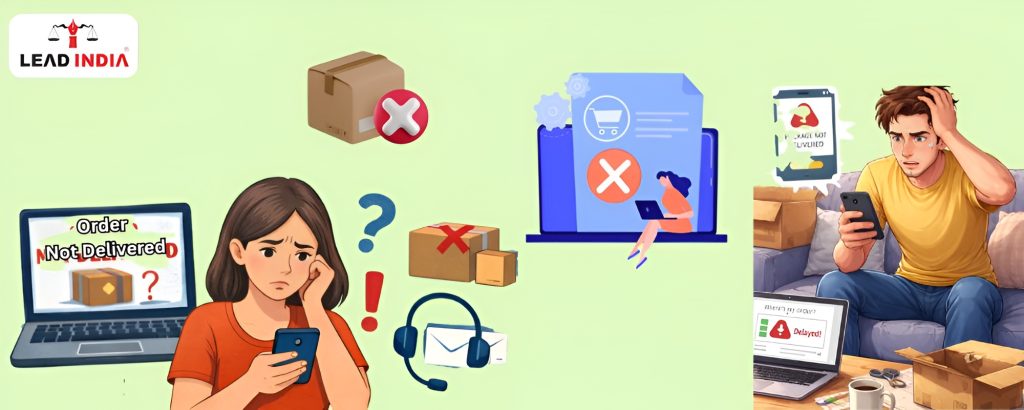
Whenever the business owners or the consumers first encounter the issues with all the non-delivered online orders, a common confusion comes to their mind: “What are my legal rights if an online order isn’t delivered, and what actions can I take?”
This confusion is very much in common, and most of the consumers seek help.
Understanding all your legal rights when the online order fails to deliver, and knowing all the major steps to take, will help you make the informed decisions and then avoid unnecessary costs.
What Non-Delivery of Online Orders Really Means
When you buy something online, you have agreed to buy that item from a company. The Indian government has laws that require those companies to give you the item you bought. If they don’t, they have violated their agreement and you can get back your money or be compensated.
Deficiency in Service
If the company doesn’t deliver your order to you when they were supposed to, that is also a violation of the law and you would be entitled to compensation for any trouble they caused you.
Unfair Trade Practice
If the seller takes your money and does not deliver the item or give you any replies to your requests or questions, that is an unlawful practice as well. This includes lying to you, saying they would deliver it, and then not doing so.
Because of these laws, you have a good case if you want to file a complaint against the company that has wronged you.
Your Legal Rights as Consumer
In India, Consumer Protection Act of 2019 offers many essential rights whenever an online order is not at all delivered:
a) Right to Prompt Delivery: All sellers/e-commerce have to honor the delivery timelines they give. Long delays without updates can be considered an infringement of service under the law.
b) Right to Refund: If the item was not delivered; you are entitled to a full refund of the purchase price as well as taxes and delivery charges.
c) Right to Damages/Loss/Harassment: You would also have a right to compensation for both financial loss and/or emotional distress caused by not receiving an item that you ordered.
d) Right to File Consumer Complaint: In case that your order has not yet been delivered, you are only entitled to file the complaint with:
- The National Consumer Disputes Redressal Commission
- The State Consumer Disputes Redressal Commission
- The District Consumer Disputes Redressal Commission
This can vary based on the value of the goods as well as the compensation sought.
e) Right to Send a Legal Notice: Before reaching the consumer forums, sending the legal notice or the letter to the seller or the e-commerce platform can assist you in supporting your own case. This will help to mostly demonstrate that you attempted resolution prior to taking legal action.
What to Do When Your Online Order Isn’t Delivered
Here’s the practical roadmap for all the consumers to follow if at all an online order isn’t delivered:
Step 1: Check Your Order Status
You need to review your order details and delivery partner tracking information because delivery partner updates will show you new tracking information which helps you understand why your order is delayed.
Step 2: Reach Out to the Seller or Website
You need to give the customer service team your order/trace information to assist you. Make sure to keep a record of any correspondence that you have regarding this issue.
Step 3: Request a Refund or Replacement
You will need to provide written confirmation that the product has been lost or not delivered then you may request a refund or replacement.
Step 4: Use the Grievance Redressal Mechanism
E-commerce Platforms are required under the Consumer Protection (E-Commerce Rules) 2020, to have a grievance redressal process in place. If the above steps do not work, then you can utilize this process.
Step 5: File a Complaint with the Consumer Court
You can start a complaint process against the business through the Consumer Disputes Redressal Commission after 30 days of waiting for a resolution.
Step 6: Legal Action and Compensation
For cases of significant loss or continued failure to deliver, you may be able to obtain compensation by using the consumer forum.
Notable Case Laws and Precedents in Non-Delivery Disputes
The Indian consumer courts have most consistently upheld the consumers’ rights in all the non-delivery cases. They are:
a) E-Scooter Not Delivered – Refund Ordered
In October 2025, a consumer court issued a refund of ₹1.31 lakh to a customer who had not received their e-scooter. The court said that not delivering an item was a breach of contract and that the customer had not received good service.
b) Mobile Phone Not Delivered – Refund + Compensation
In Ludhiana, a consumer court ordered the seller to refund the customer for the price of a mobile phone that the seller had not delivered. In addition, the court ordered the seller to pay ₹5,000 to the customer for the inconvenience they caused the customer.
c) Kitchen Rack Order – ₹30,000 Compensation
In January 2026, a consumer court awarded ₹30,000 to a customer for the failure to deliver their kitchen rack that cost Rs. 2,535 despite multiple attempts to contact the seller.
d) Marketplace Held Liable for Non-Delivery
Additionally, courts have consistently ruled that online platforms such as Amazon can be liable for a failure to deliver by third-party sellers, thus establishing that online platforms are responsible for their customers’ complete experience with them including delivery of products that were paid for.
Defenses Used by E-Commerce Platforms
Online platforms often assert that they are simply intermediaries and that issues related to delivery of goods are the fault of third-party sellers or the third-party sellers’ logistics companies. However, consumer organizations have consistently held that once an online platform collects money from the customer to pay for their purchases and processes the order on behalf of the third-party seller, the online platform assumes all responsibility for facilitating delivery of the purchased product.
Other Legal Remedies
Dispute with Payment Provider
If the seller will not provide a refund, you may dispute the charge with your bank or payment processor (credit/debit card), asking for a reversal of payment made to the seller.
Criminal Liability for Fraudulent Practices
Where a seller knowingly collects a payment but does not provide any goods, this act would be termed as cheating in law pursuant to the Bharatiya Nyaya Sanhita, 2023 (previously Indian Penal Code).
Conclusion
Whenever your online order does not get delivered, you have the strong legal protections as per Indian law. Your rights mostly include timely delivery, refunds, as well as compensation for any of the losses that are incurred. By following all the outlined steps as well as using all the available legal remedies, you can effectively enforce all your consumer rights.
Awareness of your rights as well as acting quickly makes sure that you won’t be left powerless in the case of a failed delivery.
One can talk to lawyer from Lead India for any kind of legal support. In India, free legal advice online can be obtained at Lead India. Along with receiving free legal advice online, one can also ask questions to the experts online free through Lead India.
FAQs
1. Is it totally legal for online order to not get delivered in India?
No, the failure to deliver the online order is considered as the breach of contract and the deficiency in service.
2. What should I do if at all my online order does not get delivered?
First of all, check the order status, contact your seller, and then request for the refund or replacement.
3. Is the legal notice necessary before the filing of a consumer complaint?
Sending the legal notice before the filing of a complaint can only strengthen your case.
4. Are e-commerce platforms responsible for non-delivery by the third-party sellers?
Yes, once the platform accepts the payment, it is fully responsible for making sure that the order gets delivered.


 Talk to a Lawyer