
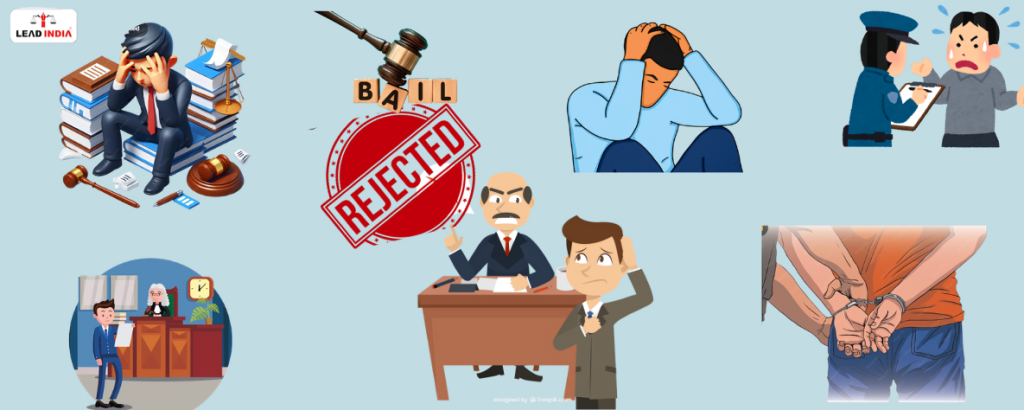
Whenever a person or their family hears that the court has rejected bail, the biggest fear that comes to their mind is:
- “Does this mean jail is final?”
- “Is there no legal remedy left now?”
This confusion is completely natural.
Understanding as to what the bail rejection actually means, what it does not mean, as well as what are all legal remedies that are available which can prevent panic, emotional decisions, as well as serious strategic mistakes.
What Bail Rejection Is and What It Is Not
One of the misunderstandings is that once the bail gets rejected, the accused must remain in jail until trial ends. That is fully incorrect.
The bail rejection simply means that at that very particular stage, based on material that is present before the court, the judge was not at all satisfied that release was appropriate.
It does not really mean:
- The accused is guilty
- Bail can never be granted
- Higher courts cannot interfere
- Constitutional remedies are exhausted
The Indian criminal jurisprudence is mostly based on the principle that one person is presumed innocent until he/she is proven guilty. As observed in the case of State of Rajasthan v. Balchand (1977), the Supreme Court stated:
- “Bail is the rule & jail is the exception.”
- Bail rejection is procedural. It is not a declaration of guilt.
What Bail Rejection Really Means in Practice
The bail rejection usually indicates that court was concerned about the factors such as:
- Seriousness or gravity of the offence
- Possibility of tampering with evidence
- Likelihood of influencing witnesses
- Risk of absconding
- Criminal history
However, these concerns are evaluated at a specific stage of investigation or trial. Once circumstances change, the legal position can also change.
For example:
- If the investigation is incomplete today, it may be complete after filing of the charge sheet.
- If custody is short today, prolonged incarceration later may shift judicial thinking.
- In other words, bail decisions evolve with facts.
Is Bail Rejection Final in India?
- The most critical issue to consider is whether the rejection of bail is a final order.
- The answer to this question from a legal perspective is that there is no definitive answer, as Indian law allows multiple remedies if bail has been denied.
- There are several ways to seek relief after being denied bail under Indian criminal procedure law, including:
- Fresh applications for bail, appeals to higher courts, statutory rights such as default bail, and possible constitutional remedies.
- In all cases, the courts of India have consistently held that the right to personal liberty under Article 21 is fundamental and cannot be denied without rational justification, even if time has passed since the time of the alleged offense.
- In Sanjay Chandra v CBI 2012, the Supreme Court stated that bail should not be denied as an intermediate punishment prior to a conviction.
Filing a Fresh Bail Application
If at all the bail is rejected, a new and fresh bail application can then be filed before the same court, but only if there is a substantial change in circumstances.
Common examples of change in circumstances include:
- Filing of the charge sheet
- Long period of custody
- Completion of recovery or investigation
- Examination of key witnesses
- Medical deterioration
In the case of Kalyan Chandra Sarkar v. Rajesh Ranjan (2004), the Supreme Court clarified that the repeated bail applications without the new grounds are not at all maintainable. The key is not the repetition; the key is change.
Approaching a Higher Court After Rejection
If at all the bail is rejected by one court, the law usually allows the accused to approach the higher court.
- If rejected by Magistrate → apply before Sessions Court
- If rejected by Sessions Court → approach High Court
- If rejected by High Court → file Special Leave Petition before Supreme Court
The power of higher courts flows from: Section 439 CrPC/Section 483 BNSS
In the case of Gurcharan Singh v. State (Delhi Administration) (1978), the Supreme Court clarified that the higher courts have wider discretionary powers in most of the bail matters.
It is important to disclose previous rejection orders honestly while approaching a higher forum.
Default Bail: A Powerful Statutory Right
One of the strongest remedies after bail rejection is default bail.
If the investigating agency fails to file a charge sheet within:
- 60 days (for the certain offences), or
- For 90 days (for the serious offences that are punishable with life or death), the accused gains the statutory right to be released on bail.
This right arises under Section 167(2) CrPC/ Section 187 BNSS
In the case of Rakesh Kumar Paul v. State of Assam (2017), the Supreme Court held that the default bail is a fundamental right flowing from Article 21.
However, this right needs to be exercised before the charge sheet gets filed.
Regular Bail After Rejection of Anticipatory Bail
Rejection of the anticipatory bail does not mean that the regular bail is impossible.
If anticipatory bail is fully rejected:
- The accused may surrender before the court
- Apply for regular bail under the appropriate provision
In the case of Gurbaksh Singh Sibbia v. State of Punjab (1980), the Supreme Court clarified that each of the bail applications needs to be decided on its own merits.
Rejections of one form of bail do not automatically bar the other.
Bail on Medical Grounds
If at all the bail was earlier rejected but the accused has developed serious medical complications, a new and fresh application can be filed.
Courts examine:
- Severity of illness
- Availability of treatment in jail
- Medical reports from authorized hospitals
Medical bail can be temporary or regular depending on the facts.
Bail Due to Delay in Trial
The right to a fair trial under Article 21 is violated when someone spends extended time in prison without any trial proceedings.
- The Supreme Court established in Hussainara Khatoon v. State of Bihar, 1979 that citizens possess a fundamental right to receive prompt judicial proceedings.
- The Court issued bail in Union of India v. K.A. Najiib 2021 because the alleged offense appeared to be a serious crime.
While the courts must balance the public’s liberty and the public’s safety, holding someone in prison indefinitely without having their trial is likely a constitutional violation.
Special Leave Petition Before Supreme Court
If at all the High Court rejects the bail, the accused can file the Special Leave Petition as per Article 136 of Constitution before the Supreme Court. The Supreme Court’s power is fully discretionary.
An SLP must generally demonstrate:
- Legal error
- Misapplication of law
- Violation of fundamental rights
It is not automatic relief, but it is an available remedy.
Interim Bail
Even if regular bail is denied, interim bail may be granted for limited purposes such as:
- Medical emergency
- Death in family
- Marriage of close relative
Interim bail is temporary and subject to strict compliance with court conditions.
Constitutional Remedies
In rare cases that involves the illegal detention or the violation of fundamental rights, a writ petition can be filed:
- Before the High Court under Article 226
- Before the Supreme Court under Article 32
This is an exceptional remedy and not routine.
What You Should Practically Do Right Now
If bail has been rejected:
- Do Not panic or assume the case is over
- Carefully read the rejection order
- Identify whether circumstances have changed
- Check custody period and charge sheet status
- Evaluate default bail eligibility
- Consider higher court strategy
Repeated applications without strategy often harm credibility.
Correct timing and proper legal drafting make a significant difference.
Legal Importance of Bail Jurisprudence
Bail law does not grant automatic release. It operates on judicial discretion.
However, courts treat liberty as a constitutional value. Bail decisions involve balancing:
- Personal liberty
- Seriousness of offence
- Societal interest
- Fairness of trial
Bail rejection is part of this balancing exercise, not a final verdict.
Bail Rejection and Constitutional Protection
- Article 21 protects life and personal liberty. The courts have repeatedly emphasized that incarceration before the conviction needs to be justified.
- While sensitivity toward victims is essential, liberty of the accused cannot be taken away merely on suspicion.
- Judicial reasoning in India consistently attempts to protect both victims and the innocent.
How We Help in Bail Matters
Strategic bail litigation requires timing, documentation, and proper presentation of changed circumstances. We assist clients in:
- Evaluating next legal steps after rejection
- Filing fresh or higher court bail applications
- Assessing default bail eligibility
- Drafting SLPs before Supreme Court
- Handling urgent interim bail matters
The objective is not at all to file the repeated applications, but it is to file the right application at the right stage.
One can talk to lawyer from Lead India for any kind of legal support. In India, free legal advice online can be obtained at Lead India. Along with receiving free legal advice online, one can also ask questions to the experts online free through Lead India.
FAQs
1. Is bail rejection final in India?
No. Fresh bail applications and higher court remedies are available.
2. Can bail be applied again after rejection?
Yes, if there is a substantial change in circumstances.
3. What happens if the Sessions Court rejects bail?
You may approach the High Court.
4. What is default bail?
It is a statutory right when a charge sheet is not filed within prescribed time.
5. Does rejection of anticipatory bail affect regular bail?
No. Each application is decided independently.


 Talk to a Lawyer