
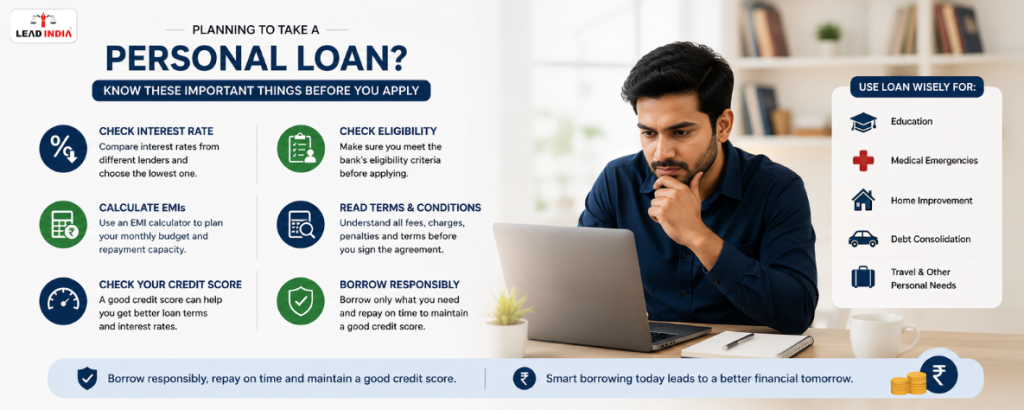
When people think about taking a personal loan for the first time, the biggest thought is: “It is just a simple loan, so why should I worry so much?” This is exactly where most of the borrowers make costly mistakes.
A personal loan appears to be one of the simplest financial products available within India. Banks & NBFCs promote very rapid approvals, very limited documentation, fast disbursal, and even sometimes apply for them (without any chance to present your qualifications at a physical location). To someone who is experiencing an immediate financial challenge, applying for a personal loan may seem to be a very simple approach to find relief.
Many people apply for personal loans because of their need for money due to some kind of tangible need i.e., medical treatment or hospital expense; expense for a wedding; expense for repairing a home; expense associated with an education; expense associated with travelling; consolidating debts from other sources; temporary cash flow shortages, etc.
Understanding the personal loans properly before applying can mainly save you from major financial as well as legal trouble.
What a Personal Loan Really Means
A personal loan can be an unsecured loan that you get from an institution, like a bank, that is able to lend you money for your own personal use.
Unsecured loans mean you typically don’t have to provide anything to the lender as security for the loan (such as real estate, jewellery, or a car).
Since your lender takes on a greater risk by lending you unsecured money, they will typically charge you a higher interest rate than they would for a secured loan (such as a mortgage or car loan).
Because many people believe that there are fewer consequences for non-payment of an unsecured loan, they will sometimes think otherwise.
You may not have any property securing your loan, but lenders will still have rights to recover amounts from you through legal or other avenues, including:
- Contractual remedies through a written agreement,
- Through arbitration if applicable to the loan agreement,
- Through civil recovery through the court system,
- Through negotiated settlements with your lender, and
- By reporting your payment history to credit bureaus.
In layman’s terms, even though you do not have any real or personal property that is used to secure the loan, a delinquency on an unsecured loan can subject you to various legal and financial consequences.
Why People Take Personal Loans
In the real world, many people get personal loans to pay for expenses that are needed immediately or cannot wait long before they are paid.
One of the most common reasons for using personal loans includes medical emergencies where immediate access to money would be required (for instance, when you have no insurance coverage or not enough).
Aside from medical emergencies, wedding expenses are second to medical emergencies as a major use of personal loans because many times families need immediate access to cash for this expense.
Many borrowers will use personal loans for assistance with education expenses, home renovations, emergency travel, consolidation of debt, or for temporary cash shortages of a small business.
If a borrower plans to use a personal loan to pay for their daily expenses, the purchase of a luxury item, to speculate on an investment or to replace money lost by gambling online, this could risk making a borrower’s financial situation worse.
Before any borrower applies for a personal loan, the first question to ask is: “Is it an absolute need for me (this expense), or am I just borrowing money because it is so easy?” This single question can prevent years of financial stress.
Who Can Apply for a Personal Loan in India
One common misconception is that personal loans are available to everyone automatically. In reality, lenders evaluate multiple eligibility factors before approval Most lenders consider:
- Age of applicant
- Monthly income
- Employment stability
- Credit score
- Repayment history
- Debt-to-income ratio
- City of residence
- Employer category
- Banking history
Employees with a regular salary are typically able to obtain approvals much more quickly than borrowers without a regular source of income due to their ability to provide proof of income each month.
In addition, both self-employed business owners and self-employed professionals can qualify for loans; however, documentation requirements are usually much greater (more complicated) for them.
Borrowers who have a proven history of paying on time (i.e., no previous defaults) and have good credit scores will normally have access to better interest rates and/or more favorable approval terms than someone who has previously defaulted on loans, paid late, or have multiple current loans.
Importance of Credit Score Before Applying
The one thing you should never overlook prior to applying for a loan is your credit score.
Lenders in India typically utilize reports generated by various credit bureaus, including CIBIL, Experian, CRIF High Mark, and Equifax, when making lending decisions.
Your credit score indicates to lenders how reliable you are at repaying your debts.
When you have a solid credit score, your chances of being approved for a loan increase, and you can negotiate a better interest rate on your loan. A weak score sends the opposite message.
Even if approval happens, the lender may treat you as high risk and charge significantly higher interest.
Many borrowers make the mistake of applying blindly without first checking their credit report. This can be harmful because repeated rejections themselves may negatively affect future applications.
Before applying, it is always practical to review your credit profile and identify inaccuracies, delayed payment entries, duplicate reporting, or outdated information.
Interest Rate Is Not the Only Cost
Many borrowers compare only the advertised interest rate. This is one of the most common financial mistakes. The actual cost of borrowing includes several other charges. Processing fees, documentation charges, GST, late payment penalties, cheque bounce charges, ECS return fees, prepayment penalties, foreclosure charges, insurance bundling, and administrative costs can significantly increase the effective borrowing cost.
For example, a loan that looks attractive at a lower interest rate may actually become more expensive if the lender deducts substantial upfront charges.
The better question is not: “What is the rate of interest?” The better question is: “What is my total repayment obligation?” This gives a more realistic financial picture.
Understanding EMI Before Borrowing
EMI simply means Equated Monthly Instalment. This is the fixed monthly amount you pay towards repayment. Many borrowers choose longer tenures because lower EMI looks comfortable initially.
However, lower EMI often means much higher total interest over time. On the other hand, shorter tenure reduces total interest burden but increases monthly financial pressure. There is not a universally perfect option.
The right tenure mostly depends on the income stability, emergency reserves, family obligations, as well as the realistic repayment capacity.
A practical borrower should ask: If my income is disrupted for 2–3 months, can I still manage this EMI? This question matters far more than aggressive marketing promises.
Read the Loan Agreement Properly
One of the biggest practical mistakes borrowers make is signing the agreement without reading it. Digital approvals have made this problem worse. People often click “accept” without understanding contractual obligations. This is legally risky.
Loan agreements usually contain clauses relating to:
- Interest calculation
- Default consequences
- Late payment penalties
- Arbitration provisions
- Prepayment restrictions
- Foreclosure conditions
- Lender rights
- Communication authorisations
- Collection procedures
Once accepted, these terms become contractually binding. Courts generally do not accept casual arguments such as “I did not read it.” This is why understanding the agreement is essential.
What Happens If You Miss EMI
Missing one EMI may appear minor, but repeated defaults can escalate quickly.
Some consequences a borrower might face right after being in default could be receiving late fees, incurring an additional penal interest amount, receiving recovery reminder notices, having information reported to credit bureaus, and receiving follow-up communications.
As recovery efforts are escalated, a lender might take formal notice actions, discuss potential settlement options, pursue enforcement under the contractual documents, or pursue legal action against the borrower.
The importance of understanding borrower’s rights in addition to lender rights are equally as important because lenders do not have unlimited power over borrowers who are experiencing financial difficulty.
Recovery must remain lawful. The borrowers facing the temporary hardship should communicate early rather than ignoring the calls completely. In many cases, structured negotiation helps avoid escalation.
Recovery Agents and Borrower Rights
This is an area where borrowers are often fearful and confused.
Yes, the lenders may pursue the lawful recovery.
No, they cannot mostly harass, intimidate, threaten, publicly humiliate, or also use any coercive tactics.
The Supreme Court of India strongly addressed the abusive recovery practices in the case of ICICI Bank Ltd. v. Prakash Kaur (2007).
The Court condemned forceful recovery behaviour and made it clear that financial institutions cannot act outside the legal framework.
Borrowers often assume that they are helpless once the default occurs. That is totally incorrect. Even if the dues are payable, the dignity and lawful procedure remain fully protected.
The threatening calls, abusive language, workplace humiliation, or the illegal intimidation may create all of the separate legal remedies.
Can a Bank File a Legal Case for Personal Loan Default?
Yes, legal action is possible. A personal loan is a contractual obligation.
If repayment fails and settlement efforts do not succeed, lenders may pursue lawful recovery through appropriate forums depending on the agreement and nature of dispute.
However, every default does not automatically lead to court action. Practical lenders often prefer negotiated recovery, restructuring, or settlement before prolonged litigation.
Borrowers should avoid panic when receiving legal notices. A notice is not an automatic conviction. It is a stage requiring proper response.
Can Personal Loan Be Settled?
This is one of the most searched practical questions. Yes, in some situations, negotiated settlement may be possible.
Settlement generally means the lender agrees to accept a negotiated amount instead of the full outstanding dues.
However, settlement is not a borrower’s automatic legal right. It depends on lender discretion, internal policies, financial circumstances, and negotiation factors.
Borrowers must also understand the consequences. Settlement may affect credit reporting.
So, while settlement can offer practical relief, it should be approached strategically.
Personal Loan Insurance Necessary or Not?
Many borrowers are offered insurance during loan processing. This may include coverage for death, disability, illness, or job loss. In many cases, such products are optional.
However, some borrowers end up accepting them without proper understanding because they assume approval depends on it:
- Always clarify whether insurance is mandatory
- Premium amount
- Exclusions
- Claim conditions
- Whether cheaper alternatives exist
- Unnecessary insurance increases borrowing cost.
Choose the Right Lender
Not every lender offering fast money deserves trust. Borrow only from the regulated institutions. The unauthorized lending platforms can mainly create serious legal and financial risks.
Red flags include:
- Unclear interest disclosures
- Hidden fee structures
- Aggressive approval promises
- Pressure tactics
- Suspicious digital permissions
- Unclear grievance mechanisms
- Always verify the legitimacy before borrowing
Important Legal Principles Borrowers Should Know
The lender-borrower relationship is only fundamentally contractual. This mostly means both sides are legally bound by the mutually accepted terms.
However, the courts have repeatedly emphasised on fairness, transparency, as well as the lawful conduct.
In Central Bank of India v. Ravindra (2002), the Supreme Court examined important principles relating to banking interest and transparency in recovery calculations.
Consumer protection law may also apply where unfair service practices exist.
The principle is very simple: The borrowers must honour the lawful repayment obligations, but the lenders must also act within the legal boundaries.
Practical Mistakes Borrowers Commonly Make
In real life, borrowers often create avoidable problems through poor decisions.
Common mistakes include taking larger loans than required, accepting offers without comparison, ignoring credit reports, skipping agreement review, borrowing for lifestyle spending, depending entirely on future uncertain income, and delaying communication after financial stress begins.
Most loan disputes begin not because borrowing itself was wrong, but because planning was weak.
Practical Borrower Advice
Before taking the personal loan, assess whether borrowing is genuinely necessary.
- Understand all of your real repayment capacity, not your optimistic assumptions.
- Read every major clause.
- Compare lenders.
- Check all charges.
- Avoid emotional borrowing.
- Do not ignore early warning signs if finances become unstable.
Financial discipline before borrowing is always cheaper than legal damage control later.
Final Thoughts
Responsible management of a personal loan can be beneficial, obtaining a personal loan can offer financial assistance in the short-term, and provide versatility due to the absence of collateral.
However, do not ever consider a personal loan as ‘free’ funds – a personal loan is a legally binding financial obligation and cannot be considered ‘low-risk’ because you may receive a quick response to your request for a personal loan.
Professional legal advice can aid you in understanding your rights and available options if you experience collection pressure from personal loans, collections and settlement issues, defaults in making your EMI payments, and legal notices or harassment by a personal loan lender.
One can talk to lawyer from Lead India for any kind of legal support. In India, free legal advice online can be obtained at Lead India. Along with receiving free legal advice online, one can also ask questions to the experts online free through Lead India.
FAQs
1. Is the personal loan legally safe in India?
Yes, the personal loans from the regulated banks and NBFCs are only lawful financial products, provided the borrowers understand the contractual obligations.
2. Can the bank send the recovery agents home?
Lawful recovery communication may only happen, but coercion, threats, harassment, or public humiliation are not at all legally acceptable.
3. What happens if at all I miss one of the EMI?
The late charges, credit reporting impact, as well as the lender follow-up may begin. The repeated defaults increase the escalation risk.
4. Can I settle all of my personal loan?
In some of the situations, the negotiated settlement may be possible, depending on the lender’s discretion and the circumstances.
5. Is personal loan insurance very much compulsory?
Usually not, unless it is contractually bundled under specific products.
6. Can lenders file legal cases?
Yes, the lenders may pursue the lawful contractual recovery remedies.


 Talk to a Lawyer