
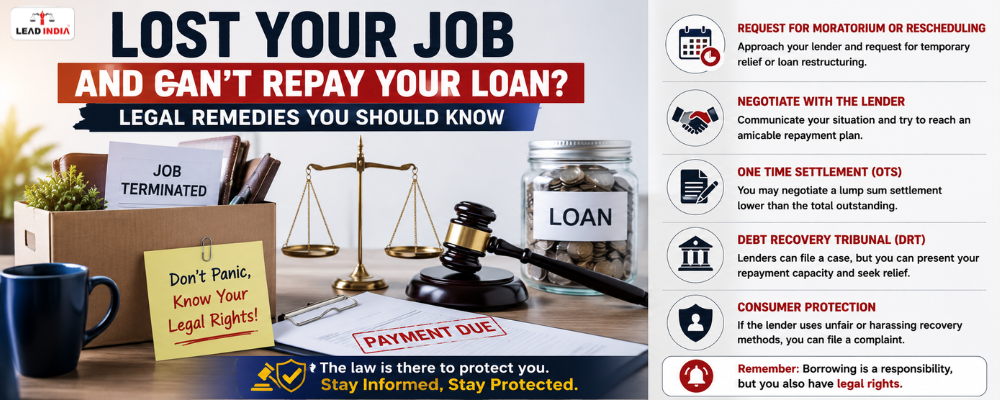
Losing a job can create the immediate financial pressure, when loan EMIs continue to fall due every month. For most of the borrowers, the biggest concern is: “What happens if I lose my job and cannot pay my loan?”
Understanding all of your rights at right time can help you avoid all the unnecessary harassment, protect all of your assets, as well as negotiate better solutions with the lenders.
Understanding Loan Default and Financial Hardship
When a borrower does not repay their loan on time- meaning that the borrower didn’t make any installment payments per the terms of their loan agreement- is known as a loan default. There is a major difference between someone who is unable to repay (due to financial problems) and someone who doesn’t repay but has the means to do so intentionally.
In many cases, courts have determined that there is a difference between someone who has lost their job, had an unanticipated health crisis, lost money in their business, had an unexpected expense or have become temporarily unable to make payments on the loan versus someone who deliberately did not intend to pay, had no intention of paying back, or committed fraud by not paying back on their loan.
Furthermore, being able to distinguish between these two types of borrowers adds significant impact on how lenders, courts and regulators evaluate disputes surrounding the collection of loans.
What You Should Do Immediately After Losing Your Job
Avoiding contact with a lender is one of the most common mistakes a borrower can make. A lot of the time people will not answer calls, and pay little attention to the notices from their lender, out of fear of being taken to collections. This is really not a good way to handle the situation.
The first thing to do is to contact your bank/financial institution as soon as possible to let them know that you are unemployed and what your current financial situation is. If possible, provide documentation such as a termination letter, letter of acceptance of resignation, layoff notice, or any other type of documentation that proves you lost your income.
Most lenders would much rather try to work out a repayment plan than drag out a long process to recover the debt from you. If you speak with the lender early on, it might open a chance to negotiate a restructuring of your repayment schedule, adjust your repayment terms, or discuss a potential settlement.
You should also keep a record of how you communicate. For instance, keep notes via e-mail and/or through letters. This will serve as evidence that you were acting in good faith and genuinely trying to settle things in a sensible way.
What Happens After Missing EMIs?
When someone has missed one EMI payment, many times the borrower goes into panic mode. It’s important to note that there is usually a multi-tiered process of recovering missed instalments.
To commence with, the lender will begin contacting the borrower via telephone calls, texts, emails, and through the mobile app reminding them of their overdue EMI. If the borrower still continues to be late on paying their EMI, the lender may add late fees and penalties on top of what is owed according to the loan agreement.
As time passes, if the payment still has not been received, the lender will move to formal notice requesting repayment. If an account has a past due greater than 90 days, the lender shall report the account as a non-performing asset (NPA) with the Reserve Bank of India.
Once an account has been classified as an NPA; however, the borrower will still have important rights and options to negotiate with the lender.
Can You Request Loan Restructuring?
Yes. Borrowers that experience difficulties related to cash flow may find relief through loan restructuring, which is one of the best forms of assistance available to them.
Loan restructuring involves modifying the repayment terms of the loan to allow additional flexibility for payment. Depending upon the circumstances, the lender will agree to one or more options for extending the term of the loan, decreasing the amount of each installment (EMI), deferring some or all payments temporarily or changing the payment schedule.
For instance, if a borrower is currently paying ₹30,000 monthly as an EMI, he/she should request that his/her lender increase the term of the loan so he/she has less monthly outflow.
Because taking care of a borrower’s obligations helps increase a lender’s ability to recover from defaulting on loan obligations, many lenders are willing to work with borrowers to come up with a solution for restructuring their loans.
Whenever borrowers submit a restructuring request, they should always do so in writing and keep copies of all communications with the lender.
Can You Be Arrested for Not Repaying a Loan?
Borrowers have a major misconception about whether they will be imprisoned for failing to pay back their loans. The answer is no.
Not paying back a loan due to real financial difficulty is usually a civil problem; it does not cause you to get arrested automatically. Most of the time, disputes over the collection of loans are resolved using civil processes, such as through contract remedies, civil litigation, or statutory means of collecting debt.
However, if at any time during the transaction there is an allegation of fraud, deception or any other type of deliberate misleading conduct (for example, forgery, false statements, deceptive intent) , then criminal liability could exist.
Just losing your job and being unable to pay your EMIs doesn’t by itself count as a criminal offense.
So, borrowers should stay composed and handle the situation through legitimate methods.
Recovery Agents and Your Legal Rights
When lenders initiate communication, many borrowers experience a great deal of apprehension, especially when it is their first encounter with these lending organizations. In some cases, lenders have used aggressive methods that have caused a great deal of media attention and public concern.
There are guidelines provided by The Reserve Bank of India regarding acceptable practices related to debt collection. Recovery agents may not make threats against borrowers, use foul or abusive language toward them, use intimidation tactics with family members of the borrower, publicly humiliate individuals who have an outstanding balance on their account or utilize physical force when attempting to recover a loan.
Each individual who has outstanding balance on their account is mainly entitled to be treated with the dignity and have reasonable amount of the privacy regardless of amount owed.
Secured Loans and Unsecured Loans
Now, the lender’s rights in this whole situation really depend on whether the loan is secured or unsecured in relation to the collateral / asset involved. A secured loan is basically backed by some collateral, like a house, car, property, or another form of asset.
For example, home loans, auto loans, and loans against property are normally treated as secured loans. An unsecured loan, on the other hand, does not have a specific asset tied to it as security.
Personal loans, credit card balances, and most typical consumer loans fall into this unsecured category. Even if the lender wants to move against the collateral because of default under a secured loan, the lender still has to stick to the legal procedure set out by the applicable government legislation.
Lenders will use recovery notices, negotiate a settlement with consumers, request arbitration, or pursue legal recovery of an unsecured loan.
By understanding this difference, borrowers will be able to better understand their legal exposure of different types of loans.
Rights Under the SARFAESI Act
The SARFAESI Act, signed into law in 2002, gives financial institutions a fairly unique kind of power to recover unpaid debts from borrowers. A lot of borrowers get nervous when they receive notices linked to the SARFAESI Act, but still, along with that authority, borrowers are also given several protections.
Before a lender actually takes possession of any collateral, the lender will generally have to send a demand notice, as required under Section 13(2) of the Act. After that notice, the borrower can respond, meaning they may raise objections, ask for more clarification, try to resolve things through a settlement discussion, and also challenge any action they believe is unlawful on the lender’s part. Then the lender is expected to consider the overall relevant material the borrower shares, and only after that assessment can the lender continue with further recovery steps.
So, if you get a SARFAESI demand, it does not automatically mean your only path is a full-blown lawsuit. In fact, there may be other remedies you can pursue within the relevant jurisdiction.
Right to Approach the Debt Recovery Tribunal
If at all a borrower believes that bank has violated the legal procedures or acted very unfairly, the borrower may approach Debt Recovery Tribunal (DRT).
The Tribunal mainly examines whether lender has followed the statutory requirements and whether recovery action complies with the applicable laws.
Mardia Chemicals Ltd. v. Union of India (2004)
In its most recent ruling, the Supreme Court confirmed that the SARFAESI Act is deemed constitutional while also affirming that there must be a means for borrowers to seek legal recourse when they are subjected to unreasonable debt collection processes.
This ruling further reaffirms that all debts must be collected according to the law and in an appropriate manner regardless of whether one is a borrower.
Can You Negotiate a One-Time Settlement?
Yes. A one-time settlement (OTS) can be useful for any borrower unable to make regular payments toward their debt.
A borrower and lender will work together to come up with an amount that is mutually acceptable to both parties for the full and final resolution of the loan account using a one-time settlement approach. Depending on the situation, the lender may even agree to forgive part of the interest, penalties and/or any other associated fees.
Banks will frequently consider OTS or settlement options for borrowers who are experiencing a hardship or have no additional ability to repay their debt.
The terms of any settlement should be confirmed in writing, and borrowers should be provided with written confirmation of having paid the agreed upon amount from the lender as part of the settlement process (i.e., no due certificate).
What Happens to Your Credit Score?
When you fall behind on your loans, your credit history, and your chance to borrow later, will get hurt. Credit Reporting Agencies record how you repay loans, so if you do not pay back a loan it could impact your ability to get loans, credit cards, or other forms of credit in the future.
In some industries, potential employers may also check your credit report when they are deciding whether to hire you.
There is hope though; even if you are currently damaging your credit, you can recover it by paying off debts, practicing good payment habits, periodically checking your credit reports and fixing any errors there.
You should also obtain a No Due Certificate after paying off a loan or closing out an account with another lender so the record remains accurate.
Consumer Protection Remedies Against Banks
Banks and other financial institutions do not have total control over all borrowers.
The Consumer Protection Act 2019 gives borrowers the right to take legal action through Consumer Commissions if they have suffered any service deficiency, improper charging, harassment, unfair trade practices, or improper conduct from lenders.
Once the borrower can prove to the Consumer Forum that they were either mentally put through hardship, suffered economic loss, or have had any other kinds of actionable complaint, the forum will award them compensation.
The remedies available under Consumer Law also act as additional protection against arbitrary lender behaviour.
Extraordinary Circumstances and Borrower Relief
Indian regulators and courts have occasionally introduced relief measures during exceptional situations.
The COVID-19 pandemic is the most prominent examples. During this particular period, the various relief measures including the moratoriums, restructuring frameworks, as well as the temporary protections were introduced to assist the borrowers facing the widespread financial difficulties.
Gajendra Sharma v. Union of India (2020)
The situation demonstrated how difficult it was for people to obtain loans during this period, with regard to this concept being applied to all borrowers experiencing temporary financial hardship due to their inability to repay their loans through the use of equitable and compassionate means whenever practical.
This case reiterated the need for balance between the stability of a borrower’s financial position and protection afforded to a borrower.
Practical Steps Every Borrower Should Take
If you have lost your job, and can’t keep up with your loan payments, instead of panicking, start to look for practical solutions.
Contact your lenders as soon as possible, make sure that you keep a record of all communications and requests. Investigate restructuring options before defaulting occurs at a serious level. If it is no longer possible for you to make your repayments, consider settlement negotiations. You should not think about borrowing from informal “money lenders” who charge high interest rates for emergency loans. When you start receiving recovery notices, are facing SARFAESI proceedings, or you feel pressured or harassed by a recovery agent, you should seek professional legal advice asap, sooner rather than later.
Taking action at the earliest possible time often prevents the matter from growing into a bigger dispute, with more noise, and more problems.
How a Lawyer Can Help in Loan Default Cases
In general, borrowers generally wait until they receive a legal notice or are subject to some form of collections action before they will approach an attorney’s assistance. However, getting help from an attorney sooner can end up being less expensive, and more effective, at least most of the time. An attorney can help you look over your loan documents and agreements, answer questions about your legal rights and responsibilities, assist with trying to settle with your lenders; challenge illegal recovery actions; file complaints related to abusive or harassing creditors; represent you in front of litigation forums, and help you insist on your legal rights during the whole collections process.
Getting professional legal guidance often stops costly mistakes, and it also helps make sure lenders are following the laws that apply to you.
Conclusion
Experiencing job loss and having trouble repaying debts can be a highly stressful time in anyone’s life. Even when borrowers find themselves facing financial difficulty, they do not lose their rights under the law in India. The law in India continues to distinguish between a genuine inability to repay and wilful default. In addition, there are several protections available to borrowers against illegal collection activities.
There are a number of different ways in which borrowers can obtain resolution to their problems, through restructuring, settlements, consumer remedies, defending against actions taken under the SARFAESI Act, or obtaining legal representation before the tribunal. The most important factor is to take action as soon as issues arise and communicate with the lender, and to retain documentation of the communications and records of the transaction as they occur, as well as to obtain legal assistance whenever appropriate.
As opposed to ignoring the problem or reacting out of fear, borrowers should work towards lawful options that preserve their financial interests while working toward a return to a state of stability. A temporary financial setback should not become a permanent legal problem when there is a clear path available to retrieve their rights.
One can talk to lawyer from Lead India for any kind of legal support. In India, free legal advice online can be obtained at Lead India. Along with receiving free legal advice online, one can also ask questions to the experts online free through Lead India.
FAQs
1. What happens if at all I lose my job and then cannot pay my loan?
You may request restructuring, settlement, or other relief measures from the lender depending on your financial circumstances.
2. Can bank take the legal action if I stop paying the EMIs?
Yes, the banks can initiate the recovery proceedings, but they need to follow the procedure established by the law.
3. Can I get arrested for not repaying the loan?
No, the mere inability to repay loan is generally civil matter unless the fraud or cheating gets involved.
4. Can I request the loan restructuring after the unemployment?
Yes, most of the lenders provide the restructuring options for the borrowers facing any genuine financial hardship.
5. What is One-Time Settlement (OTS)?
It is mostly negotiated settlement where lender agrees to close loan account for the mutually agreed amount.


 Talk to a Lawyer