
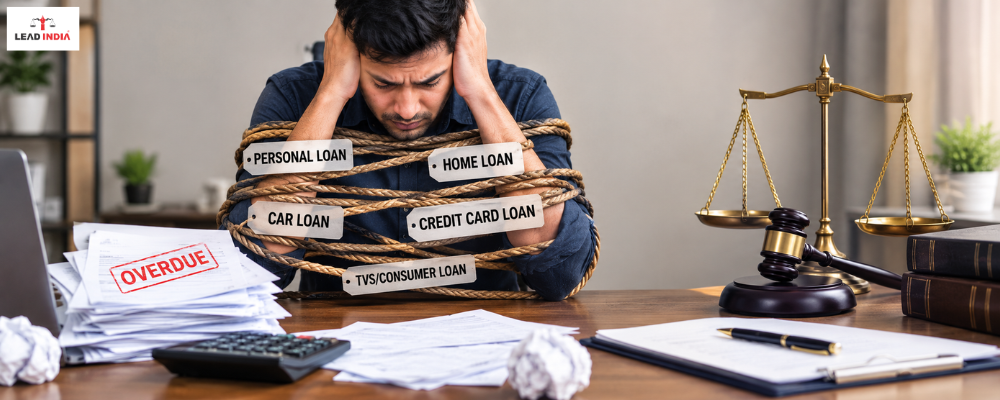
Financial difficulties can happen to any person. Most of the borrowers who miss the few EMIs find themselves taking the fresh loans to repay the existing debts. Slowly, one loan becomes two, two become four, as well as before long, the borrower feels that he/she is trapped in the debt cycle with no clear way out.
The biggest fear is:
- “Can I go to jail if I cannot repay my loans?”
- “Can recovery agents harass my family members?”
- “Can the bank seize all my assets immediately?”
- “Is there any legal solution if I have defaulted on multiple loans?”
Understanding all of these can help you make any informed decisions and avoid any unnecessary panic.
Understanding What a Loan Default Really Means
A borrower breaches his/her obligation to the loan associated with a bad loan by failing to make payments on his/her installments or outstanding amounts in accordance with the loan document. Missing a single loan payment does not give you a criminal record nor immediately lead to legal proceedings. However, after a borrower has defaulted repeatedly on a particular loan, that particular lender may initiate recovery actions against the borrower in order to collect what it is owed. A borrower’s financial conditions may also deteriorate as a result of the borrower’s repeated default.
All too often, the circumstances out of a borrower’s control led to them defaulting on their loans. Job loss due to termination or layoffs, disabling health issues, business failure, or losing significant income are all very common reasons for a borrower defaulting. Most borrowers continue to use loans taken from other lenders to make their regular monthly payments (EMIs) or pay off older loans; this leads to a continued cycle of borrowing which typically results in unmanageable amounts of debt.
When multiple creditors begin calling the borrower for payment during the same time frame, this can lead to collection calls, new legal notices, etc., and can create a feeling of helplessness and confusion as to what to do next.
Can You Be Arrested for Loan Default in India?
Many people believe they will go to jail for not paying back a loan.
The law is specific about this type of situation. Defaulting on a loan is usually a civil issue, not a criminal one. A borrower will not normally go to jail simply because they cannot afford to pay back a loan.
However, there are instances where there could be possible fraud, cheating, forgery, intentional misrepresentation or criminal breach of trust which may involve criminal proceedings.
Dishonouring a cheque could also lead to criminal charges under The Negotiable Instruments Act.
Court cases involving loans have repeatedly drawn a distinction between a legitimate financial hardship versus a fraudulent conduct. There is, therefore, a difference in how courts treat persons who are unable to pay for legitimate reasons compared to those who have engaged in fraudulent conduct with lenders.
Consequently, persons facing temporary financial stress should concentrate on finding a legal solution rather than responding to fear.
What Happens If You Default on Multiple Loans?
When borrowers default on multiple loans, their finances can suffer greatly. However, knowing how things happen can help the borrower know how to respond.
The most immediate effect of a loan default is likely to be a bad credit report. When a financial institution receives a loan payment from the borrower, that financial institution reports the payment to the reporting agency. If that borrower defaults on his or her loan, the financial institution’s information will show up on the reporting agency’s records, making it very difficult for the borrower to borrow money again, get credit cards, or get any other loans or financial assistance.
The lender may then send a demand letter to the borrower demanding the outstanding debt. If the borrower does not pay the debt, the lender will file an action to collect the outstanding balance according to the law.
When a loan is secured by collateral, such as a house or a car, the lender may take measures to enforce its security interest. Depending on the loan and/or collateral, the lender may file a recovery action under the SARFAESI Act, in the Debt Recovery Tribunal, or through civil court actions.
In each of these recovery actions, a lender must follow the law. Recovery actions cannot be initiated outside the legal framework established by statute. Banks and recovery agents cannot act contrary to the law or use other means to act contrary to the law.
Your Legal Rights as a Borrower
A lot of people who have lost their jobs or otherwise defaulted on loans don’t realize that there are many legal protections in place for them even after they have defaulted.
The Reserve Bank of India has put out a set of guidelines which outline how banks and collectors should behave when they are trying to recover money from individuals who have defaulted on loans.
When trying to recover money from borrowers, banks and collection agencies are required to treat borrowers professionally and with dignity.
There are strict guidelines in place governing how collection agents can interact with borrowers. Collection agents are prohibited from using threats, intimidation, obscene or offensive language, or humiliating people in public as a way of trying to collect money.
Collection agents are also prevented from harassing borrowers or publicly humiliating them in front of family or friends.
Conversely, borrowers have the right to privacy. Banks and collection agents are prohibited from disclosing private information about borrowers illegally, from contacting family members of the borrower unnecessarily, from distributing photographs of borrowers, and from publicly humiliating borrowers because they have outstanding debts.
Before any substantial recovery action is taken by the bank, all borrowers have the right to receive proper notice. The bank must follow the due process of law when taking possession of assets, when selling the asset at an auction, or taking legal action.
In the event that a collection agent violates the RBI regulations governing collections, borrowers may file a complaint with the bank, submit a complaint to the RBI Integrated Ombudsman Scheme, file a complaint with a civil court, or may contact law enforcement authorities, as appropriate.
How to Legally Handle Multiple Loan Defaults
The biggest mistake that borrowers make is ignoring their lender’s calls, letters, and other forms of communication from them. By not communicating with the lender; you rarely resolve the issue and will only make things worse over time.
Loan restructuring is one of the best ways to legally resolve your loan issues. Many banks provide borrowers with options to restructure their loans, enabling borrowers to change the payment schedule (when they have to pay), reduce the payment amount, extend the period to pay back the loan, or obtain temporary payment relief when they are experiencing financial hardship.
Debt consolidation is another solution for managing your debts. Instead of having multiple loans that have different terms, borrowers can combine all of their debts into a single repayment plan, which generally will help to ease some financial strain and simplify the management of repaying their debt.
If loan payment becomes impossible, a borrower might consider using a one time settlement. In a one-time settlement, the borrower and the lender will negotiate an amount that will be accepted to close the account. Even though this may affect the borrower’s credit report; a one-time settlement can provide repayment relief to borrowers in trouble.
Oftentimes negotiating a settlement offer is more successful than taking legal action. Most lenders would rather settle with you or work out a repayment plan than engage in a long dispute about a loan.
What Is a One-Time Settlement and When Should You Consider It?
The One-Time Settlement (OTS) is the negotiated arrangement where lender agrees to accept the reduced amount as the full and final settlement of outstanding debt.
This option is considered when the borrowers face any long-term financial difficulties and are unable to continue the regular repayments.
Before accepting settlement offer, the borrowers should ensure that terms are documented in writing. They need to also verify that lender agrees to issue the appropriate closure documents and also update the relevant credit records after the completion of payment.
Properly documented settlement can help the borrowers resolve the financial disputes and then move toward the financial recovery without any prolonged litigation.
Understanding SARFAESI and Borrower Protection
Most people get nervous when they see a letter from their bank or lender that relates to the SARFAESI Act, but it does not necessarily mean that they have lost all of their rights.
The SARFAESI Act allows banks and other financial institutions to recover lost money through the use of secured loans without needing to go through the court system first. However, just because a bank is using the SARFAESI Act to collect money from you, does not mean you don’t still have significant legal rights (and protections) during the entire process.
For instance, banks must send a demand notice to the borrower at least before they take possession of the secured asset. This gives the borrower an opportunity to object to what the bank is trying to do and present evidence supporting his/her objection. If there is an issue related to the debt recovery proceedings, the borrower has the right to file a petition with the Debt Recovery Tribunal to seek the appropriate relief.
The Supreme Court of India has already made it clear that while banks have recovery rights They must still provide procedural fairness to the borrower, along with receiving appropriate legal protections for the borrower.
Digital Loan Apps and Illegal Recovery Practices
Digital loan platforms have grown quickly, which has caused challenges for many borrowers. Today, a high number of borrower complaints relate to unregulated loan applications that use illegal recovery procedures.
Many borrowers have reported that they are charged excessive interest, their private data has been used without authorization, they have been threatened, their photos have been modified and shared, and even their families have been harassed.
Borrowers should ensure that if they plan on borrowing from a digital platform. The lender is regulated by the Reserve Bank of India. The lender operates through an authorized and regulated entity.
Borrowers who are subjected to illegal recovery practices should report the same at their local Cyber Crime Police, their local Police Station, to a local Consumer Forum, and the RBI complaint process, depending on the facts of their case.
No borrower should endure the unlawful harassment of themselves or their family members simply because their loan was unpaid.
What If Recovery Agents Are Harassing You?
If at all the recovery agents are using threats, intimidation, abusive language, or any unlawful methods, the borrowers should immediately start preserving the evidence.
Call recordings, text messages, WhatsApp communications, CCTV footage, emails, as well as the witness statements can become fully valuable evidence if at all the legal action becomes necessary.
The courts in India have repeatedly condemned the coercive recovery methods. In the landmark case of ICICI Bank Ltd. v. Prakash Kaur, the Supreme Court strongly criticized use of the musclemen and the unlawful recovery tactics by the financial institutions.
The judgment reaffirmed that the recovery must take place through all of the lawful means and with the respect for dignity of borrowers.
Practical Financial Steps to Break Free from the Debt Cycle
In many cases, just relying on the legal system will not help solve all debt problems but rather will require financial discipline as well.
It is essential that borrowers write down a practical budget, including their necessary expenses and prioritize their highest-interest debts whenever it is possible to do so. Taking out a new loan to pay off an old loan usually makes the borrower worse off because of the compounded amount of total debt.
Establishing even a small emergency fund can decrease the reliance on subsequent borrowing. Another way for borrowers to evaluate and create a realistic repayment plan, is to consult with financial advisors and lawyers to provide assistance for forming a repayment strategy that meets their needs.
Lastly, borrowers should act as soon as possible to avoid making financial difficulties worse; the sooner they begin working towards getting back on track financially, the greater the number of solutions available to them.
When Should You Consult a Lawyer?
The professional legal assistance needs to be considered if at all you have received the legal notices, SARFAESI notices, DRT proceedings, recovery litigation, or if are facing the unlawful harassment by recovery agents.
The legal advice is also beneficial whenever you are negotiating settlements, reviewing the loan documents, challenging the illegal charges, or responding to the recovery proceedings.
The early legal intervention often helps the borrowers avoid the costly mistakes and then protect their rights effectively.
Conclusion
Struggling with being perpetually bound by debt can sometimes feel like a troubling prospect; nevertheless, defaulting on a loan could lead you to experience much worse than simply a negative financial position. In India, there are many different avenues available for individuals borrowing money to consider in order to deal with their current situation (as well as for lenders to seek recovery from borrowers) through legally sanctioned methods.
While experiencing problems with your finances may be a temporary situation, decisions regarding how you choose to respond to this issue will potentially impact you for many years into the future. With the help of experienced legal counsel and making wise, responsible decisions in dealing with their financial troubles, borrowers may choose to break free from the cycle of debt and return to a secure financial position with confidence.
One can talk to lawyer from Lead India for any kind of legal support. In India, free legal advice online can be obtained at Lead India. Along with receiving free legal advice online, one can also ask questions to the experts online free through Lead India.
FAQs
1. Can I go to the jail for not at all paying the loan in India?
Generally, it is no. The loan default is usually civil matter unless any fraud, cheating, or any other criminal conduct that is involved.
2. Can the recovery agents contact my family members?
They cannot harass or unnecessarily contact family members for recovery purposes.
3. What is a One-Time Settlement?
It is a negotiated arrangement where the lender accepts a mutually agreed amount to close the outstanding loan account.
4. Can banks seize my property immediately after default?
No. Banks must follow legal procedures and provide statutory notices before taking recovery actions in secured loan cases.
5. Can I file a complaint against recovery agent harassment?
Yes. Complaints may be filed before the bank, RBI grievance mechanisms, consumer authorities, police authorities, or courts depending on the circumstances.


 Talk to a Lawyer