
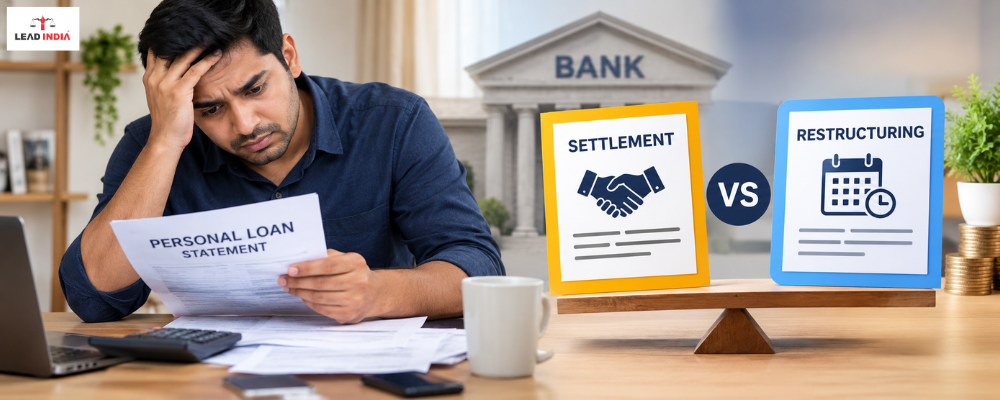
When the borrowers face any difficulty paying their personal loan EMIs, then the first question that comes to mind is: “Should I opt for the loan settlement, or is restructuring a better option?”
This confusion is very much natural. Most of the borrowers come to us after:
- Banks or the NBFCs start sending the repeated recovery notices, or
- Accounts are reported to the credit bureaus, or
- They receive aggressive calls from the recovery agents without understanding their legal rights.
Understanding all of the differences between the loan settlement and loan restructuring, the legal implications, the RBI guidelines, as well as how each affects your credit can save you from making any costly mistakes.
What Loan Restructuring and Settlement Really Mean
The unsecured loans are not backed by any collateral and it may carry a higher interest rate due to the bank’s potential exposure from losing all its money if you fail to repay. As such, the banks will typically exercise greater scrutiny in determining whether they will make the unsecured personal loan to an individual or not.
Restructuring an unsecured loan changes the repayment schedule for the entire debt without actually reducing either the outstanding balance or the total cost of the loan to the individual. In a typical restructuring, banks will increase the amount of time for which the borrower will be responsible for making payments, temporarily decrease the amount of each monthly payment, reduce the interest rate charged on the loan, or create a new term loan for the amount of all past due payments.
Unlike a restructure, a loan settlement means that a lender will accept less than the full amount owed on a loan as payment in full and final settlement of that loan. A settlement will generally occur when the borrower cannot make future payments and the lender believes there is no chance for the lender to collect any additional payments from the borrower, or if the loan has already become a non-performing asset. For example, if you have a loan for ₹5 lakh, the bank may settle that loan for ₹3 lakh.
It is very much critical for you to obtain proper documentation if at all you are successful in resolving all your loan through the settlement or by restructuring your loan. Without proper documentation, you may experience future litigation. Proper documents include written settlement or restructuring agreements, “no dues” certificates, and confirmation of the closure of accounts.
Why Borrowers Face Financial Stress
Defaulting on the personal loan can happen for various reasons:
- Job loss or the salary cuts
- Business downturns or any unexpected expenses
- Medical emergencies or the hospitalization
- Family issues, divorce, or the financial disputes
- Multiple overlapping loans
- The economic recession or the inflation
As per the RBI guidelines, the account will be classified as the NPA if at all the principal and interest amount have gone unpaid for more than 90 days. At this exact point in time, the lender may begin by charging the penal rates of interests or conduct the legal/arbitration proceedings against you, then engage collection agents (within the limits stated as per law), report default to either CIBIL, Equifax, or the Experian, and then initiate a civil lawsuit to recover balance due.
By understanding the difference between the settlement and restructuring, it is possible to intercede before the settlement escalates and before damaging all your credit rating.
How Loan Restructuring Works
The lender looks at the borrower’s income, ability to repay, and loan payment history, among other things, when deciding whether or not to give the borrower a restructured payment plan. Here are some common means of doing this:
Extending Loan Term: This extends the time period in order to reduce the amount of monthly payments made (EMI).
Temporary Moratorium on Repayment of EMI: A temporary halt in payments to aid the borrower in their financial difficulties.
Lowering of Interest Rates: Reduces monthly payments.
Conversion of Unpaid EMI into Funded Term Loan: Changes previously unpaid EMIs into a loan of principal and interest that must be repaid.
Flexible EMI: Step Up or Down EMIs which correspond to cash flow will be established.
Advantages:
- Protects credit score better than settlement
- Avoids aggressive legal recovery
- Retains banking relationship
- Reduces financial stress
- Prevents harassment by recovery agents
Disadvantages:
- Total interest paid may increase due to longer tenure
- Approval is not guaranteed
- Temporary impact on credit reports (“restructured” status)
- Not all lenders provide restructuring options
How Loan Settlement Works
A loan settlement allows the borrower to pay the less than the total dues, as well as the bank writes off the remaining. The settlement usually occurs when:
- The borrower cannot repay fully
- Recovery prospects are low
- The account has become an NPA
Process:
- Borrower defaults on EMIs
- Bank sends recovery notices
- Negotiation of settlement amount
- Written settlement agreement
- Lump-sum or negotiated payment
- Account closure
Key Consideration: A settled loan is marked as “Settled” on credit reports, not “Closed,” which can severely affect future borrowing.
Advantages:
- Immediate relief from debt
- Stops legal recovery proceedings if documented
- Reduces overall financial burden
- Avoids long litigation
Disadvantages:
- Major credit score impact
- Difficulty in the securing of future loans
- Potential tax liability (as per Section 56(2)(x) of the IT Act, 1961)
- Risk if settlement agreement is unclear or incomplete
RBI Guidelines and Legal Protections
The Reserve Bank of India (RBI) provides the frameworks for the stressed asset resolution. Key principles:
- Genuine assessment of financial stress
- Board-approved restructuring policies
- Transparent communication with borrowers
- Proper reporting to credit bureaus
The courts have also clarified that the banks cannot coerce the borrowers into the settlements or restructuring. The recovery has to follow all of the legal procedures, as well as the borrowers are protected against harassment or the intimidation by the recovery agents.
Important Case References:
- ICICI Bank Ltd. v. Shanti Devi Sharma (2008): lawful recovery practices only
- Manager, ICICI Bank Ltd. v. Prakash Kaur (2007): the illegal intimidation prohibited
- Central Bank of India v. Ravindra (2002): the arbitrary interest calculations invalid
- KSL & Industries Ltd. v. Arihant Threads Ltd. (2015): it negotiated the settlements are binding
- State Bank of India v. V. Ramakrishnan (2018): the insolvency as well as the creditor protections is reaffirmed
Impact on Credit Score
- Restructuring: It is of moderate impact, indicates the repayment intent.
- Settlement: It is of high impact, it remains on the credit report for up to 7 years.
- Tip: You need to always verify the CIBIL, Experian, or the Equifax reporting after the settlement or the restructuring.
Choosing Between Restructuring and Settlement
Opt for Restructuring If:
- You can still repay partially
- Financial problems are temporary
- You want to preserve your credit score
- You plan to take loans in future
- Long-term financial stability matters
Opt for Settlement If:
- Repayment is impossible
- Account is already heavily defaulted
- Litigation risk is high
- Immediate closure is required
Precautions Before Choosing
For Settlement:
- Obtain written agreement
- Verify final settlement amount
- Request no-dues certificate
- Confirm credit bureau reporting
- Deal only with authorized bank officials
For Restructuring:
- Assess future income stability
- Understand revised interest and tenure terms
- Compare EMIs for affordability
- Keep the copies of all the approvals and agreements
Can Banks Force Settlement or Restructuring?
No. Both are voluntary. Mainly the borrowers cannot compel the banks to restructure or to settle, and the banks cannot enforce the settlements without the mutual consent.
Alternatives to Settlement or Restructuring
When considering all options, you will find that debt consolidation loans, balance transfer options, access to financial counselling, EMI reduction negotiations with your lenders, family support/assistance with repayment of loans, and temporary income arrangements are available. You may also have greater success by talking to your lender earlier rather than later.
Tax Implications
- The loans written off by your lender may get classified as the taxable income pursuant to the Section 56(2)(x) of the Income Tax Act of 1961.
- You should seek the advice from an experienced tax professional.
Practical Tips for Borrowers
- Communicate early with the lenders
- Avoid multiple defaults
- Maintain records of notices and agreements
- Verify the legitimacy of the recovery agents
- Seek for the professional legal or the financial advice
What You Should Do Right Now
- You do not need to panic or sign the agreements blindly
- Verify recovery notices and lender communications
- Choose restructuring if temporary relief is needed
- Opt for settlement only if repayment is impossible
- Keep all agreements in writing and request a no-dues certificate
One can talk to lawyer from Lead India for any kind of legal support. In India, free legal advice online can be obtained at Lead India. Along with receiving free legal advice online, one can also ask questions to the experts online free through Lead India.
FAQs
Q1: Can the banks refuse for the loan restructuring?
Yes, the subject of the lender’s evaluation and the RBI guidelines.
Q2: How long does the settlement remark stay on the credit reports?
Usually it is 7 years, depending on the bureau.
Q3: Can the borrowers force the settlement?
No. The settlements require mutual consent.
Q4: Does the restructuring affect the future loans?
Slightly, but less than the settlement; it shows the repayment intent.
Q5: Are the waived loans taxable?
Partially, as per the Section 56(2)(x) of the Income Tax Act.


 Talk to a Lawyer