
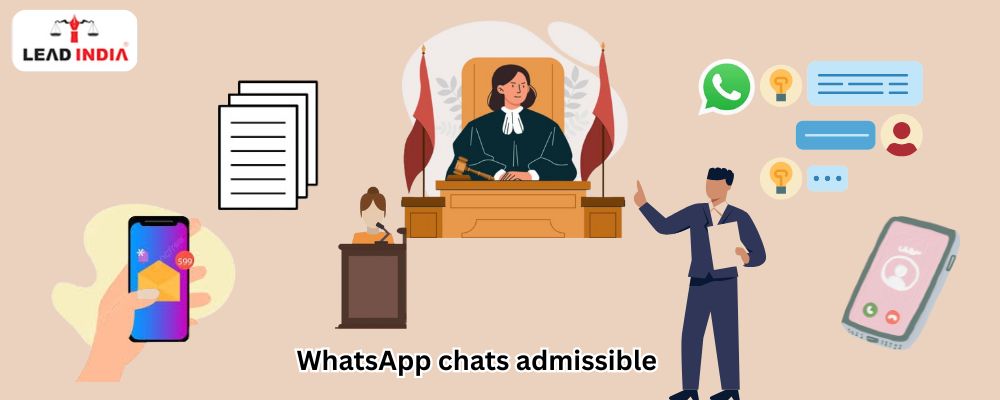
The rise of communication through WhatsApp has been seen in modern times. As more and more people use smartphones, increased internet usage ensures that WhatsApp Chats contain essential information concerning business transactions, personal disputes, or even any kind of criminal conspiracies. Therefore, the question is: Are WhatsApp chats admissible as evidence before the Indian courts?
The Indian legal system under the Indian Evidence Act, 1872/Bhartiya Sakshya Adhiniyam, 2023, and the Information Technology Act, 2000, provides the legal base under which the electronic records, including WhatsApp messages, become admissible in the Court of Law. However, the authenticity and the content have to be considered reliable in deciding an evidentiary value of such chats.
Need A Legal Advice
The internet is not a lawyer and neither are you. Talk to a real lawyer about your legal issue

How the Law Sees a WhatsApp Message?
The Indian courts do not reject WhatsApp chats. The Indian Evidence Act, 1872/ Bhartiya Sakshya Adhiniyam, 2023, as amended by the Information Technology Act of 2000, recognises electronic records in full, subject to proper authentication. Here’s how the law breaks it down:
Key Legal Provisions
- Section 65B (Indian Evidence Act)/Section 63 (Bhartiya Sakshya Adhiniyam): Lays down the provisions as regards admission of an electronic record as evidence.
- Section 2 (1) (e) (Bhartiya Sakshya Adhiniyam): Now defines “evidence” to include electronic records.
- IT Act Sections 2(1)(t), 4, 5: Validate electronic documents and digital signatures.
What is the Section 65B/Section 63 Certificate About?
In a fraud case of one of the clients, we have WhatsApp messages from the accused. But the court refused to even look at them. Why? No Section 65B/Section 63 certificate.
This certificate is like your passport for WhatsApp chats in court. It confirms that:
- The data was extracted from a reliable device.
- The messages are genuine.
- The person who created the certificate had proper access and authority.
What Makes a WhatsApp Chat Court-Ready?
Here’s a checklist from real court experiences and legal filings:
- Relevance: The message must directly relate to the dispute.
- Authenticity: Screenshots alone don’t cut it; you need forensic backup.
- Certificate (65B): Without it, your evidence gets thrown out.
- No Tampering: Deleted or manipulated messages are a red flag.
- Clear Identity: Courts want to see who sent or received the message, and when.
Landmark Cases That Set the Rules
Anvar P.V. v. P.K. Basheer (2014)
The Supreme Court ruled: No Section 65B certificate = No admissibility. Even a pen drive or CD was useless without it. This case closed the door on informal digital evidence and opened the gates for formal digital authentication.
Arjun Panditrao Khotkar v. Kailash Kushanrao (2020)
This case cleared all confusion. Even if you produce the original device, you still need a Section 65B certificate. It also clarified that only someone who controls the device can issue the certificate. That’s a game-changer in corporate disputes.
Kumar v. State of Tamil Nadu (2019)
The court admitted WhatsApp chats with forensic verification. It showed that when the rules are followed, WhatsApp chats can seal a case.
Mahavir Prasad Gupta v. State (NCT of Delhi) (2022)
A commercial case where unpaid dues were discussed over WhatsApp. The court allowed the chats but reminded us: admissibility isn’t proof. You still need supporting evidence.
Why Screenshots Alone Don’t Work in Courtroom?
In one case, the plaintiff brought a pile of printed chats, clear as day. But there was no way to prove that they were not been edited. The defense claimed fabrication, and the court refused to consider them. Moral? Printouts are just pixels without verification.
Here’s what courts actually trust:
- Forensic lab reports
- Full extraction from the device
- Metadata (timestamp, sender ID, encryption keys)
The Hidden Pitfalls: What You Think Helps Could Hurt
| Challenge | Why It’s a Problem |
| Forged Screenshots | Anyone can edit a screenshot with a photo app. |
| Fake Profiles | Proving sender identity is hard without digital footprints. |
| Deleted Messages | Courts can’t trust what’s been erased or modified. |
| No Chain of Custody | You must show who handled the device at every stage. |
How to Submit WhatsApp Evidence That Holds Up in Court
- Don’t Delete the Chat or Reset the Phone: Keep it untouched.
- Get a Forensic Expert to Extract the Data: Use certified labs.
- Ask for a Section 65B Certificate/Section 63 Certificate: From the person or firm extracting the data.
- Keep Chat Context Intact: Isolated messages look suspicious.
- Support It with Other Evidence: Emails, bank records, call logs, etc.
Are WhatsApp Chats Enough to Win a Case?
No. The courts have reiterated that admissibility is not proof in itself.
WhatsApp chats are like witnesses that could either tell the truth or lie against your case; hence judges would ask for corroboration.
The Supreme Court, in case of Ambalal Sarabhai v. KS Infraspace LLP (2020), observed that the WhatsApp messages can be filed as evidence but cannot be the sole accepted evidence in the absence of any substantiating evidence.
Final Thoughts
Yes, when it is handled correctly. WhatsApp is powerful, but fragile. One misstep, no certificate, a missing timestamp, or a deleted chat, and your evidence may crumble.
The Indian legal system is adapting fast to technology, but it still demands old-school reliability. So, if you plan to take your chats to court, treat them like gold. You must preserve and certify it.
One can talk to lawyer from Lead India for any kind of legal support. In India, free legal advice online can be obtained at Lead India. Along with receiving free legal advice online, one can also ask questions to the experts online free through Lead India.
FAQs
1. Can WhatsApp screenshots be used as evidence in courts?
Yes, but a screenshot alone is not sufficient. It must be accompanied by a Section 65B certificate and preferably supported by forensic extraction from the original device to establish authenticity.
2. Who can issue a Section 65B certificate?
It must be issued by someone in lawful control over the device from which the data was extracted, such as the owner of the device, the system administrator, or a certified forensic expert.
3. Can deleted WhatsApp messages be admitted in court?
Deleted messages are not admissible unless recovered via certified forensic methods and authenticated with a Section 65B certificate. Even then, their evidentiary value depends on corroboration.


 Talk to a Lawyer