
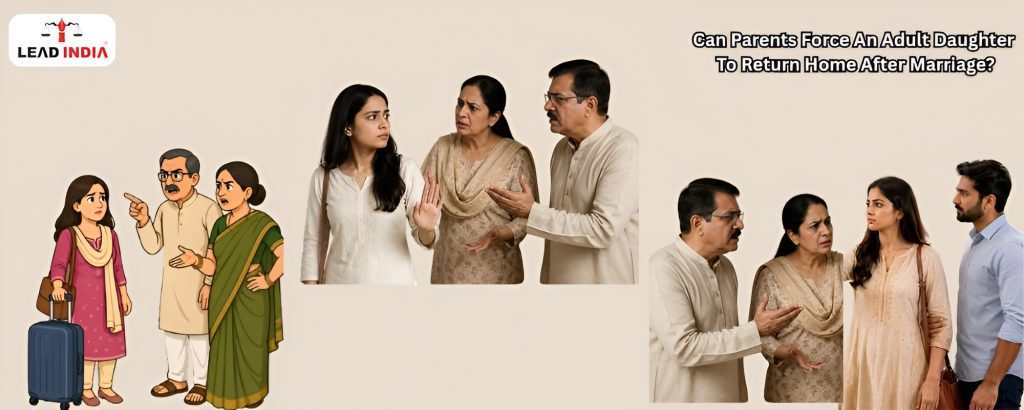
When the families face the conflicts after a daughter’s marriage, one of the most common questions is: “Can parents legally force their adult daughter to return to the parental home?”
This confusion is very much common in India.
Understanding as to what is the actual legal position that helps avoid all the unnecessary conflict, misuse of law, as well as emotional trauma.
What the Law Says About an Adult Daughter
The Indian Majority Act of 1875 defines adulthood for a person at the age of 18. The individual achieves complete legal authority to make independent choices after reaching this particular age.
This means the adult daughter has the right to:
- Decide where she wants to live
- Choose her partner or spouse
- Live separately from parents
- Make personal lifestyle decisions
People widely believe that parents retain legal rights to control their adult daughter until she reaches marriage age. The situation does not permit parents to control their adult daughter because she has reached the age of adulthood except for particular situations which include mental disabilities.
What Personal Liberty Really Means in Practice
The law treats the adult daughter as a fully independent individual. Her decisions about residence, marriage, as well as lifestyle are most legally protected.
In the most practical terms, this means:
- She can choose to live with her husband, partner, or independently
- She cannot be forced to return to her parents’ home
- Her consent is important factor in any decision
Especially Article 21of Constitution of India, mostly guarantees the right to life and personal liberty. The courts have interpreted this to include:
- The right to live with dignity
- The freedom to choose a partner
- The freedom to choose where to live
This is not just the social principle; but it is a fundamental right that is enforceable in court.
Can Parents Legally Force Her to Return Home?
- This is the important question.
- The parents cannot force an adult daughter to usually return home.
- There is no law as such in India that allows parents to:
- Compel their daughter to leave her husband or partner
- Dictate her place of residence
- Force her to live according to their wishes
Even if the parents are emotionally distressed or they are concerned about the social reputation, these reasons do not usually override legal rights. In fact, if force or pressure is used, it may amount to:
- Criminal intimidation
- Harassment
- lllegal confinement
Role of Police and Authorities
Many families try to involve the police in such matters. However, the law places clear limits on police powers.
Police authorities:
- Cannot detain an adult woman for family disputes
- Cannot force her to return home
- Must record her statement if a complaint is filed
The police will need to respect the wishes of the woman where she has expressed that the way she is living is her own decision.
Practically, where a woman goes through the court system and is brought before a Magistrate in relation to her situation, her statement will be recorded and if she declares she is there of her own free will, that case will be terminated.
Misuse of Habeas Corpus Petitions
In most of the cases, parents file the habeas corpus petition claiming that their daughter is missing or is unlawfully detained.
However, the courts have consistently clarified that:
- Habeas corpus applies only in cases of illegal detention
- It cannot be used to control personal choices of an adult
If the daughter appears before the court and states that she is living voluntarily, the petition is dismissed.
Important Legal Principles Established by Courts
The Indian courts, including Supreme Court, have repeatedly reinforced that:
- An adult woman is not the property of her parents
- She has complete freedom to choose her partner and residence
- Family objections cannot override constitutional rights
In multiple judgments, courts have emphasized that individual liberty is above societal or family pressure. Recent High Court rulings have also confirmed that:
- Parents or in-laws cannot force an adult woman to live with them
- She has the right to live independently
- Personal liberty includes the freedom to decide where to stay
Live-In Relationships and Independent Living
Indian law has also evolved to recognize modern relationships. Courts have clarified that:
- Live-in relationships between consenting adults are legal
- Parents cannot interfere or force separation
- Social morality cannot override legal rights
This further strengthens the principle that adult autonomy is fully protected under Indian law.
Property and Residence Rights: A Balanced Position
Another important legal aspect is related to property. Courts have held that:
- Adult children do not have an automatic right to live in parents’ property without consent
- Similarly, parents cannot control where an adult daughter chooses to live
This creates a balanced legal position where both sides are protected, but control is not allowed.
Exceptions Where Intervention May Be Allowed
Although the law strongly protects adult autonomy, there are limited exceptions:
1. If the Daughter Is a Minor: Parents have full legal authority over minors.
2. If There Is Illegal Detention: If the daughter gets kidnapped, confined, or under threat, the authorities can intervene.
3. Mental Incapacity: If she is not mentally capable of making the decisions, the guardianship laws may apply.
Ground Reality: What Women Actually Face
Despite the clear legal protection, most of the women face serious challenges such as:
- Emotional blackmail from family
- Social stigma and pressure
- Threats or harassment
- Misuse of police complaints
Women only go to court after they reach a point where their situation becomes impossible to handle. The law establishes clear guidelines yet public knowledge about the law and its execution still needs development.
Legal Remedies Available to the Daughter
If at all the parents try to forcefully bring her back, the daughter has various several legal remedies:
1. Police Protection
She can approach the police for protection from threats or harassment.
2. High Court Protection (Article 226)
She can file the writ petition for seeking protection of her life and liberty.
3. Criminal Complaint
If the force or intimidation is used, she can then initiate criminal action.
4. Court Intervention
She can directly approach the court to safeguard her fundamental rights.
What You Should Practically Do Right Now
If you are facing such type of situation:
- Do not panic or act under pressure
- Understand that the law is on your side
- Avoid informal settlements under coercion
- Seek legal advice before taking action
- Document any threats or harassment
Wrong decisions taken under pressure often create long-term legal complications.
How We Help in Such Cases
We assist clients in:
- Understanding their legal rights clearly
- Handling police complaints and family pressure
- Filing protection petitions in High Court
- Ensuring the safety and the legal compliance
Our approach focuses on protecting the individual liberty while resolving the disputes legally and effectively.
Conclusion
The legal position in India is very much clear and it is well settled. Parents cannot force an adult daughter to return home after marriage or otherwise.
An adult woman has:
- Full control over her life decisions
- The right to live wherever she chooses
- Strong protection under the Constitution and judiciary
- Family guidance may exist, but legal control does not.
One can talk to a lawyer from Lead India for any kind of legal support. In India, free legal advice online can be obtained at Lead India. Along with receiving free legal advice online, one can also ask questions to the experts online free through Lead India.
FAQs
1. Can the parents legally force the adult daughter to return to home?
No. Once she is an adult, her decision is totally final.
2. Can the police send her back to her parents?
No. Police must respect her statement and cannot force her.
3. Can the parents file a case to bring her back?
They can file, but the courts will not at all support it if she is acting voluntarily.
4. What if parents threaten or harass her?
She can seek police protection and legal remedies.
5. Can courts override her decision?
No, unless there is illegal detention or incapacity.


 Talk to a Lawyer