
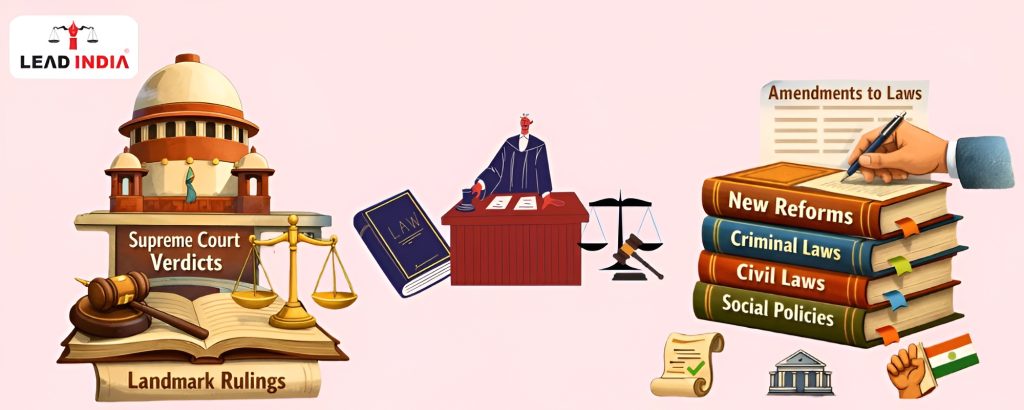
In the context of India, the Supreme Court serves as the protector of the Constitution and the ultimate interpreter of the law. The judicial outcomes of the Supreme Court resolve disputes, influence, transform, and sometimes even create valid law.
Can Supreme Court judgments create transformative laws in India?
The answer to this hinge on the Court’s interpretive authority. The Supreme Court cannot in a legislative sense create law; it can internally interpret and re-interpret law it views as legitimate and lawful, which can change the applicability and dimensions of law as defined in other statutes. Through interpretation and re-interpretation, the Supreme Court has transformed Indian law and jurisprudence in more ways than one could count.
Constitutional Powers That Let the Supreme Court Reshape the Law
The Constitution gives the Supreme Court the tools to interpret and even transform the law through:
- Article 32: to protect fundamental rights through writs.
- Article 141: to make its judgments binding on all courts.
- Article 142: to do “complete justice” in any case.
The law firm often cites these provisions when explaining why a new interpretation by the Supreme Court becomes the law of the land overnight. Once the Court interprets a statute, that meaning isn’t optional, it’s binding until Parliament says otherwise.
Judicial Interpretation: Where Reading the Law Redefines It
1. Turning Rights into Living Guarantees
Case Law: Maneka Gandhi vs. Union of India (1978)
This case transformed Article 21, once limited to procedure, into a fountain of human dignity, privacy, and livelihood rights.
When the law firm advises clients on personal liberty cases, Maneka Gandhi still forms the foundation of every argument. Parliament never amended Article 21, yet its meaning was revolutionized by the Court’s interpretation.
2. When the Court Says that “This Law Cannot Stand”
Case Law: Kesavananda Bharati vs. State of Kerala (1973)
From the Basic Structure Doctrine, the SC has declared that the Parliament does not have the power to change the core principles of the Constitution.
The Kesavananda is not only a case, it permanently redefined legislative power. That’s the magnitude of judicial interpretation in India.
3. When the Court Becomes a Lawmaker by Necessity
Case Law: Vishaka vs. State of Rajasthan (1997)
Before 2013, no law prohibited workplace-related sexual harassment. The Supreme Court adopted the Vishaka Guidelines and offered protections for women throughout India.
4. Conferring New Rights: Privacy Becomes a Fundamental Right
Case Law: Justice K.S. Puttaswamy vs. UOI (2017)
A nine-judge bench conferred the Right to Privacy under Article 21. This decision became a factor for developing the digital era in India with the enactment of the Digital Personal Data Protection Act 2023.
5. When the Court Pushes the Government to Act
Case Law: Prakash Singh v. Union of India (2006)
The direction of the Supreme Court on the reformation of police, forced states to draft a new Police Acts that was long overdue.
Such orders show how the Court nudges the executive toward accountability and modernization when politics stalls reform.
Crafting Doctrines That Outlast Generations
The Supreme Court has coined doctrines that continue to guide our legal system:
- Basic Structure Doctrine: No amendment can destroy the Constitution’s core.
- Public Trust Doctrine: Natural resources belong to the people.
- Constitutional Morality: Equality and dignity must guide every interpretation.
Every law student studies these doctrines, but in practice, they’re daily tools in constitutional litigation.
Judicial Activism or Overreach: The Fine Line in Practice
There are times when the Court steps in because the legislature stays silent, this is called judicial activism. But when that line blurs, critics cry overreach.
Example: Union of India vs. Association for Democratic Reforms (2002): The Court ordered the candidates to disclose criminal as well as financial details before the elections. It was just the judicial activism, protecting citizens’ right to know that when Parliament had done nothing.
How Supreme Court Judgments Inspire New Laws?
Time and again, judicial rulings have pushed Parliament into action:
| Court Judgment | Resulting Law | Broader Impact |
| RTI rulings | Right to Information Act of 2005 | Transparency and accountability |
| Judgments on women’s safety | Domestic Violence Act of 2005 | Legal protection for women |
| NALSA v. Union of India (2014) | Transgender Persons (Protection of Rights) Act of 2019 | Recognition of third gender |
In each case, the Court’s moral and constitutional push became the seed for legislation.
First-Hand Perspective: When a Judgment Changes Your Case Overnight
- As an advocate, the impact of Supreme Court judgments firsthand.
- A new verdict can instantly redefine the outcome of ongoing matters, especially when older precedents are overturned.
- After Puttaswamy, privacy arguments entered employment and cybercrime disputes.
- After Navtej Johar, family law and property claims involving same-sex partners found new constitutional footing.
Conclusion
The Supreme Court of India is the vibrant conscience of the Constitution as well as the nation. It makes law militant and alive, and assures that such law must advance with changing social realities. It has taken law from the anachronistic to the present and informed Parliament of the various options to engage and respond.
The Supreme Court has extended rights, balanced legislative overreach, and nudged Parliament to act, to assure that justice is never stale.
The Supreme Court judgments do change the laws, not by overstepping authority, but by reminding the nation that the constitutional justice means everything.
One can talk to lawyer from Lead India for any kind of legal support. In India, free legal advice online can be obtained at Lead India. Along with receiving free legal advice online, one can also ask questions to the experts online free through Lead India.
FAQs
1. Can Parliament overrule a Supreme Court judgment?
Yes, through new legislation or any kind of constitutional amendment, provided it doesn’t violate the basic structure of the Constitution.
2. Why do these judgments matter for citizens?
They secure rights, demand government accountability, and ensure justice when politics hesitates.
3. How do such rulings affect lawyers and clients?
Each landmark decision reshapes arguments, defense strategies, and even the laws under which clients are charged or protected.


 Talk to a Lawyer