
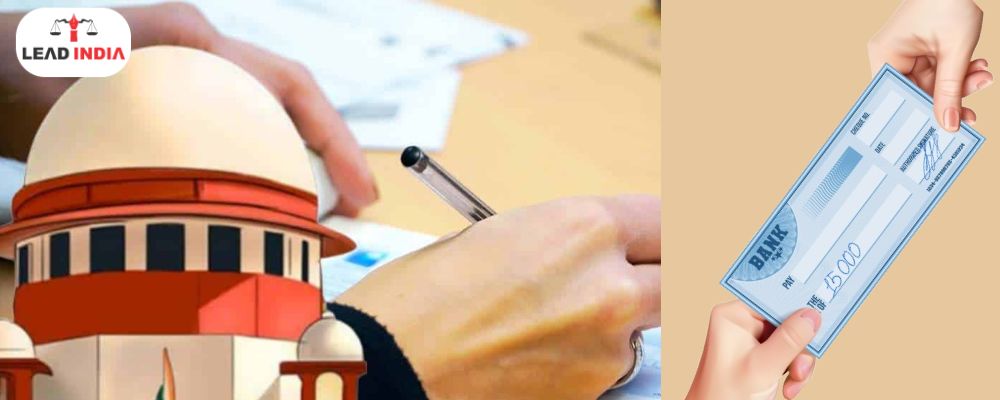
Understanding Section 138 NI Act
In India, the Negotiable Instruments Act, 1881 is one of the most prominent and essential legal provisions when it comes to cheque dishonour cases. So, section 138 of NI Act plays a very crucial role here as it criminalizes the act of cheque which gets returned due to the reason of Insufficient funds, or if it exceeds the amount arranged to be paid by the drawer.
This section was added to ensure the authenticity of cheque in commercial transactions. Before its introduction, cheque dishonour was a civil wrong, and creditors often faced difficulties recovering money. Section 138 introduced criminal consequences to enhance accountability and financial discipline.
If you want to file a case under Section 138 of NI Act then legal requirements must be fulfilled like prompt issuance of a demand notice, presenting cheque within a timely period and also filing a complaint within the limitation period of time.
So, the Indian court was instrumental in improving and enhancing the concept of section 138. Many landmark judgements and judiciary has made it clear regarding the issues related to dishonoured cheques and the related concept.
Let’s now discuss the various judgements:
Need A Legal Advice
The internet is not a lawyer and neither are you. Talk to a real lawyer about your legal issue
1.Dashrath Rupsingh Rathod v. State of Maharashtra (2014)
Citation: (2014) 9 SCC 129
Legal Issue: What can be the Jurisdiction to file a cheque bounce complaint?
In this Judgement, the Supreme Court held that the complaint of cheque bounce must be filed in court within whose jurisdiction the drawee bank locates, meaning where the cheque was bounced.
This decision has significant ramifications for complainants who had previously brought legal action at their own bank or place of business. Nevertheless, it caused practical issues and was eventually repealed by a law change.
Current Legal Position: Following the 2015 amendment to the NI Act, the jurisdiction now lies with the court where the payee’s bank (the bank in which the cheque was deposited) is situated, restoring convenience to complainants.
2. Modi Cements Ltd. v. Kuchil Kumar Nandi (1998)
Citation: (1998) 3 SCC 249
Legal Issue: Stop Payment Instructions and Section 138
In this judgement the Supreme Court held that even if the drawer states the “stop payment” direction to the bank, there will still be liability under section 138 of NI Act, which provided that cheque was issued against a legally enforceable debt.
This judgement eliminates the false beliefs that the instruction of “stop payment” impulsively protects a drawer from any liability.
3.Kusum Ingots & Alloys Ltd. v. Pennar Peterson Securities Ltd. (2000)
Citation: (2000) 2 SCC 745
Legal Issue: Nature of the liability for a cheque
The Supreme Court observed that for Section 138 to apply, the cheque must have been issued for a legally enforceable debt or liability. If the cheque was issued as a gift or towards a non-binding promise, the provisions of Section 138 would not apply.
This judgment emphasized the requirement of an underlying legal obligation as a condition precedent for prosecution under the NI Act.
4. Sadanandan Bhadran v. Madhavan Sunil Kumar (1998)
Citation: (1998) 6 SCC 514
Legal Issue: Re-presentation of cheque and limitation period
In this case, the Court held that once a cheque has been dishonoured and a notice issued, if the drawer fails to make payment, the payee cannot present the same cheque again and send a new notice to revive the cause of action. A single default results in a single cause of action.
However, this view was later overruled in a more liberal and practical interpretation.
5. MSR Leathers v. S. Palaniappan (2013)
Citation: (2013) 1 SCC 177
Legal Issue: Multiple Presentations of Cheque and Fresh Cause of Action
Overruling Sadanandan Bhadran, the Supreme Court held that a cheque may be presented multiple times during its validity, and for each dishonor, a separate cause of action can arise, provided the legal notice and complaint are filed in accordance with the prescribed timelines.
This judgment greatly favored the payee by providing multiple opportunities to enforce their rights under Section 138.
6. MMTC Ltd. v. Medical Chemicals and Pharma Ltd. (2002)
Citation: (2002) 1 SCC 234
Legal Issue: Service of Notice and Timeline Compliance
The apex court held that the legal notice under Section 138 must be sent within 30 days from the date of receiving information from the bank regarding dishonour. Non-compliance with this timeline renders the complaint invalid.
This case reaffirmed that technical requirements under Section 138 must be strictly followed to maintain the sanctity of criminal prosecution.
7. C.C. Alavi Haji v. Palapetty Muhammed (2007)
Citation: (2007) 6 SCC 555
Legal Issue: Presumption of Service of Notice
In this case, the Court clarified that if a statutory notice is sent to the correct address of the drawer by registered post, and the drawer deliberately avoids receiving it, then the notice shall be presumed to have been served under Section 27 of the General Clauses Act.
This prevents accused persons from misusing the postal system to evade liability.
8. Rangappa v. Sri Mohan (2010)
Citation: (2010) 11 SCC 441
Legal Issue: Presumption under Section 139 NI Act
Here the Supreme Court stated that once the creation of cheque is acknowledged, it will be presumed that it was created for indebtedness and the burden of proof will shift to the accused to disprove the presumption.
Most importantly, the proof required to disprove the presumption is a balance of probabilities not undeniable.
This ruling is frequently cited in trial courts during cheque bounce litigation.
9. Kumar Exports v. Sharma Carpets (2009)
Citation: (2009) 2 SCC 513
Legal Issue: Rebutting Presumption under Section 139
Reiterating Rangappa’s position, the Court emphasized that while the initial presumption lies with the complainant, the accused can rebut it by producing sufficient evidence or circumstances indicating that the cheque was not issued for a legal liability.
This case sets a fair balance between prosecution and defense in cheque bounce matters.
10. Bir Singh v. Mukesh Kumar (2019)
Citation: (2019) 4 SCC 197
Legal Issue: Oral Evidence and Rebuttal of Presumption
The Court held that the accused cannot escape liability merely on the basis of an oral statement denying liability. Once the cheque is admitted, the burden to rebut the presumption must be through cogent evidence.
This judgment strengthens the hand of genuine complainants and prevents frivolous defenses.
Additional Considerations in Cheque Bounce Cases
Security Cheques and Section 138
If a cheque is issued as a security, courts examine whether it was meant to be encashed against a legally enforceable liability. If yes, Section 138 will apply. If it was a mere guarantee with no actual debt on the due date, prosecution may fail.
Post-Dated Cheques
Section 138 will apply to post dated cheques only when presentation date and lawful debt exists. The court supported the view that the drawer will be liable if post dated cheques are issued in regards to and existing obligations.
Corporate Liability under Section 138
The company and the officers like directors will be held liable under Section 141 of NI Act, if company issues dishonoured cheque. But here the court requires a clear proof that the person was involved in running a business.
Conclusion
Courts have provided clarification on the operation of Section 138 of the Negotiable Instruments Act over time, particularly with regard to situations involving bounced checks. They have balanced the rights of both parties, clarified liability standards, and defined deadlines. To increase your chances, it’s critical to adhere to the correct legal procedures and seek advice from an attorney knowledgeable in these areas, whether you’re bringing a lawsuit or defending one.
One can talk to lawyers from Lead India for any kind of legal support. In India, free legal advice online can be obtained at Lead India. Along with receiving free legal advice online, one can also ask questions to the experts online free through Lead India.
FAQs
1. What is the time limit to send notice under Section 138?
You must send the legal notice within 30 days of getting bank intimation of cheque dishonour.
2. Can a cheque issued as a gift attract liability under Section 138?
No, unless the cheque was issued against a legally enforceable debt or liability.
3. What if the drawer refuses to accept the legal notice?
Refusal or avoidance of notice is treated as valid service under law.
4. Can I file a case where I deposited the cheque?
Yes, as per the 2015 amendment, the complaint can be filed where the payee’s bank is located.


 Talk to a Lawyer