
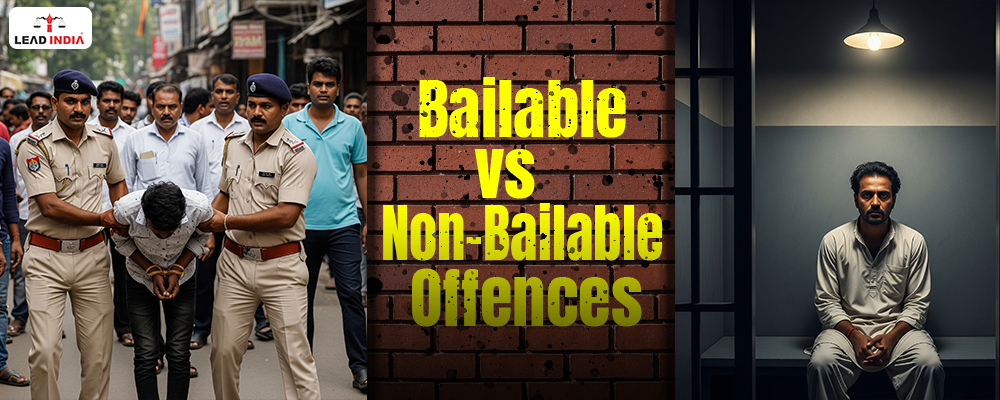
The Indian criminal justice system classifies offences into different categories based on their severity. One of the most important distinctions is between bailable and non-bailable offences, as defined under the Code of Criminal Procedure, 1973 (CrPC)/Bhartiya Nagarik Suraksha Sanhita, 2023 (BNSS). This classification directly affects whether an accused person can seek bail as a right or must depend on the discretion of the court.
In this article, we explain the meaning, legal provisions, examples, and key judicial interpretations that help you understand the difference between bailable and non-bailable offences in India.
What is Bail and Why It Matters So Much?
Imagine your friend is arrested for a minor scuffle in the neighbourhood. He calls you and says that he is in lockup. Should you rush to get a lawyer? A surety? Will he be released the same day?
Bail is a legal mechanism that allows an accused person to be released from custody, either on personal bond or with sureties, while the case is being investigated or tried. It’s the legal lifeline between arrest and trial.
Need A Legal Advice
The internet is not a lawyer and neither are you. Talk to a real lawyer about your legal issue

The Legal Backbone: CrPC/BNSS
According to Section 2(a) of the CrPC/Section 2 (1) (c) of the BNSS, every criminal offence is either bailable or non-bailable.
- Bailable offences: Right to bail exists
- Non-bailable offences: Bail depends on court’s discretion
As someone who has handled hundreds of bail matters, I can tell you: this one classification can decide whether you sleep at home or behind bars tonight.
Bailable Offences: You Have a Right to Bail
These are generally less serious offences, and the law is on your side. If you’re arrested for a bailable offence, the police or magistrate must release you once you provide surety or personal bond.
Real-World Examples I See Often
- Fights resulting in minor injury (Section 323 IPC/Section 115 (2) BNS)
- Petty assault or abuse (Section 352 IPC/ Section 131 BNS)
- Public nuisance cases (Section 268 IPC/ Section 270 BNS)
- Death by negligence (Section 304A IPC/ Section 106 BNS), such as road accidents
In most such cases, we apply for bail at the police station itself and get the client released the same day.
Relevant Law: Section 436 CrPC/Section 478 BNSS
Non-Bailable Offences: You Have to Convince the Court
If you’re booked under a non-bailable offence, bail is not your right. It’s up to the judge to decide, based on multiple factors. And yes, the seriousness of the crime matters and your circumstances.
Cases I Commonly Handle
- Murder (Section 302 IPC/ Section 103 BNS)
- Rape (Section 376 IPC/ Section 64 BNS)
- Kidnapping (Section 363 IPC/ Section 137 (2) BNS)
- Dowry Death (Section 304B IPC/ Section 80 BNS)
In one rape allegation case, the client was granted bail only after proving that the FIR was filed after a property dispute, and we submitted WhatsApp chats as evidence of prior settlement.
Relevant Law: Section 437 CrPC/Section 480 BNSS
Bailable vs Non-Bailable Offence: Know the Difference
| Aspect | Bailable Offence | Non-Bailable Offence |
| Right to Bail | Yes. It is granted automatically | No. The court decides |
| Severity | Minor offence | Serious or heinous offence |
| Police Authority | Can grant bail directly | Must take accused to magistrate |
| Examples | Hurt, assault, public nuisance | Rape, murder, dowry death |
| Procedure Section | Section 436 CrPC/Section 478 BNSS | Section 437 CrPC/ Section 480 BNSS |
| Bail Discretion | No discretion | Full discretion with the judge |
What Do Judges Look at Before Granting Bail?
When I argue a bail application, I always prepare answers to these:
- How serious is the crime?
- Is there strong evidence or just a complaint?
- Will the accused run away or cooperate?
- Could they threaten witnesses?
- What’s their background, any prior records?
A solid bail application is a legal story backed by documents. I once got bail for a man accused of grievous hurt by showing CCTV footage proving self-defence.
Arrested in a Bailable Case? Here’s What to Expect
- Police may release you at the station itself
- You might not need to go to court
- You just need proper documents and surety
Tip: Always keep a friend or family member ready with ID proof, they can act as surety in emergencies.
In a Non-Bailable Case? Here’s the Reality Check
- Police may arrest without warrant
- You must be produced before magistrate within 24 hours
- Bail hearing usually takes place in court
- For serious charges, only Sessions or High Court can grant bail
In one economic offence case, we helped the client file for anticipatory bail and avoided arrest altogether.
Bail Even After Conviction? Yes, But It’s Tough
Bail after conviction depends on:
- Weakness in evidence
- Delay in hearing appeal
- Medical issues
- Clean prior record
Case to Know: Kashmira Singh v. State of Punjab: The Supreme Court ruled against long jail terms during appeals for minor offences.
Can Bail Be Cancelled?
Yes. If you skip court dates, threaten witnesses, or break conditions, the court can cancel your bail.
Laws to Know
- Section 437(5) CrPC/Section 480 BNSS
- Section 439(2) CrPC/Section 483 BNSS
There was a case where bail was cancelled because the accused posted derogatory videos about the complainant on social media.
India’s Changing Approach: Bail Is the Rule, Not the Exception
In recent years, courts have started leaning towards liberty.
Landmark Case: Satender Kumar Antil v. CBI (2022): Guidelines for bail, particularly in instances that are bailable and not severe, were given by the Supreme Court. It concluded that:
“Unnecessary arrests infringe upon Article 21 of the Constitution’s guarantee of life and liberty.”
Why Bail Reform Is Urgent: A Lawyer’s Ground Level View
It is often heard that undertrial prisoners who’ve spent months locked up for petty offences, just because they couldn’t arrange surety.
Problems I see often
- Poor undertrials with no legal aid
- Families not aware of bail rights
- Paperwork and delays even in minor cases
What India Needs?
- Simplified bail documentation
- Wider use of personal bonds
- More legal aid cells in courts
Final Thoughts: Know Your Rights, Act Smart
Whether you’re a concerned family member, a law student, or someone dealing with legal trouble, knowing the difference between bailable and non-bailable offences is essential.
Here’s what every client should know:
- If your case is bailable: Act fast, arrange surety, and get released immediately.
- If it’s non-bailable: Build a strong bail application and focus on facts, not emotions.
Bail is not just a legal term. It’s about your freedom, reputation, and peace of mind.
One can talk to lawyer from Lead India for any kind of legal support. In India, free legal advice online can be obtained at Lead India. Along with receiving free legal advice online, one can also ask questions to the experts online free through Lead India.
FAQs
1. What is the difference between bailable and non-bailable offences in Indian law?
In an offence categorized as bailable, it is an absolute right for an accused to be released on bail, usually in lesser offences. Non-bailable offences involve more serious charges, the granting of bail in such circumstances being the discretion of the court.
2. Can I get bail under a non-bailable offence in India?
Yes, but one is not entitled to it automatically. The court considers the gravity of offence, risk of absconding, evidence, history of similar prior cases, execution of prior bail recognizance against time limits, etc., in granting bail.
3. Which factors do courts assess in considering bail that is granted for a non-bailable offence?
Courts consider the seriousness of the offence, evidence against the accused, risk of absconding, density of witnesses, and health, age, and character of the accused.


 Talk to a Lawyer