
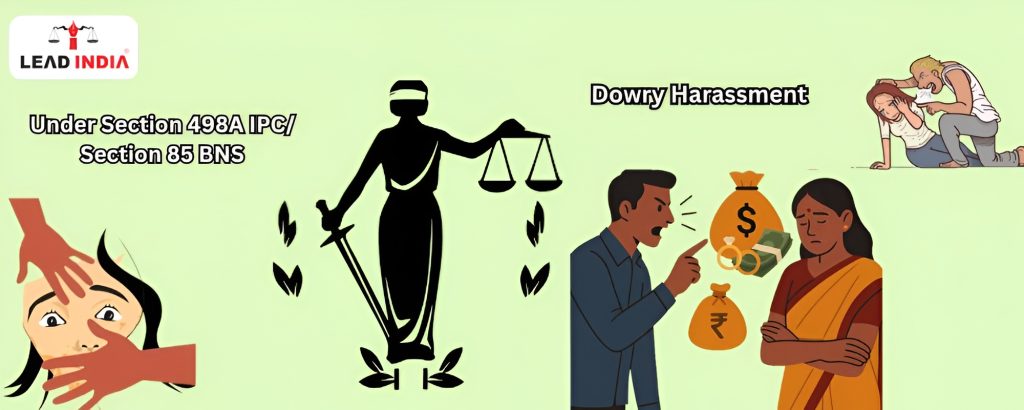
The attacking issues for marriages remain one of the district ones in India, dowry harassment. Despite being forbidden, many women still are subjected to atrocities and humiliation due to dowry threats. Such forms of harassment sometimes even lead to deaths.
To prevent these crimes, Section 498A of the Indian Penal Code (IPC)/Section 85 of the Bhartiya Nyaya Sanhita was brought into force in 1983. This section usually criminalizes the cruelty by a husband or his relatives that is performed towards a married woman when it is linked to dowry or any unlawful demands. It gives women a strong legal weapon to protect themselves, while also providing punishment for offenders.
This article explains what Section 498A IPC/Section 85 BNS is, how victims can seek legal remedies, the FIR process, punishments, related laws, case laws, and safeguards against misuse, all in simple, client-friendly language.
Section 498A IPC/Section 85 BNS Explained
If your husband or in-laws harass you for money, gifts, or property, or subject you to cruelty, Section 498A applies.
- Punishment: Imprisonment for a term of up to three years with a fine
- Who can be punished? Husband and his relatives
From practice, there is seen cases where even subtle forms of mental cruelty (constant taunts about not bringing enough dowry) were recognized by courts under this section.
Legal Remedies for Dowry Harassment Under Section 498A IPC/Section 85 BNS
Step 1 – Filing an FIR: Your First Legal Weapon
- You can file an FIR under Section 498A IPC/ Section 85 BNS at your local police station.
- Police cannot refuse to register it, 498A/85 is a cognizable offence.
- If they delay or refuse, you can approach a Magistrate under Section 156(3) CrPC/Section 175 BNSS.
In one case, the police initially refused to register the FIR, calling it a “family matter.” Upon this refusal, the lawyers approached the Magistrate, and within a week, the FIR was lodged. This step is important when the authorities are hesitant.
Step 2 – Criminal Trial: How the Case Moves Forward
- After FIR, the police investigate, then they collect evidence, and at the end file charge sheet.
- Trial happens before Magistrate.
- If guilt is proved, punishment can be up to 3 years’ imprisonment and fine.
There is seen a woman regain confidence when the court finally takes cognizance. The very fact that the law is on their side acts as a deterrent for the abusers.
Step 3 – Use the Dowry Prohibition Act Alongside 498A/85
The Dowry Prohibition Act, 1961 strengthens your case:
- Punishes giving or taking dowry (Section 3).
- Punishes demanding dowry (Section 4).
Clients are often advised to file parallel complaints under this Act because it widens the scope of punishment for the accused.
Step 4 – Immediate Protection through the Domestic Violence Act
While 498A/85 is criminal, the Domestic Violence Act (2005) gives you quick civil reliefs:
- Protection orders to stop harassment
- Right to residence in the shared home
- Monetary relief including maintenance
- Compensation for physical or mental injuries
In one matter, one client was thrown out of her matrimonial home at midnight. The law firm secured a residence order within days, and she returned legally protected.
Step 5 – Secure Financial Stability: Maintenance Rights
You can claim maintenance under:
- Section 125 CrPC/Section 144 BNSS: it offers basic maintenance if you cannot support yourself
- Hindu Marriage Act: Interim and permanent alimony
From experience, clients are told to file maintenance applications early. Court cases take time; financial relief ensures you do not suffer silently while waiting.
Step 6 – Divorce on Grounds of Cruelty
If cruelty continues, divorce is a legal option:
- Hindu Marriage Act: Section 13(1) (ia)
- Similar provisions exist in other personal laws
In a landmark case, one client was granted divorce solely on the ground of repeated dowry demands. Courts recognize dowry harassment as cruelty, even if no physical violence is involved.
Step 7 – Claim Compensation Beyond Punishment
Under Section 357 CrPC/Section 395 BNSS, courts can order compensation to victims at the time of conviction. This is over and above imprisonment.
Misuse of 498A/85 – What Courts Have Said
Courts know 498A/85 can be misused. So, they have added checks:
- Police cannot arrest immediately (Arnesh Kumar v. Bihar)
- Family welfare committees were suggested to filter false cases (Rajesh Sharma v. UP)
In practice, there is seen both genuine cases and false cases. That is why, as a lawyer, the clients are always advised to keep evidence, messages, medical reports, witness accounts, so their case stands strong.
Challenges Women Face in 498A/85 Cases
- Long delays in trial
- Family or social pressure not to complain
- Fear of being blamed for breaking marriage
- Lack of awareness about rights
Suggested Reforms from a Lawyer’s Perspective
- Fast-track courts for dowry harassment cases
- Mandatory counselling before trial to see if reconciliation is possible
- Government awareness drives about 498A/85 rights
- Balanced safeguards to stop false cases
Conclusion
If you are being harassed for dowry:
- Speak up early, do not wait for things to worsen
- File a police complaint and consult a lawyer
- Use multiple remedies such as the 498A IPC/85 BNS, Domestic Violence Act, Dowry Prohibition Act, as well as the maintenance laws
From practice, one can say that the bravest step is walking into a lawyer’s office for the first time. Once you take that step, the law will always stand with you.
One can talk to lawyer from Lead India for any kind of legal support. In India, free legal advice online can be obtained at Lead India. Along with receiving free legal advice online, one can also ask questions to the experts online free through Lead India.
FAQs
1. What evidence is required to prove 498A?
Medical records, witness statements, call recordings, messages, and financial transaction proofs can all help establish cruelty or dowry demands.
2. How long does a 498A/85 case take to resolve?
On average, 2-5 years, depending on the court’s workload. Fast-track courts and mediation may shorten the duration.
3. Can in-laws living separately be booked under 498A.85?
Yes, if there is evidence of their involvement in harassment or dowry demands. Otherwise, courts may strike their names off to prevent misuse.


 Talk to a Lawyer