
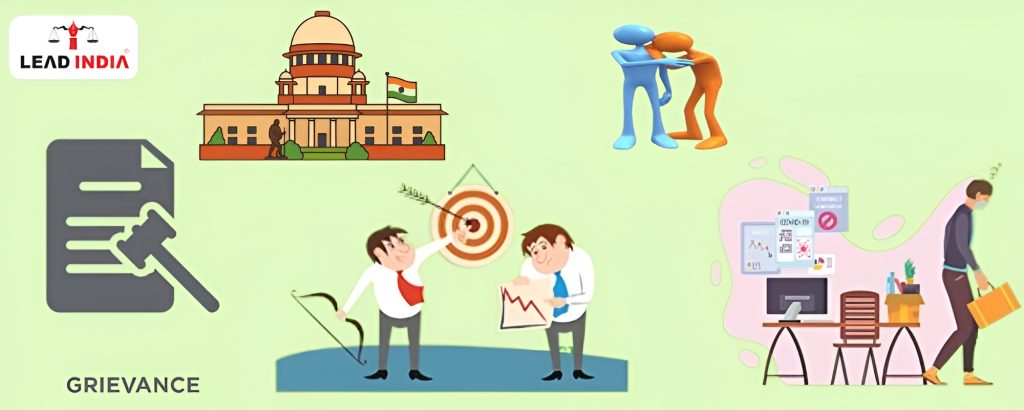
Disputes at the workplace occur more often than one perceives. From unpaid wages and unfair promotions to harassment and unfair disciplinary actions, employees face issues which, when ignored, lead to serious conflicts. To protect the rights of the employees and maintain a healthy working environment, organizations are required by law to have an Employee Grievance Redressal System.
The system is one that listens to complaints, investigates them, and fairly resolves them in an appropriate period. In India, grievance redressal is no longer a matter of HR practices; it is enforceable under several labour laws, with one of the most important being the Industrial Disputes Act, 1947, and with reinforcement from the judiciary.
This article explains what is an employee grievance, the laws relating to grievance redressal in India, the stepwise procedure for grievance resolution at the workplace, key case laws, and a few practical tips for both employees and employers.
What is a Workplace Grievance?
Any treatment that is either rightfully or wrongfully dealt with injustice to you at work might be a grievance. It could include:
- Non-payment or underpayment of wages
- Denial of promotions or any kind of unfair transfers
- Harassment or discrimination by any supervisors or colleagues
- Unsafe or toxic work environments
- Victimization after reporting misconduct
Tip from experience: Always document everything, emails, messages, orders, before raising a grievance. It strengthens your case.
Why Every Employee Should Know the Grievance Redressal Law?
There are many employees that keep quiet, fearing they will lose their jobs or that nothing would change. However, Section 9C of the Industrial Disputes Act, 1947, exists for a purpose: to direct every company of 20 plus employees to maintain a Grievance Redressal Committee (GRC).
This legal safeguard ensures you can:
- The protection it afforded to employees guarantees that complaints may be heard before a neutral panel.
- You should receive a written resolution with a time-line (normally within 45 days).
- Appeal to the higher authority in case of dissatisfaction
- Take the matter to Labour Court if internal remedies fail
The Grievance Redressal Committee: Your First Door to Justice
In most cases, employees do not even realize that the company they work for has a GRC. The way the GRC works are:
- Equal representation: Half the members are to be chosen from the employees themselves and half represent the management. There must be at least one female member.
- Two-year term: Members of the committee hold office for a term of two years.
- Time-bound resolution: Complaints needs to get resolved within 45 days.
Step-by-Step Guide: How to File a Grievance in India
- You need to write a clear complaint mentioning what happened, when, and who was involved in this.
- Attach all of the evidence, such as emails, payslips, medical reports, or witness statements that is required.
- Submit to HR or the GRC and ask for a copy of acknowledgment.
- Attend the hearings, present your case calmly, and keep things factual.
- Get a written decision and keep a copy for your personal record, as one may never know when they would need the record again.
- If left unresolved, approach the Labour Commissioner or the Labour Court.
First-Hand Tip: Never highlight a grievance just verbally; written ones create accountability.
Real-Life Example: Harassment Complaint Resolved through GRC
One of the clients experienced verbal harassment from a senior colleague. She was hesitant to complain, foreseeing retaliation. After being made aware of her rights against sexual harassment as per the POSH Act, 2013, she went ahead with the grievance.
- The Internal Complaints Committee (ICC) took over the inquiry.
- A warning letter was issued to the person who harassed, with a counselling session that was arranged.
- Workplace sensitivity training was then later on conducted.
Key Laws Protecting Employees
- Industrial Disputes Act, 1947: It usually makes GRC a must for big the companies.
- POSH Act, 2013: It has a separate mechanism for sexual harassment complaints.
- Factories Act, 1948: It offers right to safe work conditions.
- Shops & Establishments Acts: It is usually for the workers in offices, shops, etc.
- Standing Orders Act, 1946: It particularly ensures transparent terms of employment.
Landmark Case Laws You Should Know
- Vishaka v. State of Rajasthan (1997): It lays down the foundation of sexual harassment laws.
- Bharat Forge Co. Ltd. v. Uttam Nakate (2005): It has ensured a fair and disciplinary process.
- Chairman, LIC v. A. Masilamani (2013): It has re-affirmed the supremacy of the grievance procedure against the employees before their termination.
Practical Advice for Employees
- Speak up early and don’t wait
- Do maintain your professionalism while dealing with the grievance
- Know your rights under the appropriate labour laws.
- Seek legal help if internal processes fail to give you justice.
Conclusion
An Employee Grievance Redressal System is not a mere legal formality; it is your shield against workplace injustice. From disputes concerning salaries to events of harassment, every grievance must be heard and settled with equity.
If you are experiencing something at work, do not remain silent. Knowing and exercising your rights, following through with the proper mechanism, and getting professional help would help uphold those rights and thus be a safe and just place to work.
One can talk to lawyer from Lead India for any kind of legal support. In India, free legal advice online can be obtained at Lead India. Along with receiving free legal advice online, one can also ask questions to the experts online free through Lead India.
FAQs
1. Is an employee allowed to directly approach a labor court without first attempting to resolve the grievance internally?
While the internal attempt is more preferred by laws, the employee can approach the Labor Commissioner or the Labor Court in case the grievance is not taken up or ignored by the employer.
2. Is it necessary for every company to have a grievance redressal mechanism?
All the industrial establishments who have employed 20 or more workers are required under the law to constitute a Grievance Redressal Committee. Moreover, these establishment that has employed 10 or more employees must constitute the Internal Complaints Committee to look after the cases of sexual harassment.
3. What are some common workplace grievances in India?
Disputes over wages, wrongful termination, promotion refusal, workplace harassment, discrimination, unsafe working conditions, as well as violations of terms of employment are some of the major types of employee grievances.


 Talk to a Lawyer