
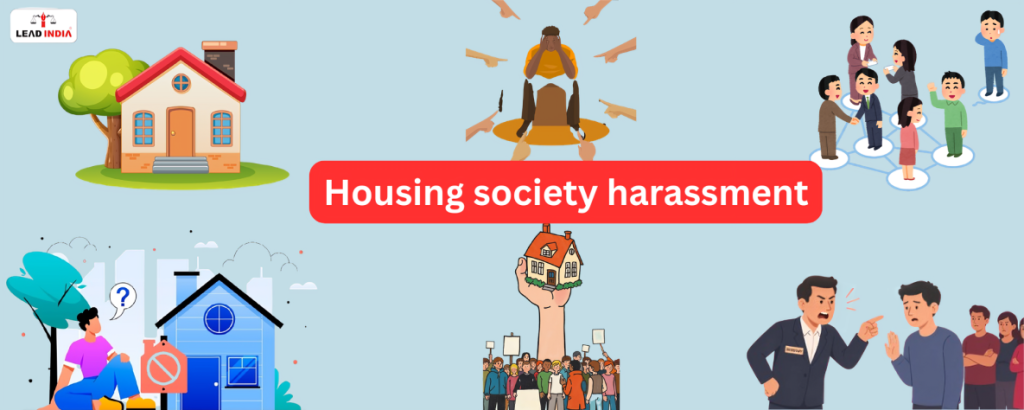
Whenever a flat owner first faces problems with their housing society, the biggest confusion that usually comes to their mind is: “Can a housing society legally harass me, or do I just have to tolerate it?”
This confusion is very much natural.
Understanding as to what legally amounts to the housing society harassment, when the society is actually acting within its authority, as well as when it is exceeding its powers, mostly helps you to avoid the unnecessary stress, financial loss, as well as the prolonged disputes.
What Housing Society Harassment Is and What It Is Not
Not every disagreement with the managing committee is harassment.
A housing society is legally allowed to:
- Collect maintenance charges
- Enforce registered bye-laws
- Regulate common areas
- Conduct elections
- Issue notices for genuine violations
However, harassment begins when the managing committee:
- Imposes charges not authorized under bye-laws
- Denies access to common facilities without lawful reason
- Refuses to provide financial records
- Blocks sale or transfer without valid legal basis
- Targets a member personally
- Acts in a discriminatory or arbitrary manner
A housing society is not a private authority above the law. It is a registered body bound strictly by statutory provisions and its own registered bye-laws.
What Housing Society Governance Really Means in Practice
The main purpose of a housing society is to manage shared facilities while safeguarding the common interests of its members.
You own your flat. The building does not possess ownership of your property.
The committee can control administrative tasks and maintenance work and execute bye-law regulations. The committee cannot take away your ownership rights except for the limitations which the law establishes.
Most housing societies in India operate under:
- State Cooperative Societies Acts (such as Maharashtra Cooperative Societies Act,
- Delhi Cooperative Societies Act, Karnataka Cooperative Societies Act)
- Apartment Ownership Acts (state specific)
- Societies Registration Act, 1860 (in case of RWAs)
Each of these laws defines member rights and dispute resolution mechanisms.
Is Housing Society Harassment Legal in India?
- This is the important question, and the legal position is very much clear.
- A housing society cannot harass a member arbitrarily.
- There is no law in India that gives unlimited power to a managing committee.
- Every action must comply with the governing state Act registered bye-laws principles of natural justice constitutional protections such as fairness as well as non-arbitrariness
However, in practice, many societies misuse procedural powers to pressure members. In such cases, the remedy is fully legal and not emotional.
Indian courts have more consistently held that the managing committees needs to act fairly, transparently, as well as within their legal limits.
Common Situations Where Legal Action Becomes Necessary
The flat owners generally seek legal help when:
- Illegal maintenance penalties are imposed
- Society refuses to issue share certificate
- NOC for sale or mortgage is denied
- Access to lift or water is blocked
- Inspection of accounts is denied
- Managing committee elections are manipulated
- Threats or intimidation occur
In such cases, the issue shifts from internal dispute to legal violation.
Who Can Challenge Society Harassment?
Every registered member of a housing society can challenge illegal actions.
It does not matter whether you are:
- A salaried individual
- A senior citizen
- An NRI owner
- A tenant (in certain limited situations)
- A joint owner
There is no minimum dispute value requirement. Even small illegal fines can be challenged if imposed without authority.
Legal Remedies Available Against Housing Society Harassment
1. Complaint Before Registrar of Cooperative Societies
If the society is registered under a Cooperative Societies Act, you may approach:
- Registrar
- Deputy Registrar
- Cooperative Tribunal
They have powers to:
- Quash illegal notices
- Order record inspection
- Restrain unlawful actions
- Appoint administrator in extreme cases
2. Civil Court Remedy
A civil suit may be filed for:
- Declaration of rights
- Permanent injunction
- Mandatory injunction
- Recovery of damages
Courts can grant interim protection to stop harassment immediately.
3. Consumer Commission
If the issue relates to deficiency in service such as:
- Lift not maintained
- Water supply negligence
- Structural defects
- Misuse of maintenance funds
You may file a complaint under the Consumer Protection Act, 2019.
4. Criminal Complaint (Where Necessary)
If the managing committee commits serious misconduct such as:
- Forgery
- Misappropriation of funds
- Criminal intimidation
- Cheating
Relevant provisions under the Bharatiya Nyaya Sanhita, 2023 may apply. However, criminal law should not be used for purely civil disagreements. Strategic evaluation is important.
Practical Steps Before Filing a Case
If you are facing society harassment, you should:
- Review the registered bye-laws carefully
- Keep written record of all communications
- Avoid verbal confrontations
- Send formal written representation
- Seek inspection of documents lawfully
- Send legal notice if required
Many disputes resolve after a properly drafted legal notice.
What Happens If You Ignore Society Harassment?
Ignoring repeated illegal actions may result in:
- Accumulation of unlawful penalties
- Blockage in property transfer
- Prolonged internal targeting
- Weakening of your legal position
- Early legal action often prevents escalation.
Legal Importance of Bye-Laws
Registered bye-laws are binding on both the society and members. The managing committee cannot:
- Create new penalties beyond bye-laws
- Interpret provisions arbitrarily
- Selectively apply rules
Courts intervene when actions are ultra vires (beyond authority).
Housing Society Harassment and Constitutional Principles
- Even though housing societies are not government bodies, courts apply principles of fairness and reasonableness.
- Arbitrary or discriminatory actions can be challenged legally.
- The law protects both collective governance and individual property rights.
Housing Society Harassment vs Genuine Rule Enforcement
It is important to distinguish between:
- Legitimate enforcement of maintenance recovery
- Lawful penalty under registered bye-laws and
- Harassment through excessive or unauthorized demands
Not every notice is harassment. Legal advice helps determine the difference.
Practical Risks of Escalating Without Legal Strategy
Many members:
- Stop paying maintenance
- Circulate allegations on social media
- Threaten police complaints immediately
Such reactions may legally weaken your position. The correct approach is documentation and lawful challenge.
What You Should Practically Do Right Now
If you are confused about society harassment:
- Do Not ignore repeated illegal actions
- Do Not rely only on verbal assurances
- Do Not stop paying legitimate dues
- Verify the applicable Act and bye-laws
- Seek structured legal advice
- Take timely legal action where required
Wrong handling of society disputes often leads to long-term litigation and financial complications.
How We Help Flat Owners in Society Disputes
We assist flat owners in:
- Examining legality of society notices
- Reviewing registered bye-laws
- Drafting effective legal notices
- Filing complaints before cooperative authorities
- Seeking injunctions from civil courts
- Protecting property transfer rights
We use a strategic approach to handle disputes while we protect your ownership rights and your legal status.
If you need legal help because of housing society harassment in India, then professional guidance will help you avoid unnecessary conflicts and protect your property rights.
One can talk to lawyer from Lead India for any kind of legal support. In India, free legal advice online can be obtained at Lead India. Along with receiving free legal advice online, one can also ask questions to the experts online free through Lead India.
FAQs
1. Where can I file a complaint against housing society harassment?
You can approach the Registrar of Cooperative Societies, Civil Court, Consumer Commission, or Cooperative Tribunal depending on the issue.
2. Can a society deny lift, water, or parking access to a member?
No, essential common facilities cannot be denied without lawful authority.
3. Can I stop paying maintenance if society is harassing me?
No, withholding legitimate maintenance payments may weaken your legal position.
4. When does housing society harassment become a criminal matter?
It becomes criminal if there is forgery, fund misappropriation, cheating, or criminal intimidation.


 Talk to a Lawyer