
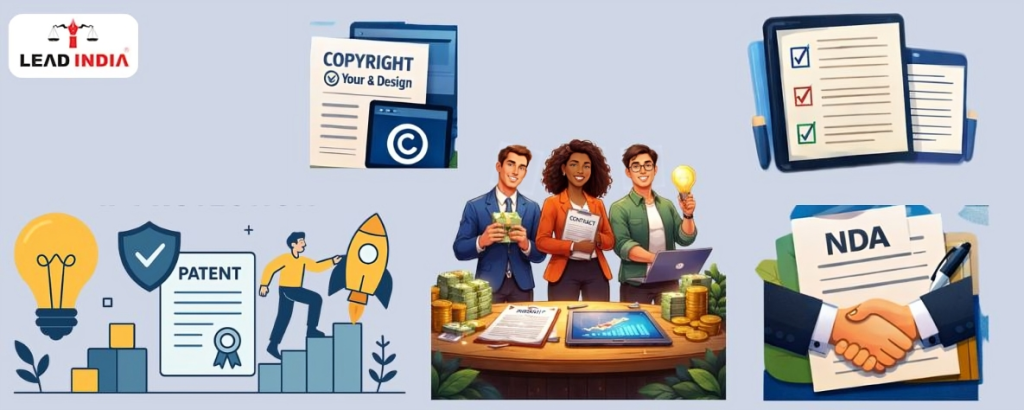
When the startup founders think about building one app, the biggest fear that comes to their mind is:
- “What if someone copies my app idea?”
- “Can I legally stop others from using my concept?”
This confusion is very much natural.
Understanding what the law actually protects, what it does not protect, and how protection works in practice helps startups avoid costly mistakes, false assumptions, and future litigation.
What App Idea Protection Is and What It Is Not
The most important legal truth every founder must understand is this:
- Indian law does NOT protect ideas by themselves.
- This does not mean the law is against startups. It only means that the law protects execution, not imagination.
- Indian courts have consistently held that an idea, concept, or business model is free for everyone to think about. Whatever the law protects is the only form in which that idea is expressed as well as implemented.
- The Supreme Court in the case of R.G. Anand v. Delux Films held that the copyright does not exist in the ideas, themes, or concepts, but it only esixts in the manner of their expression.
- This means that you cannot legally protect a raw app concept and you can most legally protect the app once it is made, designed, written, or it is documented.
What App Protection Really Means in Practical Terms
To simplify it for founders, legal protection for apps means this:
Once your app takes a tangible form, the law steps in.
This includes:
- Source code written by developers
- App design, layout, and UI/UX flow
- Written content, images, and graphics
- Databases and structured data
- Branding elements like name and logo
The right to legally protect your invention is not guaranteed simply because you were the first to develop it. The ability to legally protect your invention starts once you have made it available to others in a “visible,” “working,” and/or “documented” form.
Copyright Protection for Apps: What It Covers and Why It Matters
With respect to copyright protection of software applications, software applications are considered by law to be literary works under the United States Copyright Law of 1957, therefore your application code and content will have copyright protection when the application itself is created.
Copyright protects:
- source code and object code
- app text, images, videos, and audio
- interface layouts and original designs
- databases and original compilations
In the decision of Eastern Book Company v. DB Modak, the Supreme Court interpreted the definition of originality as requiring a low threshold for creativity and that most software meets this low threshold.
While an author obtains copyright protection automatically when they create their work, registering the authorship of the work provides important legal benefits to the author. Registration provides a significant presumption of the validity of the copyright and provides an expedited process for obtaining an injunction against infringement.
Trademark Protection: Securing Your App Name and Brand
The app name, logo, and brand identity of an application may be more important than the idea itself. These three elements fall under protection afforded through the Trade Marks Act of 1999.
Through trademark registration you will receive an exclusive right to use the app name and logo, guarantee against the launch of deceptively similar apps and provide you with the ability to remove any other listings from an app store which are copies of your app.
In Yahoo! Inc. v. Akash Arora, the Delhi High Court recognized that all digital names and identities have trademark value and they will restrain from allowing similar works to be sold.
Therefore, when you launch your app; you need to ensure that your trademarks are protected prior to launching them publicly instead of waiting until the app is a well-established product before you have made any efforts to protect those trademarks.
Can an App Be Patented in India? The Reality Founders Must Know
Many founders believe that patents are the strongest form of protection. However, Indian law does not allow patents for software “as such”.
Section 3(k) of Patents Act mostly excludes the pure software as well as the business methods from the patentability.
The patent protection may be possible if at all your app:
- shows a technical advancement
- solves a technical problem
- integrates hardware or system architecture
Examples can consist of AI based processes, IoT systems, industrial automation apps etc. Patent eligibility is primarily technical and therefore each application requires individual submission and approval.
NDAs: The First Legal Shield for App Founders
Before discussing your app with developers, potential investors, designers, marketing consultants, or any other individuals involved in your development. You need an NDA in place.
An NDA is a legal contract which binds you and the other party to maintain confidentiality on disclosed information, cannot misappropriate, or otherwise use the disclosed information for any other than authorized purposes.
Indian courts enforce NDAs as valid contracts. In Navigators Logistics Ltd. v. Kashif Qureshi, misuse of confidential business information was restrained by the court.
NDAs are especially important during:
- pitch meetings
- outsourced development
- beta testing
- strategic partnerships
Trade Secrets: Protecting What You Don’t Register
Not all valuable aspects of an app are registered. Most elements considered to be the essential factors for trade secrets include formulas, pricing algorithms, processes, and data relating to customers.
Unlike some countries, India does not have a specific statutory regime governing trade secret; however, protection for trade secrets can arise through the following legal mechanisms:
- Contract law
- Confidentiality clauses
- Equity principles
For example, in the case of Zee Telefilms Ltd. v. Sundial Communications, the Bombay High Court determined that confidential information transmitted in the course of negotiating a business agreement was entitled to equitable protection.
Developer Agreements: Ownership Must Be Clearly Written
It is also very important to ensure that ownership of a developer’s code is clearly defined in writing. Startups often make the mistake of assuming that by paying a developer they automatically acquire ownership rights to the source code.
Legally, the creator primarily owns the copyright unless it is assigned in the form of writing.
Every development agreement must clearly state:
- All intellectual property belongs to the startup
- Source code must be handed over
- No reuse or resale of code
- Clear assignment of rights
Without this, even your own developer may legally claim ownership.
What If Someone Copies or Clones Your App?
If your app’s design, content, or the branding is copied, the Indian law provides strong remedies.
You may file:
- copyright infringement actions
- trademark infringement suits
- passing off claims
In Burlington Home Shopping v. Rajnish Chibber, the court restrained unauthorized copying of software content and business formats.
The courts today mostly grant the injunctions, takedown orders, as well as the damages against the cloned apps.
What You Should Practically Do Right Now
If you are building an app and feel confused:
- Do Not assume ideas are legally protected
- Do Not skip NDAs with developers or investors
- Do Not delay trademark filing
- Do Not rely on verbal ownership promises
- Do Not ignore proper contracts
The wrong legal decisions at the earliest stage often cost the startups money, control, as well as credibility.
How We Help Startups Protect Their App Ideas
We help all the startups to understand what is legally protectable, structure the IP ownership correctly, draft the most enforceable NDAs, and take timely action against such infringement.
Our primary approach focuses on only preventing the disputes and not just reacting to them.
One can talk to lawyer from Lead India for any kind of legal support. In India, free legal advice online can be obtained at Lead India. Along with receiving free legal advice online, one can also ask questions to the experts online free through Lead India.
FAQs
1. Are the app ideas fully and legally protected in India?
No. Ideas alone are not protected. Execution and expression are protected.
2. Can any person legally copy the idea of my app?
They can actually copy the idea, but they cannot copy your code, design, or the branding.
3. Is copyright registration compulsory for all the apps?
No, but the registration is strongly recommended for the registration.
4. Should I trademark my app before the launch?
Yes. The trademark filing before the public launch is very much ideal.
5. Can developers claim ownership of my app?
Yes, if ownership is not assigned in writing.
6. What is the fastest legal remedy against app cloning?
Injunctions through copyright or trademark enforcement.


 Talk to a Lawyer