
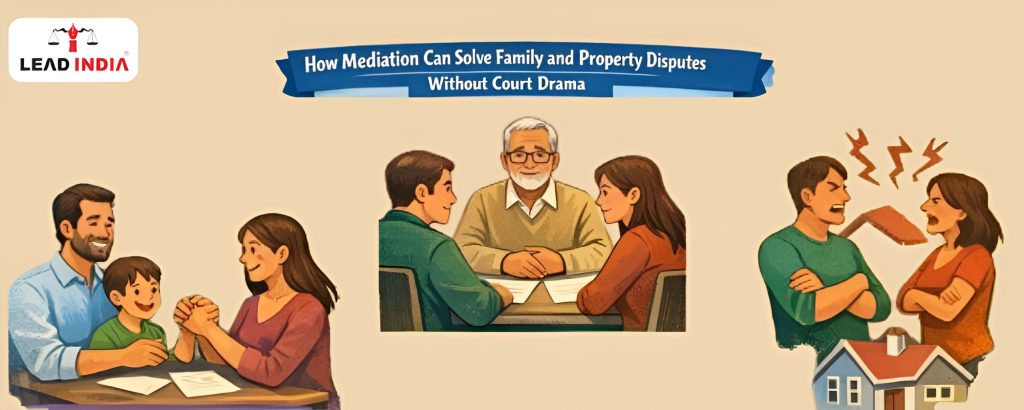
Family and property disputes can have a very negative impact on a person’s health (emotional, financial, and mental) and take a lot of time and money to settle. If you ever went to a court trying to settle an issue, you already know how exhausting litigation can be with numerous hearings, anxiety, lawyers’ bills, and uncertainty for years. India alone has 5 crore pending cases across the country so it is totally justifiable to feel overwhelmed and helpless in finding your way through the legal system if you have a case pending in India.
Mediation brings back open communication, respect, and future relationships. As a result, mediation has become one of the most effective processes in resolving family and property disputes in India.
Mediation Explained Simply
Mediation is voluntary, confidential, as well as it is a structured conversation procedure facilitated by a neutral third person known as the mediator. Unlike judges, mediators do not impose decisions. Mediators are present for both the parties during the whole process of mediation:
- Open up safely,
- Understand each other,
- Rebuild communication,
- And find a solution that works for everyone.
Mediation is built on three principles:
- Respect
- Privacy
- Choice
It allows families to resolve problems with dignity instead of confrontation.
Why Most Family Conflicts Don’t Need a Judge: They Need a Conversation
Family disputes are rarely about the legal issue alone. Mediators frequently observe that:
- A dispute over property often hides years of hurt or miscommunication.
- A marital fight may stem from unmet expectations, not incompatibility.
- A custody battle may be a reflection of stress, not lack of love.
Mediation provides a safe space where these unspoken concerns finally come out, something courtrooms simply cannot offer.
The Types of Disputes Mediation Solves Faster Than Court
1. Matrimonial & Relationship Disputes
- Communication problems
- Divorce settlements
- Maintenance/alimony
- Parenting plans
- Conflicts with in-laws
2. Property & Inheritance Matters
- Division of ancestral property
- Joint family property disputes
- Co-owner disagreements
- Partition of residential or commercial property
3. Elder Care & Family Responsibilities
- Shared caregiving
- Expense distribution
- Medical responsibility planning
4. Family-Owned Business Issues
- Partnership disputes
- Profit-sharing conflicts
- Decision-making disagreements
Mediation vs Court: The Difference Seen Daily in Real Cases
Mediators regularly observe a dramatic difference between families who choose mediation and those who fight in court.
Court Proceedings:
- Long delays
- Formal hearings
- Public exposure
- Expensive procedures
- Win-lose outcome
Mediation:
- Private discussions
- Faster closure
- Low cost
- Emotional relief
- Win-win solutions
What Actually Happens Inside a Mediation Session (Step-by-Step)
Understanding the process of mediation helps remove anxiety.
1. The Introduction: The mediator explains the rules, ensures comfort, as well as it sets a respectful tone.
2. Sharing Stories: Both sides share their experience without interruption. Mediators often observe that this is the first time both parties truly hear each other.
3. Identifying the Core Issues: The mediator summarises concerns, whether financial, emotional, or practical.
4. Joint and Private Conversation: The mediator may have an individual conversation with each side to facilitate additional honest communication, free of emotional risk.
5. Generating Options and Building an Agreement: Options are generated, misunderstandings are reconciled, and preliminary agreements take shape.
6. Settlement Agreement: The settlement is documented, signed by all parties, and if necessary, delivered to the court. Mediation settlements referred by the court are legally enforceable.
Strong Legal Backing That Makes Mediation Safe and Reliable in India
Mediation is fully supported within the legislative framework of India. Courts favour it for mediation of family disputes because it tends to minimize ill will and helps preserve relationships.
Key Legal Provisions Supporting Mediation
- Section 89 CPC: Courts are permitted to refer matters to mediation.
- Family Courts Act, 1984: counselling and settlement.
- Legal Services Authorities Act, 1987: Enables mediation through Lok Adalat.
- Mediation Centres of High Courts & District Courts: Thousands of matters are settled through mediation each year.
- The Mediation Act, 2023: India’s dedicated law ensuring:
- time-bound mediation
- enforceable settlements
- trained, qualified mediators
- a standardised process
This Act gives mediation the legal certainty families need.
Case Laws That Transformed Mediation in Family Disputes
1. In Afcons Infrastructure Ltd. v. Cherian Varkey Construction (2010), the Supreme Court affirmed mediation is appropriate for family matters under Section 89 CPC.
2. In K. Srinivas Rao v. D.A. Deepa (2013), the Court noted that mediation has a way of diminishing emotional anguish, especially in matrimonial matters.
3. In M.R. Krishna Murthi v. New India Assurance (2019), the Court urged a statutory framework for mediation in family disputes, which led to the introduction of the new Act of 2023.
4. In Satyapal v. Anita (Delhi HC, 2014), the parties were able to resolve a 20-year dispute over a family property peacefully through mediation.
5. In Gaurav Nagpal v. Sumedha Nagpal (2009), the Court observed mediation is suited to create child-centred custody orders.
How Mediation Gently Heals Marriages, Families, and Communication?
Mediators repeatedly observe that family disputes often have one thing in common, i.e., the unexpressed emotions.
Through mediation:
- Couples rediscover communication
- Parents and children rebuild trust
- Siblings find shared ground
- In-laws’ clear misunderstandings
- Co-owners understand each other’s needs
The focus is not on winning, but on regaining peace.
Property Fights That Could Have Gone on for Years but Didn’t
Property matters can strain even the closest families. But mediation brings practical clarity.
Mediation helps families decide:
- Who will retain the property
- How compensation will be paid
- How to divide sentimental spaces
- How to share rental income
- How to settle long-pending inheritance issues
Mediators often observe that once emotional barriers reduce, families realise the dispute was never about the physical property, but the feelings attached to it.
Real Stories from Mediation Practice: How Families Found Peace?
These examples are based on common mediator experiences seen across India.
1. Brothers Reunite After 12 Years
Two brothers fighting over ancestral land had not spoken in a decade.
In mediation, one finally expressed how the dispute made him feel excluded from the family.
Hearing that dissolved the other brother’s attitude, and the matter was settled in three sessions.
2. Elder Care Plan Among Siblings
Three siblings fighting over caregiving responsibilities reached a practical plan: shared expenses, scheduled visits, and regular check-ins.
The court could never have crafted such a personalised solution.
Why Mediation Works When Court Fails?
Mediators consistently notice three truths:
1. Court Addresses Law; Mediation Addresses Emotion
Court orders cannot heal emotional wounds. Mediation can.
2. Mediation Looks Toward the Future
Instead of focusing on “Who is right?”
Mediation asks, “What will work from here?”
3. Mediation Allows Creative Solutions
Courts follow legal rules.
Mediation allows:
- flexible custody plans
- sentiment-based property distribution
- shared elder care
- customised financial arrangements
These solutions simply cannot come from a judgment.
Conclusion
Family mediation provides an opportunity for families to resolve issues with courtesy, privacy, dignity, and collaboration. There is a chance for legal resolution after a court battle however with mediation the emotional resolution is what counts.
Mediation has strong legal backing, increasing rates of success, and is made for humans to talk to each other. Mediation is quickly catching on as India’s preferred way of resolving family and property disputes, with mediation provided by the justice system.
You don’t always need a courtroom to find peace. Sometimes, you just need a conversation guided the right way.
One can talk to lawyer from Lead India for any kind of legal support. In India, free legal advice online can be obtained at Lead India. Along with receiving free legal advice online, one can also ask questions to the experts online free through Lead India.
FAQs
1. Is mediation legally binding in India?
If the mediation is referred by the court, the final settlement agreement becomes legally binding as soon as the court records it. Besides, under the new Mediation Act, 2023, the settlements made through private mediation can also be enforced like a court decree if the agreement is signed by both the parties.
2. Is mediation helpful even when the parties are extremely angry or not communicating at all?
Mediation is still a good option in such extreme situations; for instance, when there is a lot of emotion or no talk at all. It happens that a family starts mediating all filled up with rage, but the feelings change gradually, and family members learn to communicate and be supportive when they feel that their needs and feelings are being respected and that mediation is a safe place for them. Judges have also had successful case resolution in high-conflict situations through mediators.


 Talk to a Lawyer