
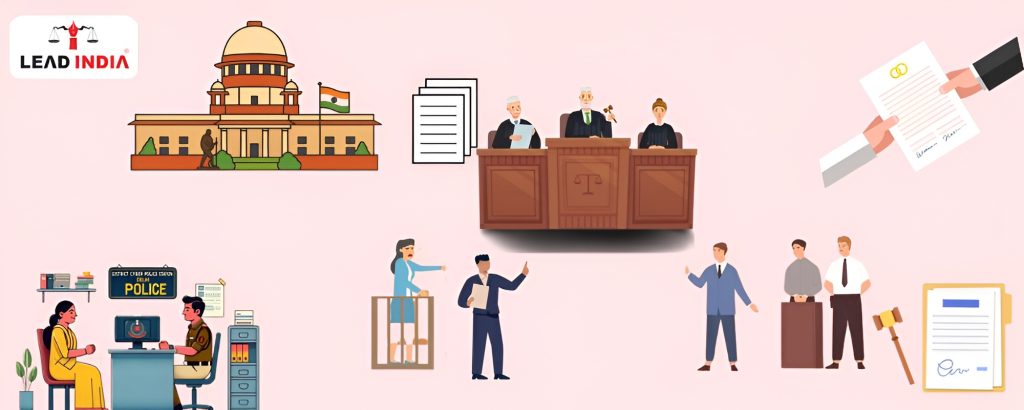
Under Article 124 of the Constitution of India, the Supreme Court has been established as the country’s highest judicial body. It is the final authority on legal matters and serves as the protector of fundamental rights. As the court of final appeal, it can hear cases on constitutional matters, matters of national importance, matters involving the violation of fundamental rights, and appeals on Special Leave Petitions (SLPs) from the decisions of High Courts or tribunals.
The Supreme Court case filing procedure is laid out in the Supreme Court Rules, 2013, which also references the Civil Procedure Code (CPC) and the Criminal Procedure Code (CrPC)/Bhartiya Nagarik Suraksha Sanhita (BNSS). There are, however, certain matters that cannot be initiated in the Supreme Court. This guide clarifies the matters in which the Supreme Court can be approached, the petition filing steps, the relevant time limits, and important case law, in addition to the detailed procedure.
When Can You Go Directly to the Supreme Court?
The Supreme Court doesn’t entertain every dispute. Based on experience with clients, here are the situations where it’s possible:
- Fundamental Rights Violations (Article 32): For example: A citizen facing wrongful arrest approached us to file a writ petition directly in the Supreme Court.
- Disputes Between Union & States (Article 131): Rare but important, it is handled directly by the Court.
- Appeals from High Courts (Articles 132-136): The majority of petitioners enter the Supreme Court through this channel, primarily through SLP applications.
- Public Interest Litigations (PILs): NGOs and citizens can file cases for social causes, it is seen that the PILs bring relief in cases of environmental pollution, bonded labour, and police brutality.
Who Can File a Supreme Court Case?
- An employee claiming violation of Article 21 (right to livelihood).
- A state government in a water-sharing dispute.
- An accused who feels wrongly convicted by a High Court.
- An NGO filing against industrial pollution affecting thousands.
It is noticed that many ordinary citizens hesitate, thinking the Supreme Court is “out of reach.” But with the right Advocate-on-Record (AOR), the process becomes manageable.
What Actually Happens When You File in the Supreme Court?
Here’s what you will experience step by step:
Step 1: Hiring an Advocate-on-Record (AOR)
Clients are often surprised when told that only AORs can file petitions. Even big corporate clients must route their filings through an AOR.
Step 2: Preparing Your Petition
Depending on the case type (Writ, SLP, Review, Curative), your lawyer drafts a petition with:
- Synopsis of facts
- List of dates
- Supporting documents
- Affidavits
First-hand tip: Clients often forget certified copies of High Court judgments, causing delays. Always keep documents ready.
Step 3: Filing the Petition
- Offline at the Registry in Delhi.
- Online via the Supreme Court e-filing portal.
E-filing has made things faster, especially for outstation clients.
Step 4: Registry Scrutiny
Your petition is checked for defects (fees, annexures, affidavits). Don’t panic if defects are flagged, they are common and can be corrected.
Step 5: Listing & Admission Hearing
The case is listed before the Chief Justice or a bench. Many clients feel nervous at this stage, but remember, admission is only about whether the case deserves a full hearing.
Step 6: Notice & Final Hearing
If admitted, notice goes to the other party. After counter-affidavits, the Court hears arguments.
- The Division Bench consists of 2 judges for most of the cases.
- The Constitutional Bench consists of 5+ judges for any type of big constitutional issues.
Step 7: Judgment & Relief
All the courts in India need to mandatorily follow the judgment of the Supreme Court in accordance with Article 141.
How Much Time and Money Should You Expect?
Time Limits:
- SLP: 90 days from High Court judgment (60 if appeal certificate denied).
- Review: 30 days.
- Curative: only after review dismissal.
Delays: A valid reason can allow the courts to accept the delays in accordance with the Limitation Act, 1963.
Costs: In addition to the nominal filing fees (₹200-₹500), the real costs depend on the fees of advocates-on-record (AOR), the senior counsel, the printing and as well as the documentation.
Tip: If affordability is the issue, you can approach the Supreme Court Legal Services Committee for any type of free legal aid.
Case Laws That Changed Access to Justice
- Kesavananda Bharati v. State of Kerala (1973): This case has preserved the Constitution’s” basic structure.”
- Hussainara Khatoon v. State of Bihar (1979): This case has linked the speedy trial to Article 21.
- S.P. Gupta v. Union of India (1981): This particular case has allowed public interest litigation (PIL).
- M.C. Mehta v. Union of India (1987): This case has made the environmental protection actionable.
Common Challenges People Face
From client stories, here’s what usually troubles them:
- High legal costs: Senior lawyers charge lakhs.
- Procedural complexity: Many documents and affidavits.
- Delay in listing and hearings: Due to heavy backlog.
- Accessibility: Traveling to Delhi is tough for rural clients.
Practical Advice to Clients
- Be ready with all documents: Missing annexures cause the most delays.
- Don’t wait till the last day: File well within limitation periods.
- Discuss costs openly: Understand advocate’s fee structure.
- Ask about interim relief: Sometimes urgent stay orders matter more than final judgment.
Conclusion
Filing in the Supreme Court is not just about legal forms; it’s about strategy, timing, and the right professional help. As long as these necessary steps are followed, these common citizens can seek justice from the highest court of the country.
The Supreme Court has consistently acted as the protector of rights and justice in the country. Therefore, understanding the procedure enables you to act appropriately and takes the burden out of the situation.
One can talk to lawyer from Lead India for any kind of legal support. In India, free legal advice online can be obtained at Lead India. Along with receiving free legal advice online, one can also ask questions to the experts online free through Lead India.
FAQs
1. What papers do I need to file a case in the Supreme Court?
You absolutely need to have certified copies of the High Court judgment, affidavits and their supporting documents, and a drafted petition. All of these need to be duly signed by an Advocate-on-Record.
2. Is it possible to obtain emergency relief from the Supreme Court?
Certainly. You can request for interim relief including stay orders, bail, or injunctions, even while your petition is pending.
3. Is it possible to file a Supreme Court case online?
Yes. The Supreme Court provides an e-filing portal where you can submit both the petitions and the associated documents in digital form.


 Talk to a Lawyer