
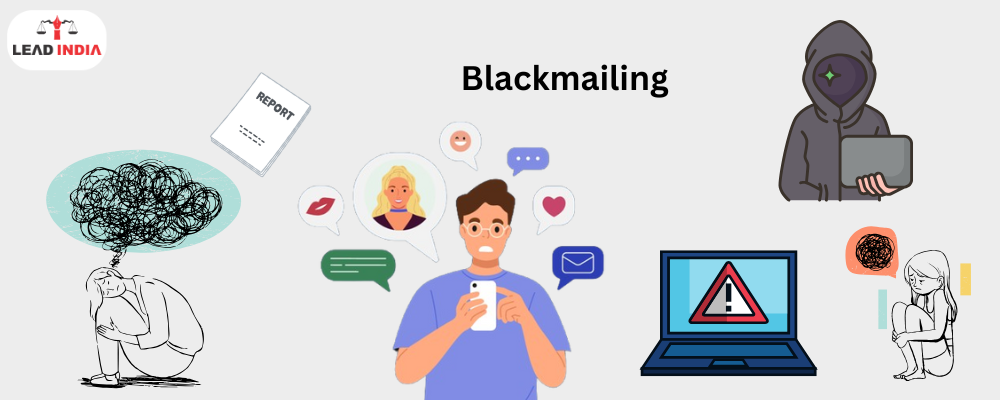
How to File a Complaint Against Blackmail in India – A Step-by-Step Legal Guide
Blackmail constitutes a serious crime according to Indian law, involving intimidation or pressure to compel an individual to meet illegal demands. These requests may involve money, sexual favors, property, or confidentiality. Regardless of happening in person or via digital mediums, blackmail is subject to punishment under the Indian Penal Code (IPC) and associated cyber regulations.
This piece acts as a comprehensive, person-focused legal resource on filing a blackmail complaint in India, encompassing definitions, relevant legal provisions, reporting procedures both online and offline, and expert legal solutions.
Need A Legal Advice
The internet is not a lawyer and neither are you. Talk to a real lawyer about your legal issue

What Is Blackmailing? Legal Meaning and Real-Life Examples
Blackmailing refers to threatening an individual in order to force them into doing something against their will, usually for the blackmailer’s personal gain. It may involve:
- Threatening to publish personal photos or videos
- Demanding money or favours in return for keeping secrets
- Using confidential information to create fear
- Coercing someone to stay silent about a crime or wrongdoing
Legal Definition:
Blackmailing is covered under:
- Section 384 IPC BNS Section 308, (Extortion): Forcing someone to deliver money or property through threats.
- Section 503 IPC BNS Section 351 ,(Criminal Intimidation): Threatening someone with injury to their person, reputation, or property.
- Section 506 IPC/ BNS Section 351: Punishment for criminal intimidation.
Common Blackmail Scenarios in India:
- A person threatens to leak morphed intimate pictures unless money is paid.
- A former partner threatens to expose private conversations unless sexual favours are returned.
- Someone uses your past or confidential medical history to force you to resign from a job or marriage.
Is Blackmailing a Crime in India? – Understanding Applicable Laws
Yes. Blackmailing is clearly recognized as a punishable crime under Indian Penal Code and IT Act, especially when it involves coercion, threats, or extortion.
Relevant Legal Provisions:
| Section | Law | Explanation |
| IPC Section 384/ BNS Section 308 | BNS | Defines and punishes extortion (up to, 2 to 10 years of imprisonment + fine)(According to the Classifications of the Offences) |
| IPC Section 503/ BNS Section 351 | BNS | Defines criminal intimidation—any threat of harm to body, reputation, or property |
| IPC Section 506/ BNS Section 351 | BNS | Punishment for criminal intimidation (up to 2 years; more if threat to life involved) |
| Sections 66E & 67 | IT Act | For transmitting obscene content or violating privacy digitally |
These sections can be used to file criminal charges depending on the nature of blackmail—whether digital (cyber blackmail) or physical threats.
How to Recognize You Are Being Blackmailed
Before filing a complaint, ensure the incident qualifies as blackmail. If any of the following conditions apply, you may have a valid legal case:
- Someone is demanding money, sex, or favors in exchange for silence
- You are being threatened with release of private photos or videos
- You are under pressure due to fear of reputation damage
- The threats are made repeatedly or with increasing demands
The intention to cause fear and obtain unlawful gains is the core of blackmail.
Step-by-Step Guide: How to File a Complaint Against Blackmail in India
Step 1: Gather All Evidence
Before approaching the authorities, collect and preserve any form of proof:
- Threatening messages (WhatsApp, email, SMS)
- Screenshots of social media chats
- Call recordings (if legally recorded)
- Photographs or video clips used for threats
- Bank transfer or payment screenshots (if any demand was met)
Even if partial, these documents will help law enforcement build a stronger case.
Step 2: Write a Detailed Complaint
Draft a complaint that clearly outlines:
- Who is blackmailing you (if known)
- How they are threatening you
- What they are demanding
- When and how the threats occurred
- Any prior relationship with the person (if applicable)
Keep the language factual and avoid emotional statements.
Step 3: Visit the Nearest Police Station
Go to your local police station with the written complaint and evidence. Request them to file an FIR (First Information Report) under IPC Sections 384/ 308 BNS, 503/351 BNS and 506/351 BNS..
What to Expect:
- Your statement will be recorded.
- The officer-in-charge may ask for a copy of digital evidence.
- You may receive a copy of the FIR with an FIR number.
If the police are reluctant or dismissive, approach the Superintendent of Police or file a complaint with the State Police Complaint Authority.
Step 4: File a Cyber Crime Complaint (If Online)
If blackmail occurred online—through social media, email, or video calls—report it to the Cyber Cell.
How to File a Cyber Complaint:
- Online Portal: Go to https://www.cybercrime.gov.in
Choose Category:
- Cybercrime against women & children
- Other cyber crimes (select appropriate category)
Fill the Form:
- Complainant name, phone, email ID
- Offender details (if known)
- Description of the incident
- Upload screenshots or files as proof
- Get Complaint Number: Keep the acknowledgement safe for tracking.
Cyber Cells are present in almost every major city and state, including Delhi, Mumbai, Bangalore, Pune, Hyderabad, etc.
Step 5: Seek Help from National Commission for Women (For Women Victims)
If you’re a woman being blackmailed or harassed, you can approach the National Commission for Women (NCW) for urgent intervention.
- Visit https://ncw.nic.in/
- File your complaint online under the “Register Complaint” tab
They can help escalate your case and coordinate with local police if your complaint isn’t being taken seriously.
Step 6: Send a Legal Notice (Through a Lawyer)
If you wish to avoid immediate FIR and want to first warn the blackmailer legally:
- Hire a criminal or cyber lawyer
- Ask them to send a legal notice stating that any further threats or action will lead to prosecution under IPC
- This can act as a deterrent, and in some cases, it helps resolve issues without court involvement
Why Is Legal Support Important in Blackmailing Cases?
Blackmailing cases can become complex, especially if:
- The blackmailer is anonymous or hiding behind fake accounts
- The evidence is scattered across devices and platforms
- There is emotional or reputational sensitivity involved
A lawyer can help you:
- Choose the right legal sections
- Draft a complaint or legal notice
- Preserve digital evidence properly
- File for injunctions (to prevent further harassment)
- Represent you in court if required
What Happens After a Complaint Is Filed?
Once your complaint or FIR is registered:
- Investigation begins under the relevant IPC/IT Act provisions
- Police may summon the accused for questioning
- Digital evidence may be collected (via IP tracing, account logins)
- If charges are proven, a chargesheet is filed in court
- The accused may be arrested or get bail depending on the severity
If threats continue or new evidence arises, you can file supplementary complaints.
Precautionary Tips to Avoid Being Blackmailed
Never share private photos, passwords, or personal videos with anyone
- Enable 2FA on all social media accounts
- Regularly scan your devices for spyware or screen recorders
- Report suspicious behavior immediately
- If harassed once, don’t give in. The more you pay or comply, the more you’ll be targeted
Rights of the Victim in Blackmail Cases
Under Indian law, blackmail victims have the right to:
- Immediate police protection if there is a threat to life
- Anonymous filing, especially for women and children
- Free legal aid through District Legal Services Authorities
- Compensation, under victim compensation schemes in some states
- Digital takedown requests via CERT-IN or intermediaries like YouTube, Instagram, etc.
Conclusion:
Speak Up, Don’t Stay Silent
Blackmail can cause emotional trauma, financial loss, and reputational harm—but it is never your fault. Staying silent gives power to the offender. Filing a complaint, preserving evidence, and seeking legal help are your best tools to stop it.
Whether you are being blackmailed online, in a relationship, or by a stranger, the Indian legal system has clear mechanisms to help you. Police authorities, cyber cells, and legal professionals are there to support and protect you.
One can talk to lawyers from Lead India for any kind of legal support. In India, free legal advice online can be obtained at Lead India. Along with receiving free legal advice online, one can also ask questions to the experts online free through Lead India.
FAQs
1. Can I report blackmail online in India?
Yes, you can file an online complaint at www.cybercrime.gov.in.
2. Is blackmail through WhatsApp or Instagram a crime?
Yes, blackmail via social media is a cybercrime and punishable under IPC and IT Act.
3. Do I need evidence to file a blackmail complaint?
Yes, screenshots, messages, or recordings can help strengthen your case.


 Talk to a Lawyer