
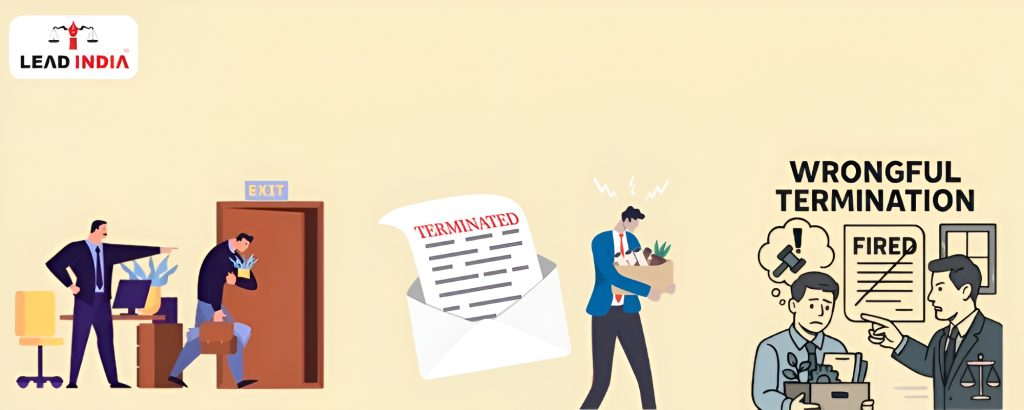
When the employees suddenly tend to lose their job, the first question is: “Can my employer terminate me like this, or is this illegal?”
This confusion is so common.
In most of the situations the employees believe that the employer has the complete authority to terminate them at any point of time. This belief is not fully correct. While the employers do have the right to terminate employment, the law mostly requires them to follow the proper procedure, fairness, as well as the legal safeguards.
Understanding as to what exactly the illegal termination means, when the termination becomes unlawful, as well as what are the legal remedies that are available which can help the employees protect their rights as well as avoid serious financial and professional damage.
What Illegal Termination Really Means
Illegal termination is the act of terminating an employee without due process, thereby violating labour law, the terms of an employee’s employment contract and the concept of natural justice.
In other words, termination becomes illegal when an employer terminates an employee from employment without using the proper legal methods to do so.
The current labour laws in India do not allow an employer to terminate an employee for arbitrary reasons. Instead, the employer must satisfy all of the requirements set out in the applicable labour law statutes, the terms of any applicable employment contracts and the internal rules of discipline used by the employer.
The following are examples of situations where an employee can be legally terminated:
- The employee was not given prior notice of termination and/or payment of notice on termination.
- The employee was terminated without an employee being given the opportunity to defend themselves or have their actions investigated (i.e. without a domestic enquiry);
- The employee was terminated due to discrimination on the basis of such things as race, religion, gender or pregnancy;
- The employer terminated the employee as the employee has filed the complaint against the employer as well as reported the misconduct as a whistleblower.
- The employee had to leave his job as the employer used the threats and bullying to force him out.
A workman who has worked 240 days during the 12-month period before his firing must receive advance notice and layoff compensation before his employer can terminate his employment. The labour court will consider a termination to be invalid when an employer fails to meet this specific obligation.
What Employers Are Legally Required to Follow Before Termination
Termination of employment in India is controlled by the legislation governing labour practices and the employer and employee agreement or employment contract.
Before taking any action to terminate an employee’s employment, the employer has to comply with certain processes:
- First, an employee should receive the notice period as outlined in the employment agreement unless notice is waived and the employer compensates for such waiver.
- An employer needs to investigate internal employee misconduct through a domestic inquiry, which involves a termination dismissal process that requires employers to investigate employee misconduct, and the employee needs to receive an opportunity for defense against the inquiry findings and the chance to respond to the case against him.
- The employer must initiate employee termination processes through a statutory system that establishes employee rights under laws such as the Industrial Disputes Act and the Shops and Establishments Act.
An employee’s termination does not establish that the employer terminated the employee through illegal means. The presence of specific factors connected to the employee’s dismissal suggests that the employer violated employment relationship laws through the employee’s termination.
Situations Where Termination May Be Illegal
Just because an employee is terminated does not mean that the employer’s termination of that employee was automatically illegal. However, if there are certain elements associated with the employee’s termination, this could indicate that the employee’s termination was in violation of the laws governing employment relationships.
One of the most common circumstances under which an employee’s termination would be considered illegal would occur where an employer terminates an employee without providing notice, notice period, or providing a severance package as provided for under the employment agreement (contract).
Another instance of illegal termination would occur if an employer terminated an employee based on allegations of misconduct after not performing a proper investigation into the matter prior to taking the disciplinary action against the employee. The Indian Supreme Court has consistently held that an employee must be afforded the opportunity to defend themselves against all allegations prior to the employer taking the disciplinary action.
An employee with protected status who experiences discrimination at work can face illegal termination from his job. This includes current employees who are pregnant, employees who belong to a trade union, and employees who report workplace misconduct through protected channels.
In some of the circumstances, the employee may be pressured to submit their resignation letter; this may be only deemed to be the constructive discharge, which means that the resignation of the employee from the employment was not at all voluntary.
What Employees Should Do Immediately After Illegal Termination
If you suspect that your termination was illegal, it is important to take appropriate actions as soon as possible to protect your legal rights.
- The first step you need to take is to maintain all employment documents which you received during your time at work. The standard practice requires you to receive this:
- An appointment letter
- Your employment agreement
- Your termination email
- Your salary slips
- Performance reviews
- Any written communication to or from your employer
- The documents serve as evidence to establish your employment status and to demonstrate whether your employer broke the contract and whether they violated legal requirements.
- The second step requires you to contact your employer and ask for a written termination explanation. Employers typically provide formal termination letters which specify the reasons for your dismissal.
- The third step requires you to seek legal counsel and evaluate sending a legal notice to your employer.
- The Labour Commissioner will handle your claim if your employer refuses to settle it through mandatory conciliation proceedings.
- If conciliation does not succeed, your claim will proceed to either the Industrial Tribunal or the Labour Court for hearing.
Important Laws That Protect Employees in India
Numerous employee protections against wrongful termination exist in Indian law.
- Among them, one of the main protections is the Industrial Disputes Act. According to this act, when terminating employment of a person with sufficient tenure of employment, an employer must give proper notice and retrenchment compensation (Section 25F).
- The Industrial Disputes Act also provides for the principle of “last in, first out” (Section 25G) to be followed by an employer during the retrenchment of employees.
- Private sector employees are also protected by the Shops and Establishments Acts in their respective states as they relate to working conditions, termination process and employee rights.
- In the case of government or public sector employees, terminating an employee may violate constitutional protections for equality before the law (Article 14) and for equal opportunity to employment in government (Article 16).
Important Court Judgments on Illegal Termination
The Indian judiciary system has demonstrated its dedication to protect workers’ right to fair treatment and due process during employment termination processes.
- The Supreme Court found that D.K Yadav v J.M.A Industries Ltd required employers to allow employees to defend themselves before making any termination decisions.
- The Court in Workmen of Motipur Sugar Factory v Motipur Sugar Factory established that when there exists no domestic inquiry or the existing inquiry shows serious flaws, the Labour Court must evaluate the termination decision to determine its fairness and reasonableness.
The above noted cases demonstrate that the judiciary does not condone arbitrary or unfair dismissal of employees.
Remedies Available to Employees After Illegal Termination
If a court decides that a termination was illegal or a wrongful act then the employee could receive several types of remedies from the court.
- If a court orders the reinstatement, then it gives the worker his/her job back.
- Employees can also receive back wages (the wages that were lost due to the illegal termination) as a remedy in many cases.
- In addition to reinstatement of employment, the court can also award the employee continuity of service (keeping benefits earned previously like gratuity, seniority, etc.).
- Where reinstatement of employment is not possible for practical reasons then the court could award alternate monetary compensation.
- Even if a dispute is resolved through negotiations by the parties (the employee and employer), an employee may receive compensation and both parties agree to settle their dispute.
Practical Precautions Employees Should Always Take
The employees need to maintain proper work habits because this will help them protect themselves from wrongful termination.
- Keep copies of your appointment letters, employment contracts, pay stubs, etc.
- You must record all essential messages which you receive from your employer that include but do not limit to disciplinary actions and job evaluations.
- Employees should avoid signing resignation letters or settlement agreements until they understand their legal implications and until their pressure condition stops.
- Get legal assistance prior to accepting any monetary compensation in exchange for signing any exit documents, these documents may create long-lasting legal issues down the road.
Most importantly, after termination, you must move quickly because most labour-related issues are subject to limitation guidelines.
Why Understanding Your Legal Rights Is Important
Unlawful termination can lead to both severe financial as well as physical and emotional harm, but Indian Labour Laws provide strong protections against unjust termination.
Employees who believe they face unjust termination must gather evidence and contact a lawyer within a brief period to access their available legal options through both labor authorities and court systems. The Indian courts have consistently held that employers must comply with proper procedures, transparency, and principles of natural justice before terminating an employee.
Employees who take swift actions will prove their termination occurred without justification, which will enable them to receive proper compensation through reinstatement, damages, or settlement.
One can talk to lawyer from Lead India for any kind of legal support. In India, free legal advice online can be obtained at Lead India. Along with receiving free legal advice online, one can also ask questions to the experts online free through Lead India.
FAQs
1. Can the employer terminate one employee without any notice in India?
No. The employers must follow the notice period that is mentioned in the employment contract or they need to pay the salary in lieu of notice unless the termination is based on proven misconduct after the proper inquiry.
2. What should I do if at all I am terminated in an illegal way?
You should usually collect the employment documents, request all the written reasons for termination, consult the lawyer, as well as consider sending the legal notice to the employer.
3. Can I get my job back after the illegal termination is done?
Yes. The labour courts may order the reinstatement with all the back wages if the termination is found to be unlawful.
4. Can the employers force the employees to resign?
No. If at all the resignation is obtained through any kind of coercion or pressure, it may be treated as constructive dismissal as well as it can be legally challenged.
5. How long does it take to resolve the labour court case?
The duration varies mostly depending on the case, but the labour disputes may take usually several months to few years depending on the complexity as well as the court workload.


 Talk to a Lawyer