
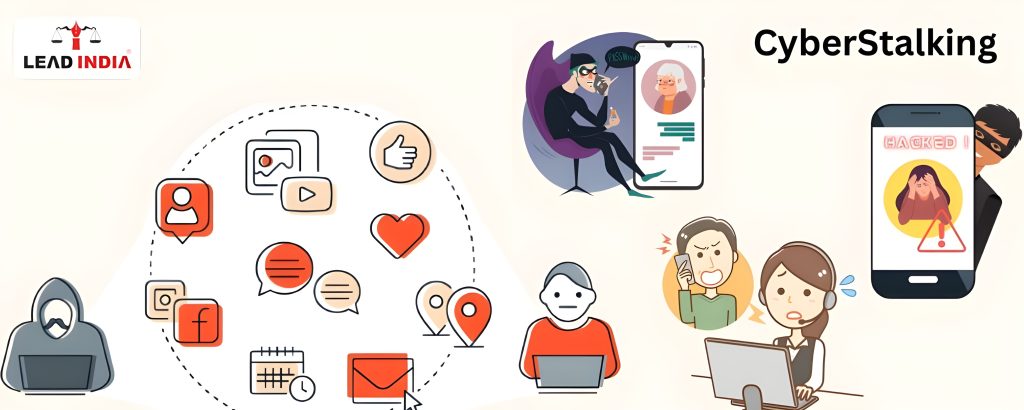
The digital world has provided new paths for connecting, working, and expressing ourselves; new threats have mushroomed. Cyberstalking is among the most fearful types of threats, an ongoing and persistent online harassment that can impact your mental health and safety, dignity.
In India, cyberstalking has been declared a crime under the Information Technology Act, 2000, and under the Indian Penal Code, 1860/Bhartiya Nyaya Sanhita, 2023. This article tells you how you can recognize early warning signs, understand your legal rights, and how to keep yourself safe.
What is Cyberstalking?
Cyberstalking cannot only be a target to celebrities or social media influencers; everyday women, students, professionals, and even teenagers become a victim of cyberstalking.
In many cases, the pattern is subtle at first:
- A random person keeps liking every story
- You block them, but another account appears
- Suddenly, they know where you were yesterday
- This behavior isn’t normal, it’s cyberstalking.
Need A Legal Advice
The internet is not a lawyer and neither are you. Talk to a real lawyer about your legal issue

Common Forms Victims Report
- Flood of unwanted messages, even after being blocked
- Obscene content sent via DMs or email
- Fake profiles pretending to be you
- Personal photos shared without permission
- Messages like “I saw you at the café yesterday” from strangers
How to Know It’s More Than Just a Troll: 6 Red Flags
Real victims have shared how they realized something was wrong:
- Persistent Messaging After Blocking
- They Knew Too Much
- Fake Profiles Flooding Your Feed
- Public Humiliation
- Threats That Feel Real
- Twisted Concern
Your Legal Shield: Indian Laws That Protect You
India has laws that don’t just punish cyberstalkers, but also empower victims. Here’s how:
IPC Section 354D/BNS Section 78 – Stalking, including online stalking of women
- Covers unwanted messages, monitoring, and contact
- For the First offence: Up to 3 years of imprisonment as well as fine
- For the Second offence: Up to 5 years of imprisonment as well as fine
IT Act Section 66E – Violation of privacy
- Covers capturing or sharing private images
- Punishment: Up to 3 years of jail time or ₹2 lakh rupees fine
IT Act Sections 67 and 67A – Obscene or sexually explicit online content
- Punishment: Up to 5 years imprisonment and fine
IPC Section 507/BNS Section 351 (4) – Anonymous threats and blackmail
- Used when stalkers use fake emails or numbers
- Punishment: Up to 2 years
True Cases That Changed the Game
Ritu Kohli (2001):
- She began receiving lewd calls from strangers, someone had shared her number in a chatroom. Delhi Police tracked and arrested the person.
- Why it matters: India’s first cyberstalking case.
Kalandi Lenka Case (2017):
- A student’s morphed images and threats shook her mental health. The Orissa High Court allows strict action.
- What it proved: Cybercrime is not just virtual; it brings real trauma.
Yogesh Prabhu (2021)
- A woman complained daily emails, each time explicit, from a colleague. The man was convicted under IPC 354D and IT Act 67.
- Takeaway: Law is there for your protection, even if it is physical harassment at your workplace
How Real People Protect Themselves: 6 Practical Steps
- Lock Down Your Privacy Settings
- Block and Report, No Guilt
- Screenshot Everything
- Secure Your Accounts
- Don’t Respond or Argue
- Use Cybersecurity Tools
Where and How to Report Don’t Wait Until It Gets Worse
- Online: Visit www.cybercrime.gov.in. Anonymous reporting available for women and children
- Police Station or Cyber Cell: File an FIR as per IPC/BNS and IT Act provisions. Bring your evidence folder
- Women’s Helplines and Legal Aid: National Commission for Women (NCW) accepts complaints. State Legal Services Authorities (SLSA) offer free legal aid
What the Government is Doing to Help?
- Indian Cyber Crime Coordination Centre (I4C): Tracks/counters/investigates/and supports cybercrime cases throughout India
- Cyber Surakshit Bharat Campaign: Intends to provide citizens greater authority over the use and abuse of personal data.
- Digital Personal Data Protection Act, 2023: Aims to give citizens more control over how their data is used and misused
How Courts Are Stepping In?
Courts in India are acting swiftly in cyberstalking cases by:
- Issuing restraining orders against stalkers
- Directing platforms to remove harmful content
- Prioritizing victim safety and psychological well-being
“The dignity of a woman must be respected online just as in the real world.” Orissa High Court, Kalandi Lenka Case
What Needs to Change?
- Digital safety education in schools and colleges
- Faster takedown action by social platforms
- Empathy in police and judicial response
- More awareness campaigns backed by real survivor voices
Conclusion
Cyberstalking is more than an online nuisance; it is a crime. It is a violation of your privacy, the freedom to live your life, and the peace of your mind. It is a violation of your privacy, the freedom to live your life, and the peace of your mind. This is not paranoia. It is called exercising caution. It is okay to think there might be a problem because this probably isn’t the first time someone has acted like a stranger to you.
If someone is cyberstalking or harassing you in the digital world, do not wait! Document it, report it, you can even take legal recourse; you have a right to be safe in your space, offline and online.
One can talk to lawyer from Lead India for any kind of legal support. In India, free legal advice online can be obtained at Lead India. Along with receiving free legal advice online, one can also ask questions to the experts online free through Lead India.
FAQs
1. What types of evidence would be most helpful in a cyberstalking case?
Screenshots of messages, emails, timestamps, call logs and records of false profiles are all essential. It’s also a good idea to try and keep everything relevant in a folder prior to reporting it.
2. Can someone be arrested for sending repeated annoying messages via WhatsApp?
Yes, if the messages were harassing, obscene, threatening or if they continue after someone has blocked them, it could constitute cyberstalking under IPC section 354D or BNS section 78 of the IT Act, and therefore could warrant arrest.
3. What if my friend is being cyberstalked but is afraid to complain about it?
She can ask you to assist her filing a complaint online, or to accompany her to a cyber cell. Some states have women police officers, or legal aid clinics that help with cases of cyberstalking.


 Talk to a Lawyer