
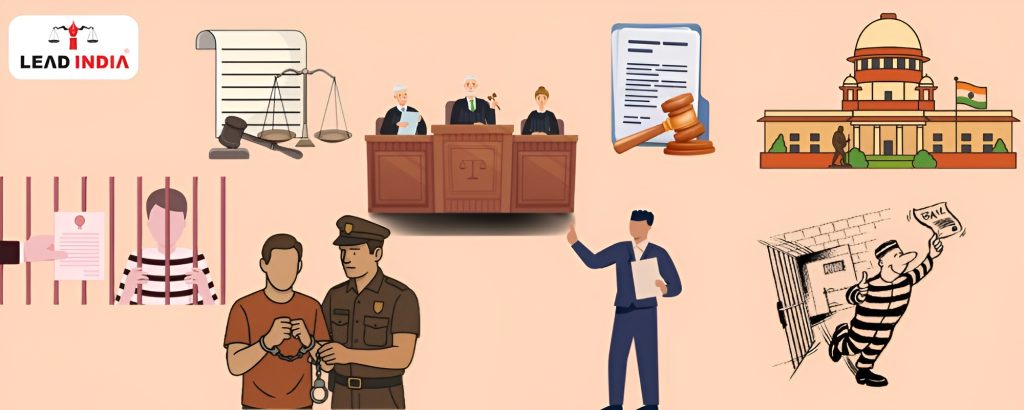
In the criminal justice system in India, the bail system is one of the important protections for any person. It allows the individual to make use of the right to personal liberty as under Article 21 of the Indian Constitution. At the same time, it safeguards the interest of justice. The bail system is primarily regulated by the Code of Criminal Procedure, 1973 (CrPC), which generally indicates the situations where bail may be granted, refused, or revoked.
Bail applications are generally made before the Trial Court or High Court. However, in scenarios where the Trial Court or High Court has declined to provide relief, or the matter involves a serious issue of constitutional or public interest, an accused person may apply for bail directly to the Supreme Court of India.
This article sets out the complete procedure for obtaining bail from the Supreme Court, the relevant provisions under the CrPC and the new Bharatiya Nagarik Suraksha Sanhita (BNSS), 2023, the documents required, and the judicial precedence that shapes the bail jurisprudence in India.
Understanding Bail: More Than Just “Release from Jail”
Bail is the temporary release of an accused person pending the trial process based on the good faith assurance they will return to answer to the charges when ordered. But beyond this technical definition is the more significant value of bail, balancing the presumption of innocence alongside the interest of justice.
1. Regular Bail: When You’re Already Arrested
Regular bail is granted under Sections 437 and 439 of CrPC and is applicable when a person has already been arrested and remains in custody. The Sessions Court or High Court will consider the circumstances of the alleged crime, including the severity of the offence, the likelihood of fleeing, and the individual’s own conduct could have abiding personal interests during the course of the investigation.
Based on experience, when the accused demonstrates an abundance of cooperation with the investigatory agency and shows a connection to the community by way of employment, family ties, etc., it has proven to elicit positive positivity from the courts.
2. Interim Bail: A Temporary Shield
This term defines a short-term barrier, avoiding unnecessary custody while the basic bail petition is pending. Temporary bail affords the accused the opportunity to organize their main application.
3. Anticipatory Bail: Protection Before Arrest
Anticipatory bail is an application by means of Section 438 of CrPC, signifying permanent escape from custody before being arrested. If a person fears to be arrested for a charge being false or completely politically motivated, this is the provision to defence to invoke.
Bail Provisions under CrPC and BNSS: Old Numbers, Same Protection
The new Bharatiya Nagarik Suraksha Sanhita (BNSS), 2023 has renumbered sections but kept the essence of bail intact.
| Subject | CrPC 1973 | BNSS 2023 | Essence |
| Bailable offences | Section 436 | Section 478 | Bail is a right |
| Non-bailable offences | Section 437 | Section 480 | Court’s discretion |
| Anticipatory bail | Section 438 | Section 482 | Pre-arrest relief |
| High Court powers | Section 439 | Section 483 | Special powers |
| Default bail | Section 167(2) | Section 187(2) | Statutory right |
| Undertrial release | Section 436A | Section 479 | Maximum detention |
Pro Tip: Always cite both CrPC and BNSS provisions in current matters, especially when cases are under transition. Judges appreciate accuracy in cross-references.
Bailable vs. Non-Bailable Offences: Knowing Which Side of the Law You’re On
Bailable Offence: A Right You Can Claim
For any type of bailable offences, release is automatic once a bond or surety is furnished. The police or court cannot deny bail in such matters.
Non-Bailable Offence: Where Legal Strategy Counts
For any type of serious offences, bail depends on the discretion of the court. Judges evaluate:
- The nature and seriousness of the offence
- Possibility of absconding
- Chances of evidence tampering
- Past criminal record
Courts are generally more lenient with the accused mentioned above, i.e., women, minors (under sixteen), or anyone unfit for medical reasons.
In experience: Emotional affidavits attacking on the basis of age, illness, and family responsibility have a stronger influence on the court’s decision.
Conditions and Role of Sureties: Why the Court Needs Assurance?
1. Reasonable Bail Amount
Under Section 440 CrPC / 484 BNSS, the bail amount must be fair and proportionate. Excessive bail indirectly amounts to denial of liberty.
2. Sureties as Guarantors
Sureties act as financial guarantors ensuring that the accused complies with bail conditions. The court checks their income, property, and credibility before acceptance.
3. Deposit Instead of Surety
Under Section 445 CrPC / 490 BNSS, an accused can deposit the bail amount directly if unable to arrange sureties. This ensures that financial limitations do not obstruct liberty.
The Real Process: How to Obtain Bail from the Supreme Court?
When permission for bail has been denied by the lower courts or any violation of constitutional rights has been committed, the next step is to approach the Supreme Court of India.
Step 1: Filing Special Leave Petition (SLP)
A bail petition before the Supreme Court is filed as Special Leave Petition (SLP) under Article 136 of the Constitution of India. It should contain:
- Certified copies of lower-court orders
- FIR and charge sheet
- Grounds of parity or personal hardship
- Relevant medical or humanitarian evidence
Step 2: Notice to the State
Once SLP gets admitted by the Supreme Court, the Supreme Court will issue notice to the State or Prosecution. In urgent matters, even interim bail may be granted by the Supreme Court, before a reply is made.
Step 3: The Hearing
During the hearing of the matter the Court would determine:
- Whether the High Court had committed a mistake in denying bail.
- The seriousness of the charge
- Duration of custody
- Conduct of the accused
Step 4: Either Grant Bail or Deny Bail
If the Court is satisfied, then the Supreme Court may grant regular bail, interim bail, or anticipatory bail with conditions such as surrendering passport, or not travelling to certain areas, or not contacting witnesses
Courtroom Insight: The most important factor that the Supreme Court considers is fairness and clarity. The Judges like to see facts that support short arguments rather than long emotional arguments which are, of course, to be avoided.
Landmark Supreme Court Judgments That Changed Bail Law
- Sanjay Chandra v. CBI (2012 1 SCC 40): The Court noted that long pre-trial detention is a way of undermining the presumption of innocence.
- Arnab Goswami v. State of Maharashtra (2020 SCC OnLine SC 964): The Court observed that there is no justification for even a single illegal day in detention.
- Satender Kumar Antil v. CBI (2022 SCC OnLine SC 825): The Court laid down general guidelines to prevent unnecessary arrests and, at the same time, encourage similar bail applications in like cases.
Default Bail – The Statutory Right You Shouldn’t Miss
The accused becomes entitled to default bail under Section 167(2) CrPC / 187(2) BNSS if the police do not file a charge sheet within the time limit of 60 or 90 days.
Key Judgments:
- Uday Mohanlal Acharya v. State of Maharashtra: It states that the right to default bail when the time is over.
- Rakesh Kumar Paul v. State of Assam: It states that the right is unassailable, no matter how severe the offence is.
- Sanjay Dutt v. State through CBI: It states that the period begins from the time of remand.
Practical Tip: Many undertrials stay in custody because they do not make the default bail application on time. The timing of the application is key, the accused must apply for default bail prior to the filing of the charge sheet.
When Bail Gets Cancelled – Common Mistakes to Avoid
Under Sections 437(5) & 439(2) CrPC, bail may be cancelled if:
- The accused breaches bail conditions
- Attempts to influence witnesses
- Commits another offence
Courts view violations seriously. Even social media posts discussing the ongoing case can lead to cancellation. Always follow the conditions strictly once bail is granted.
BNSS 2023 – A Modern Touch to Bail Jurisprudence
The BNSS 2023 delineates “bail” and “bail bond” in Sections 2(1)(b) and 2(1)(d), respectively, for the sake of clarity. It also emphasizes some procedural safeguards for undertrial prisoners in Section 479, to ensure that they are not detained unnecessarily. The law states that liberty is a fundamental value of criminal jurisprudence.
Conclusion
The Supreme Court of India again proclaimed that bail is a right, not a bounty. If we have honed our petitions based on truth and fairness, we will be able to bring liberty back even after first rejection.
Accuracy, calmness, and respect for all of the procedures are required in to going from a Special Leave Petition to the Bench with the facts. Moving from CrPC to BNSS 2023 is India’s continued dedication to trying to achieve the balance of justice to liberty.
One can talk to lawyer from Lead India for any kind of legal support. In India, free legal advice online can be obtained at Lead India. Along with receiving free legal advice online, one can also ask questions to the experts online free through Lead India.
FAQs
1. How long does it typically take to receive bail from the Supreme Court of India?
This typically takes between 1-3 weeks, depending upon the urgency, court vacations, and case load. In some urgent domestic or medical emergencies, then interim bail can be issued in a matter of a few days.
2. Is personal appearance of the accused required during the Supreme Court bail hearing?
No. Generally, the advocate-on-record represents the accused. Physical presence is required only if the court specifically directs.
3. Can I apply for bail directly in the Supreme Court without approaching lower courts?
It is uncommon but possible when there is a clear violation of fundamental rights or when immediate constitutional intervention is necessary under Article 32 or 136.


 Talk to a Lawyer