
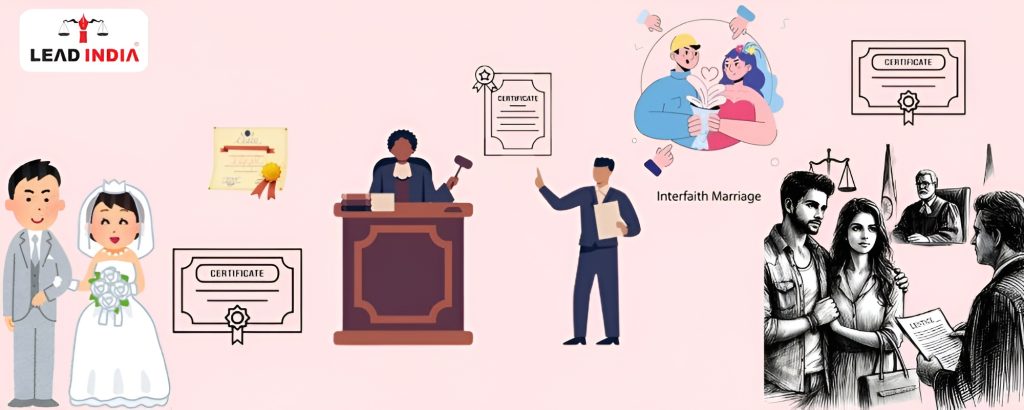
When couples decide to marry across religions, the first confusion they face is not emotional, it is legal.
Most couples ask questions like:
- “Is our marriage legal?”
- “Do we have to convert?”
- “Can parents or police stop us?”
- “What if someone raises an objection?”
This confusion is natural because religion, personal laws, and social pressure often overlap, making people believe inter-religion marriage is risky or illegal. The truth is very different.
Understanding the correct legal route helps you avoid future disputes, police harassment, and court complications.
Is Inter-Religion Marriage Legal in India?
Yes, it can be issued! In India, interfaith marriage is legally permitted by a court of law; Consequently, citizens of India have constitutional rights to make choices regarding the selection of a life partner. Further, individuals are permitted to make these choices irrespective of their religion, caste, parental approval, or the perception of “acceptable levels” by society. This is true because every human being has an inherent personal freedom and dignity.
The legality of the marriage process is, in part, dependent on the way in which the marriage process is conducted. Significant personal and emotional value is attached to a religious marriage ceremony by a great number of couples. Nevertheless, the marriage ceremony may not provide the sufficient legal safeguards for the partners, particularly if they are marrying anyone outside their religion. Consequently, the marriage law recognizes civil unions as a way of marrying that offers the same protection rights to both the parties.
Which Law Governs Inter-Religion Marriage?
The Special Marriage Act 1954 basically deals with inter-caste marriages. This particular act is only intended for those who want to marry outside their religion and at the same time they retain their religion, and it also views marriage as a civil contract rather than a religious sacrament.
Commonly, personal marriage laws apply only where both parties to the marriage are of the same religion, therefore if the two persons getting married practice different religions, then relying solely on the religion with which they identify, poses some issues with respect to inheritance, succession, maintenance, or even the validity of the marriage. The courts have often advised interfaith couples to follow the provisions set out in the Special Marriage Act, 1954, in order to prevent these potential issues from arising.
How the Legal Process Actually Works?
The legal process begins with filing a Notice of Intended Marriage before the Marriage Officer. This notice is submitted in the district where either partner has lived for at least thirty days. The law allows couples to choose the district, which becomes important in situations where family interference is expected.
After the notice is filed, there is a statutory waiting period of thirty days. This stage often causes unnecessary fear because people believe that anyone can stop the marriage. In reality, objections are permitted only on limited legal grounds such as age, existing marriage, or prohibited relationship. Objections based on religion, caste, family honour, or social morality have no legal value.
If an objection is raised at all, the Marriage Officer is only required to examine only its legal validity. If the objection is false or it is motivated by personal reasons, it needs to be rejected. In cases where an officer wrongly refuses to proceed, courts provide remedies through appeal or constitutional protection.
Once the notice period is over, the marriage is solemnized in the presence of the Marriage Officer and three witnesses. After this, a marriage certificate is issued. This certificate is conclusive legal proof of marriage and is accepted for all purposes, including passports, visas, inheritance, banking, insurance, and court proceedings.
Is Conversion Required for Inter-Religion Marriage?
No. The conversion is not required. Marriage under the Special Marriage Act is completely secular and does not involve any change of religion. Choosing to convert only for marriage usually creates various legal complications rather than solving them.
The courts have also made it crystal clear that forced, fake, or the misrepresented conversions can make the marriage legally unsafe. The safest as well as the most legally sound route is marriage as per the Special Marriage Act without any change of faith.
What If Parents or Police Interfere?
The parents usually don’t have any kind of legal power to stop the marriage between two consenting adults. The emotional pressure may exist, but legally their consent is not at all required.
The police also have no authority to particularly interfere with the lawful marriage procedure. If the police call repeatedly, ask any personal questions, or create any pressure under the guise of the inquiry, it is very important not to panic or give any kind of statements without any legal advice. Such interference can be challenged through various higher authorities, magistrate courts, or the High Court.
The courts across the country have repeatedly protected various couples from harassment as well as misuse of authority whenever they are following the law.
Documents You Will Need
- Identity proof
- Age proof
- Address proof
- Passport-size photographs
- Affidavit of the marital status
- Divorce decree / death certificate (if at all applicable)
- For foreigners: visa and NOC
Document requirements may vary slightly by district, but core documents remain standard.
What You Should Practically Do Before Taking Any Step?
- Stay calm and avoid family or social pressure
- Do not convert just to “simplify” marriage
- Choose the correct district for notice filing
- Do not respond to police without legal advice
- Preserve all communication records
- Consult a lawyer before filing notice, not after problems arise
- Early legal planning prevents 90% of complications.
How We Help Inter-Religion Couples
Most of the couples usually approach us with their concerns about safety, legality, as well as the future consequences. Our job is to make sure that the marriage is legally secure, procedurally performed correct, as well as it is protected from interference. We mostly guide the couples at every stage, from notice filing to the certificate issuance, and also take immediate legal action if the objections, harassment, or any kind of threats arise.
Our primary focus is not just completing the marriage, but our focus is to protecting your rights, dignity, as well as future stability.
One can talk to lawyer from Lead India for any kind of legal support. In India, free legal advice online can be obtained at Lead India. Along with receiving free legal advice online, one can also ask questions to the experts online free through Lead India.
FAQs
1. Can parents legally stop an inter-religion marriage?
No. Parents have no legal authority to stop a marriage between consenting adults.
2. Is the 30-day notice compulsory?
Yes, under the current Special Marriage Act. However, legal strategies exist to manage risks during this period.
3. Can police stop us from marrying?
No. Police cannot interfere with a lawful marriage process.
4. Is the religious ceremony legally sufficient?
No, it is not. For the inter-religion couples, registration as per the Special Marriage Act is very essential for full legal protection.


 Talk to a Lawyer