
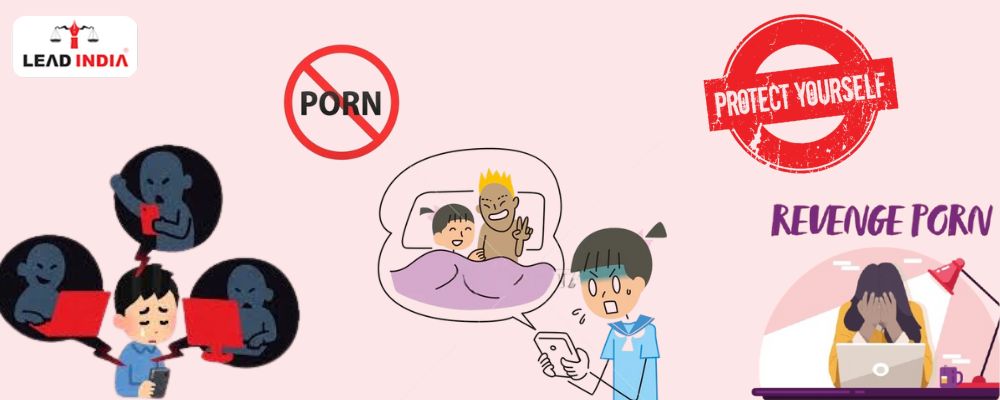
Using smartphones and social media platforms is becoming the routine these days, and it has provided fertile grounds for perpetrating digital crimes. Among the most invasive and traumatic offenses is revenge pornography, which is the non-consensual circulation of private, intimate images or videos, usually by erstwhile partners, in order to shame, harass, or blackmail the victim. In India, mostly women victims undergo emotional trauma with the added burden of stigma from society.
In this article, we shall look into laws, remedies, and case laws that may prove helpful in protecting oneself or a close one from such acts of abuse.
What is a Revenge Porn?
Revenge porn is said to take place when somebody shares someone else’s intimate images or videos without consent, most times after a breakup. It is done to humiliate or blackmail.
Need A Legal Advice
The internet is not a lawyer and neither are you. Talk to a real lawyer about your legal issue
Common Characteristics:
- Your private photos/videos appear online without your consent.
- Someone threatens to leak them unless you give in to demands.
- Your ex uses your past trust to control you now.
Which Laws in India Protect You from Revenge Porn?
Though “revenge porn” isn’t a term used in Indian statutes, the law is still on your side. Here’s how:
IT Act (2000):
- Section 66E: Privacy violations have a punishment of up to 3 years.
- Section 67: Publishing obscene content on the internet calls for Imprisonment and fine of ₹5 lakh.
- Section 67A: Publishing sexually explicit content calls for punishment is up to 5 years imprisonment.
- Sections 66C/D: Does the accused use fake profiles or identity theft?
Indian Penal Code (IPC)/Bhartiya Nyaya Sanhita (BNS):
- Section 354C IPC/ Section 77 BNS: Voyeurism.
- Section 354D IPC/ Section 78n BNS: Stalking via phones, apps, or email.
- Section 499/500 IPC/ Section 356 (1)/ (2) BNS: Defamation.
- Section 503/506 IPC/ Section 351 (1)/ (2) BNS: Criminal intimidation.
Before It Happens: How You Can Stay Protected?
1. Don’t Rely on Love. Rely on Privacy Settings.
- Don’t send intimate photos, even in a “safe” relationship.
- Turn on 2FA on all cloud-based accounts.
- Use encrypted messaging apps like Signal.
2. Talk About Consent Early
- Educate the children, teenagers, as well as young adults.
- If you’re an HR or teacher, you need to speak openly about digital boundaries.
3. Document Everything
When a young professional approached me with threats from an ex, screenshots were our biggest tool. She had proof, and that proof got him behind bars.
What to Do If You’re a Victim of Revenge Porn Cases?
1. File an FIR Immediately
Visit the nearest police station or cybercrime cell. If you can’t get help? Escalate to SP or file directly in court.
Pro Tip: Mention sections of IT Act and IPC/BNS from above to make your case strong.
2. Report It Online (Anonymously If Needed)
Use www.cybercrime.gov.in:
- You can file a women-centric complaint.
- Attach URLs/screenshots.
- Get a tracking ID for follow-up.
3. Reach Out to Platforms
Facebook, Instagram, Google, etc., must remove content within 36 hours if properly reported.
Send them:
- URLs of the content
- Screenshot proof
- Links to police reports (if available)
4. File a Civil Case for Injunction
- You can get a court order stopping anyone from sharing your content.
- You can also get content removed from search engines.
5. Claim Compensation
Under Section 43A IT Act, you can:
- Seek monetary damages for mental harassment.
- File a civil defamation case too.
Landmark Judgments
- Suhas Katti Case (2004): A man posted obscene messages online using a woman’s name. Outcome: Conviction under IT Act. One of India’s earliest cybercrime wins.
- Kalandi Lenka v. State of Odisha: Fake Facebook profile with morphed photos = harassment. Court’s take: Stalking + impersonation = punishable.
- X v. Union of India (Delhi HC, 2021): A brave woman moved Delhi High Court to take down leaked videos. Result: Platforms ordered to delete & prevent re-upload.
- Puttaswamy Case (2017): This case declared Right to Privacy a fundamental right. That’s what your case stands on too.
What If Your Images Are Still Online? The Intermediary Rules Help
Under 2021 IT Rules:
- Platforms must remove content within 36 hours of complaint.
- They must preserve evidence for 180 days for investigation.
If you face delay, go to court. I’ve done it for clients, and courts take it seriously.
Challenges Faced Regularly
- People don’t know these rights exist.
- Police often delay or dilute complaints.
- Social stigma silences victims.
- Evidence is often lost due to panic-deleting.
That’s why documentation and early action is everything.
How India Can Do Better?
1. A Law Dedicated to Image-Based Abuse
So far, we’re relying on a patchwork of laws. We need clarity, fast action, and accountability.
2. Fast-Track Courts for Cyber Abuse
Delay deepens trauma. Let’s fast-track these cases like it is done in POCSO.
3. Digital Support Clinics
Imagine a place where you get legal advice, psychological help, and digital cleanup support in one place. That’s what we need.
Final Thoughts: Your Dignity Is Non-Negotiable
Revenge porn is a weaponized breach of trust. But you have rights, remedies, and resources. Don’t wait, Don’t be silent, Take control. If your privacy has been violated, your next step is not shame it’s justice.
One can talk to lawyer from Lead India for any kind of legal support. In India, free legal advice online can be obtained at Lead India. Along with receiving free legal advice online, one can also ask questions to the experts online free through Lead India.
FAQs
1. Is revenge porn a gender-neutral offence in India?
While most victims are women, Indian laws apply regardless of gender. Any person can file a complaint.
2. What legal action can I take if my morphed image is shared online?
You can file an FIR for defamation, identity theft (66C/66D IT Act), and image-based abuse. Courts may also order content removal.
3. Can a Minor be Charged for Distributing Explicit Gore Images of Other People?
Yes, if the accused is under the age of 18, and the case will proceed through the Juvenile Justice Act while charging the person with the offence, nonetheless still considered very serious.


 Talk to a Lawyer