
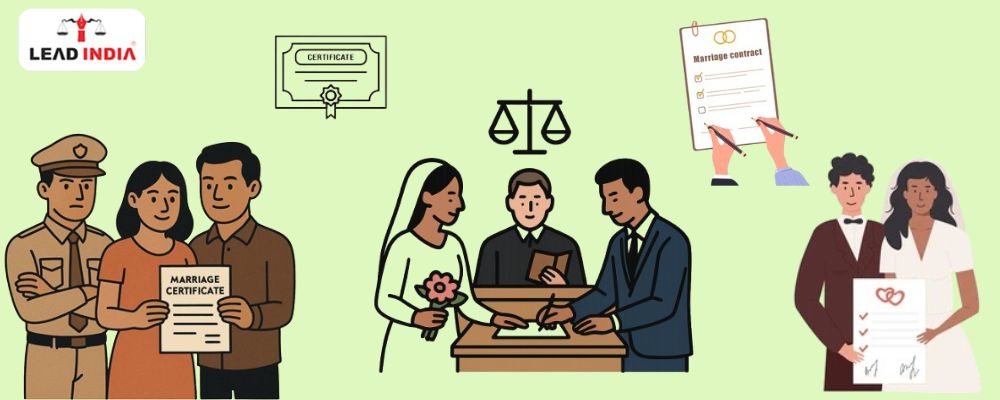
Many couples come to us with this confusion: “We are already married, but we don’t have a marriage certificate. Is it compulsory? Will it create problems later?”
This confusion usually arises when something goes wrong, a visa application is rejected, police verification is stuck, a spouse claims maintenance, or a property or inheritance issue comes up. At that stage, people realise that marriage registration is not just paperwork, it is legal protection. Let us understand this clearly and practically.
Why Marriage Registration Is So Important in Practical Life?
It is still a common occurrence in legal practice to see couples fighting over the consequences of failure to timely register their marriages. Marriage certificates are considered as the ultimate proof by many authorities such as embassies, courts, banks, insurance companies, and even police departments. Without the registration, one would need to go through a long process involving witnesses, documents, and court hearings to establish the spousal status.
Couples registered as married are granted equal rights in the eyes of the law regarding maintenance, divorce, child custody, inheritance, nominations, immigration, and access to government benefits. Moreover, it also serves as a protective wall against false marital claims, separation, and denial of rights.
Is Marriage Registration Compulsory in India?
The Indian judiciary has dispelled any doubt regarding the mandatory nature of marriage registration for the legal record and protection, regardless of the religious denomination. The government of India has mostly taken this step to combat any kind of social evils like the child marriage as well as bigamy and to make sure that the spouses, particularly women, are not usually denied their legal rights.
At the same time, it is very necessary to have the right perception on this particular matter. Non-registration does not automatically result in the invalidation of a marriage that has been conducted according to the law. Yet at the same time, it is much more difficult to prove an unregistered marriage in the event of disputes. Practically, registration is like digging a trench for your legal position and avoiding future complications.
Which Law Applies to Your Marriage Registration?
The law that applies to the registration of your marriage depends on how it was performed.
If both spouses are from the Hindu, Buddhist, Jain or Sikh faiths and the marriage was performed pursuant to a religious ceremony, the registration will occur pursuant to the Hindu Marriage Act. Although registration will occur under the Hindu Marriage Act after the marriage has already taken place.
If the marriage is inter-religious, inter-caste, has either one or both spouses who are foreign nationals, or if the couple desires to have a civil marriage without the performance of any religious ceremonies, then registration and solemnisation of the marriage will occur simultaneously pursuant to the Special Marriage Act. To complete this process, the couple must wait for a notification period of 30 days after giving notice to the Marriage Officer and must have their marriage solemnised by the Marriage Officer at the completion of this notification period.
It is mandatory for Muslims, Christians, and Parsis to perform their marriages according to their respective laws, but they will not be recognised as legal by the government unless a marriage registration is done with the state marriage authority.
Who Is Eligible to Register a Marriage?
The minimum age for marriage registration is to be 21 for the groom and 18 for the bride. There should not be a spouse alive for either party at the time of marriage, and both must be able to give consent that is free and valid. The parties should not fall within any kind of prohibited relationships unless any legally recognised custom allows it.
If at all these basic conditions are not satisfied, then the Marriage Registrar may refuse the registration.
Documents Required for Marriage Registration
Most of the Marriage Registrars ask for:
- Marriage application form
- Proof of age (Birth Certificate, Passport, or the School Certificate)
- Address proof (Aadhaar, Passport, Voter ID, or the utility bill)
- Passport-size photographs
- Marriage photographs
- Identity proof of both parties
- Affidavit that states the date of marriage, marital status, as well as nationality
- Identity proof of the witnesses (usually two or three)
- Requirements might vary from state to state.
How to Register a Marriage After It Has Already Taken Place
After the marriage, the couple is then register their marriage as per Hindu Marriage Act. The couple will apply it with the Marriage Registrar where the marriage took place (or where one of the partners is living). Once the documents get verified, both the partners, along with their witnesses, must come to the office of the registrar. After all the checks, if the registrar is satisfied, he will finish the registration of the marriage and issue the couple the marriage certificate that is registered.
Marriage registrations are subject to a maximum of 30 to 60 days in most states, but late registrations can still be carried out if the late fee is paid and an affidavit claiming the delay is filed.
How Court Marriage Works Under the Special Marriage Act
Court marriage follows a structured legal process. One party must give a notice of intended marriage to the Marriage Officer of the district where either party has resided for at least thirty days. This notice is displayed publicly for thirty days to invite objections.
If objections are raised, the Marriage Officer examines whether they are legally valid. Objections based purely on parental disagreement or social pressure do not hold legal value. After the end of the notice period, the marriage is solemnised in the presence of at least three witnesses, and then after a marriage certificate is issued. This particular certificate serves as a strong legal proof of marriage.
Can Marriage Be Registered Online?
Most of the states have created online platforms wherein the couples can fill their applications, upload their required documents, as well as schedule an appointment through online mode, but they must still appear in person before the registrar. Be careful of any websites or other agents that are offering instant marriage certificates through digital channels without you appearing personally for verification.
What Problems Arise If a Marriage Is Not Registered?
An unregistered marriage poses problems for couples seeking proof of their legal rights. When they seek a claim for maintenance or wish to show that they are married during divorce/custody proceedings, apply for visas, or assert inheritance rights, they will face great difficulty in proving their claims and establishing their marriage. Courts give considerable weight to documentary evidence (registration) proving relationship status; therefore, the absence of a Registration Certificate lessens each individual’s claims.
Is a Marriage Certificate Final Proof of Marriage?
A marriage certificate is treated by courts as strong and reliable evidence of marriage. While it can be challenged in rare circumstances, it generally creates a presumption of a valid marriage and simplifies legal proceedings significantly.
What If You Register the Marriage Late?
Late registration is permitted in most states. It mostly requires payment of the late fee, submission of an affidavit that is explaining the delay, as well as sometimes the additional verification. The courts have consistently held that the delayed registration does not actually invalidate the legally solemnised marriage, but the early registration helps to avoid any type of unnecessary disputes.
What You Should Practically Do Now
- Do not delay marriage registration after marriage
- Choose the correct law based on how marriage was performed
- Keep all the affidavits, photographs, as well as the receipts safely
- Seek the legal help if the registration is refused, delayed, or it is objected to
Most problems arise not because marriage is invalid, but because proper legal steps were not taken in time.
How We Help Couples with Marriage Registration Issues
Couples often approach us when their application is rejected, documents are incomplete, parents object during court marriage, registration is delayed, or one spouse is an NRI or foreign national. We assist by providing clear legal advice, drafting affidavits, representing couples before authorities, and ensuring lawful and smooth registration.
Our objective is straightforward. To secure your legal status today so that you do not face legal uncertainty tomorrow.
One can talk to lawyer from Lead India for any kind of legal support. In India, free legal advice online can be obtained at Lead India. Along with receiving free legal advice online, one can also ask questions to the experts online free through Lead India.
FAQs
1. Can parents legally stop a court marriage?
No. The parental objection alone is not at all a valid legal ground to prevent the marriage between the consenting adults.
2. Can a marriage be registered years later?
Yes. The delayed registration is allowed with an affidavit as well as late fee.
3. Is a Nikahnama sufficient proof of marriage?
In most of the cases, the government authorities still require the registered marriage certificate.
4. Do both spouses need to be present for registration?
Yes. The physical presence of both the parties is totally mandatory.


 Talk to a Lawyer