
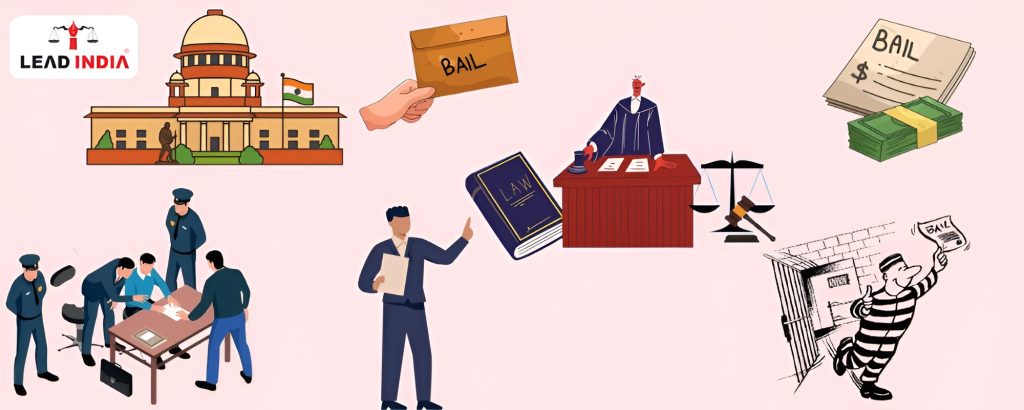
When an individual’s bail application is rejected by the lower courts, the next pertinent question frequently becomes – “Will I qualify for bail from the Supreme Court?”
In Indian Law, personal liberty is a fundamental right guaranteed under Article 21 of the Constitution of India which stipulates that “No person shall be deprived of his life or personal liberty except according to procedure established by law”. Bail provides a safeguard to this right and allows an accused person to remain free from custody throughout the investigation or trial, subject to appropriate conditions.
However, bail from the Supreme Court of India is not granted lightly. The Supreme Court acts as the court of last resort and will intervene in matters only where there is blatant injustice or infringement of fundamental rights. This guide will review the process of obtaining bail, some of the legal principles relevant to bail, case law that deals with bail, and what makes this process difficult.
What is Bail?
Bail is not about escaping the law. It ensures that an accused person’s liberty is preserved until guilt is proven. It is governed by Sections 436-450 of the Code of Criminal Procedure (CrPC), now replaced by Sections 480-490 of the Bharatiya Nagarik Suraksha Sanhita (BNSS), 2023. It balances two things, the presumption of innocence and the interest of justice.
Why Courts Say “Bail, Not Jail”
In State of Rajasthan v. Balchand (1977), Justice Krishna Iyer famously said:
- “The basic rule may perhaps be tersely put as: Bail, not Jail.”
- That single line captures the spirit of liberty the Constitution protects.
How the Supreme Court Becomes Your Last Door for Bail?
The Supreme Court’s power to grant bail arises under:
- Article 136: via Special Leave Petition (SLP) challenging a High Court’s denial
- Article 32: to enforce fundamental rights, including liberty
- Article 142: to do “complete justice” in extraordinary situations
However, the Court does not act as a regular bail forum. It intervenes only when injustice is clear, lower courts have erred, or detention becomes oppressive.
How a Supreme Court Bail Case Actually Begins?
In most of the cases, the client approaches us after exhausting both Sessions and High Court remedies. The law firm then prepare an SLP under Article 136 enclosing:
- Certified High Court bail rejection order
- FIR and charge sheet
- Timeline of custody and trial delay
- Grounds showing violation of Article 21
The SLP is filed, numbered, and listed before a bench, usually within two to three weeks. In urgent cases such as medical emergencies or long custody, interim bail can be sought.
When the Supreme Court Will Hear Your Bail Plea?
The Court entertains bail pleas in specific circumstances:
- Lower courts rejected bail despite weak grounds
- Prolonged pre-trial detention without conclusion
- Violation of liberty or fundamental rights
- Exaggerated or politically motivated allegations
- Serious miscarriage of justice
If a person has spent years in custody or the trial is unreasonably delayed, the Supreme Court considers such cases sympathetically.
What the Supreme Court Considers Before Granting Bail
1. The Gravity of Offence
Heinous crimes invite stricter scrutiny. In P. Chidambaram v. Directorate of Enforcement (2019), the Court noted that economic offences “affect the fabric of society.”
2. The Risk of Absconding
The Court checks if the accused has stable roots, home, family, and work ties.
3. The Risk of Influencing Witnesses
If the accused can tamper with evidence or pressurize witnesses, bail is usually refused.
4. The Delay Factor
In Hussainara Khatoon v. State of Bihar (1979), the Court said that prolonged detention without trial violates Article 21. This remains a strong ground for bail.
5. Parity and Consistency
If co-accused are already on bail, the same relief may be extended—unless distinguishing circumstances exist.
6. Societal Impact
Courts weigh personal liberty against societal safety, especially in offences like terrorism, NDPS, or corruption.
Why Getting Bail from the Supreme Court Isn’t Easy?
1. It’s Not a Routine Court for Bail
The Supreme Court mainly deals with constitutional and appellate matters. Routine bail pleas are meant for High Courts. It steps in only when there’s exceptional injustice.
2. You Must Exhaust Lower Remedies
An SLP is maintainable only after the High Court’s rejection. Direct approach to the Supreme Court is rarely entertained.
3. The Scrutiny Is Tough
Judges review the FIR, charge sheet, and previous orders line by line. Each detail must establish miscarriage of justice.
4. It Doesn’t Re-Assess Facts
The Court doesn’t re-evaluate evidence; it checks whether the law or process was misapplied.
5. It Handles High-Profile or any type of Sensitive Cases
Cases involving any kind of political figures, corporate scams, or the national security are treated with most caution.
First-Hand Experience: Inside the Courtroom
In one of the cases, the accused had been in jail for over three years under UAPA. The law firm highlighted the trial’s delay and lack of progress. The Bench observed, “Liberty cannot be hostage to delay,” and granted bail.
In another, involving a financial offence, the Court refused bail, noting the magnitude of public money involved. These examples show how the particular facts as well as the fairness of each case determine the outcome of the case.
Landmark Judgments That Shaped Bail Jurisprudence
| Year | Case | Key Takeaway |
| 1977 | State of Rajasthan v. Balchand alias Baliay | “Bail, not jail.” Liberty is the norm. |
| 1978 | Gudikanti Narasimhulu v. Public Prosecutor | Liberty and social security must coexist. |
| 2012 | Sanjay Chandra v. CBI | Bail is not punishment before conviction. |
| 2014 | Arnesh Kumar v. State of Bihar | Guidelines to prevent unnecessary arrests. |
| 2019 | P. Chidambaram v. ED | Economic offences form a separate class. |
| 2020 | Arnab Goswami v. State of Maharashtra | Courts must guard against any type of misuse of criminal law. |
| 2022 | Satender Kumar Antil v. CBI | Clear bail framework to avoid arbitrary arrests. |
| 2025 | Celestium Financial v. A. Gnanasekaran | Liberty under Article 21 overrides technicalities in prolonged custody. |
Current Judicial Trends: Liberty Vs Security
The Supreme Court’s approach in recent years reflects a fine balance, liberal in long detentions, strict in security-related offences.
- In Union of India v. K.A. Najeeb (2021), a UAPA accused who had been in detention for five years underwent bail because the trial delayed violated Article 21.
- But NIA v. Zahoor Ahmad Shah Watali (2019) did not get bail when the UAPA charges were prima facie true.
The Court in both of these highlighted to the lower courts that pre-trial detention must never be a form of punishment.
Practical Guidance for Anyone Seeking Supreme Court Bail
If you are planning to move the Supreme Court for the bail, you need to prepare meticulously:
- Obtain certified copies of all previous bail orders
- Maintain a clear timeline of custody and trial delay
- Emphasize medical or humanitarian grounds where applicable
- Include case-law citations supporting parity or prolonged detention
- Engage a lawyer experienced in Supreme Court filings, drafting quality is critical
Conclusion
The Supreme Court’s doors are not easily opened in getting bail, but it is the ultimate safety when there is an unjustified infringement on one’s liberty.
The Court constantly weighs two countervailing interests, the freedom of the individual governed by safety of the public. It has responsibly developed the jurisprudence of bail being humane, but cautiously.
If the High Court has denied your bail, a well-reasoned special leave petition (“SLP”) under Article 136, based ultimately on solid legal and factual basis on which you are entitled to your constitutional liberty.
One can talk to lawyer from Lead India for any kind of legal support. In India, free legal advice online can be obtained at Lead India. Along with receiving free legal advice online, one can also ask questions to the experts online free through Lead India.
FAQs
1. Can the Supreme Court grant bail immediately?
It can grant interim bail on an urgent basis in cases of medical illness, especially prolonged illness or humanitarian basis while the main petition is pending.
2. Can a family member file the bail petition on behalf of the accused?
Yes, any implicated authorized person, including but not limited to the family member or legal representative, can file through a Supreme Court Advocate.
3. Can the Supreme Court cancel bail granted by the High Court?
Yes. If liberty is misused or the accused tampers with evidence, the Supreme Court can cancel bail under its constitutional powers.


 Talk to a Lawyer