
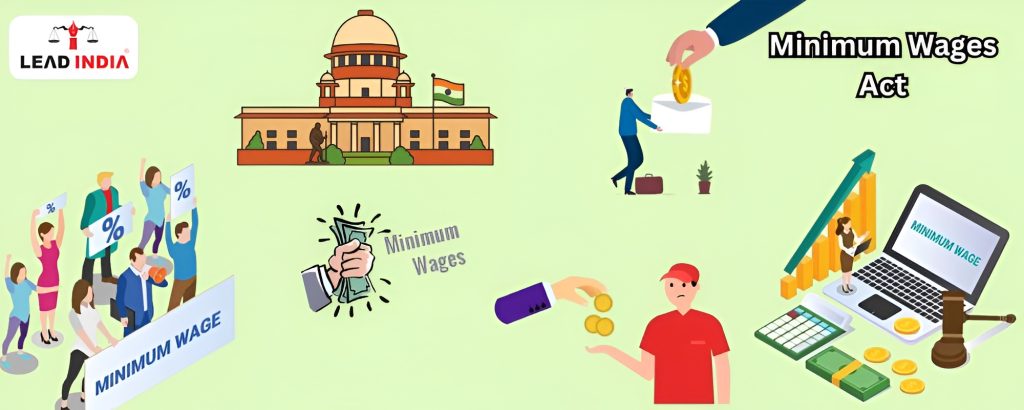
For millions of workers in India, fair pay is often the difference between a life with dignity and one of exploitation. The Minimum Wages Act, 1948 was created to protect this right, and ensure that in certain employments, the employee was paid a wage, that at minimum, allows an employee to satisfy their most basic living needs, food, clothing, shelter, medical-care, and education.
Despite being one of India’s earliest labour welfare laws, issues of enforcement continue to be problematic, especially in the unorganized sector. The article discusses the purposes for which the Minimum Wages Act was enacted in 1948, some of the more important provisions with respect to case laws, recent amendments under the Code on Wages 2019 Act, workers’ rights under the Minimum Wages Act, and meaningful parallels with other aspects of the employment relation, as well as some practical tips for workers to enforce their claims.
What is the Minimum Wages Act, 1948?
The Minimum Wages Act is meant to ensure that a worker in certain employment is being paid a minimum wage sufficient for the worker and his family to maintain a decent standard of life, to provide food, housing, medical treatment and education ensure that employers cannot compel workers to be paid starvation wages.
Your Legal Shield: Key Provisions Every Worker Should Know
1. Government-Fixed Minimum Pay: No Employer Can Go Lower
Every state government publishes various minimum wage rates according to different jobs and skill levels. Wages can be set hourly, daily or monthly, and raised periodically.
For example, in 2025, Delhi’s minimum wage for unskilled labour is ₹17,234/month whereas in Uttar Pradesh it is lower due to cost-of-living differences.
2. Overtime Pay: You Deserve Double for Extra Hours
Workers often share that overtime is forced but underpaid. The law makes it clear:
- A 9-hour workday is standard.
- Overtime must be paid at twice the normal rate.
3. Mandatory Timely Payments
- The law says Payment must not exceed a 30-day interval.
- Any agreement to accept lower or delayed wages is invalid.
4. Wages Are More Than Just Salary
Following the Reptakos Brett & Co. case, courts held that minimum wages should cover:
- Food and clothing
- Housing and healthcare
- Education for children
- Savings for emergencies
It’s not just survival pay; it’s a minimum for living with dignity.
Real Court Cases That Changed Lives
- Bijay Cotton Mills Case (1955): Confirmed that fixing minimum wages protects public welfare and is constitutional.
- Sanjit Roy Case (1983): A drought relief worker was underpaid. The Supreme Court ruled this violated Article 23, calling it forced labor.
- People’s Union Case (1982): Even in government projects, failure to pay minimum wages was termed a violation of Article 21 (Right to Life).
Ground Reality: Challenges Workers Still Face
The ongoing issues are:
- Lack of knowledge: Workers seldom know their specific legal wage entitlement.
- Informal work: Without a written contract it can be very difficult to claim wages owed.
- Gender pay gap: A woman often is paid much less than a man for the same work.
- Weak enforcement: Inspections seldom happen and penalties are weak.
Recent Reform: Code on Wages 2019
India passed a new Code on Wages, yet to be fully enforced. It promises:
- One law for all employees, not just certain sectors.
- A national floor wage to avoid big state-to-state disparities.
- Predominantly gender-neutral pay provisions.
This would be very beneficial by simplifying the approach to wage protection and limiting employers’ ability to exploit loopholes.
What You Can Do If Paid Below Minimum Wage?
Here’s what works best:
- Collect Evidence: Keep payslips, messages, and witness details.
- Approach the Labour Commissioner: File a claim under Section 20 of the Act within six months.
- Seek Union Support: Workers’ groups can pressure employers to settle dues.
- File a Labour Court Case: Courts usually award not just unpaid wages but compensation.
- Use Online Platforms: Many states now have e-labour portals for complaints.
Key Takeaways
- The Minimum Wages Act guarantees every worker basic pay for a dignified life.
- Courts have consistently ruled against underpayment, even calling it forced labour in some cases.
- Awareness and action are your best weapons, don’t let lack of knowledge cost you your rightful wages.
- The upcoming Code on Wages may make wage rights stronger and universal.
One can talk to lawyer from Lead India for any kind of legal support. In India, free legal advice online can be obtained at Lead India. Along with receiving free legal advice online, one can also ask questions to the experts online free through Lead India.
FAQs
1. Can an employer pay less than minimum wages in India?
No. An employer paying any wage less than the minimum wage fixed by the State Government stands specifically prohibited under the Minimum Wages Act 1948. Therefore, any agreement/contract entered into by a worker agreeing to work below minimum wages is void in law. Besides this, the employer is liable to pay fines and face a possible prosecution for his failure to pay minimum wages.
2. How regularly does the government revise minimum wages?
Generally, the minimum wages are revised every five years by either the Central or State Government. Many states however regularly update yearly to be in step with the cost-of-living index. Regardless of the intervals and revisions, it is worth mentioning that all employers must implement revised rates when officially notified.
3. Which industries are covered under the Minimum Wages Act?
The Act applies to all “scheduled employments” notified by the government, including agriculture, construction, textile, mining, shops, establishments, beedi manufacturing, and other industries. States maintain separate lists of covered sectors, so applicability can vary regionally.


 Talk to a Lawyer