
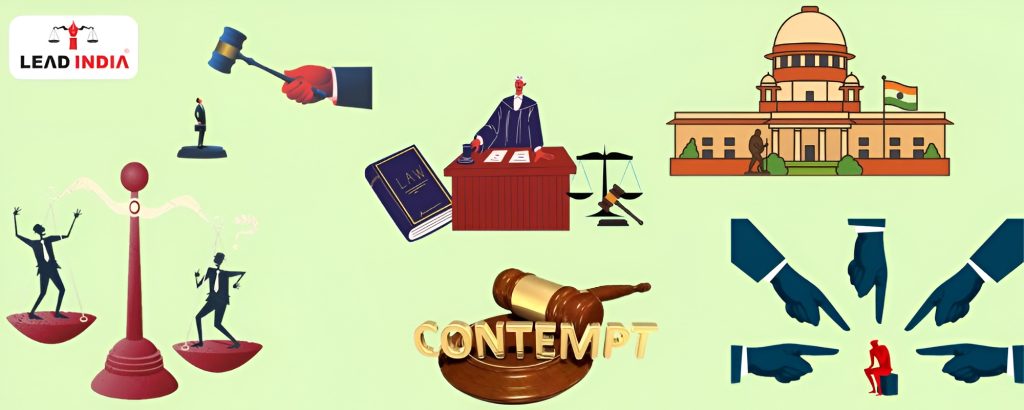
In India, that degree of defiance strikes at the heart of justice. The Supreme Court possesses the constitutional authority to impose punishment for any act that, in its view, disrespects its orders or see its authority. This power to punish is referred to as “contempt of court”, and is critical to preserving the rule of law.
To restate, contempt law operates to guarantee that what the court orders is not simply rhetoric, but a legally enforceable command. Otherwise, an individual could, without consequence, ignore the judgment of the court.
The article discusses in detail the various aspects of the contempt jurisdiction like its constitution and statute basis, types of contempt, punishment for noncompliance with Supreme Court orders, Supreme Court cases, and issues together with the proposed reforms.
Where Does the Supreme Court Get Its Power to Punish for Contempt?
The Constitutional Foundation
- The Supreme Court derives its contempt power under Article 129 of the Indian Constitution, which identifies the Supreme Court as a “court of record”, and thus provides it with the authority to punish for contempt of itself.
- Article 142(2) further states that the Supreme Court can make any order in the territory of India for the investigation or punishment for contempt.
- The powers operated under Article 129 and Article 142(2) ensure that the Supreme Court does not have to rely on any enactment of legislation to take action against a person who disobeys or intentionally degrades the orders of the court. Its powers to punish for contempt come directly from the Constitution.
The Contempt of Courts Act, 1971
This Act defines the terms as well as the procedures related to contempt.
The Contempt of Courts Act’s Section 12 includes:
- Jail Sentence: Up to 6 months in jail.
- Fine: A fine of ₹2,000.
- Both.
However, the Supreme Court has clarified that these limits primarily apply to High Courts. Its own powers under Articles 129 and 142 are not restricted by the statute. The Act supplements but does not confine the Supreme Court’s constitutional authority.
Civil vs Criminal Contempt What’s the Real Difference?
The confusion between civil and criminal contempt is common. The distinction is important both for lawyers and for those subject to court orders.
| Type of Contempt | Definition | Purpose | Example |
| Civil Contempt | Disobeying the court order or breach of any undertaking given to the court. | To secure any type of compliance with court orders. | A government officer who is ignoring a Supreme Court order to reinstate an employee. |
| Criminal Contempt | It is the acts or publications that scandalise the Court of law, prejudice any proceeding, or obstruct the administration of justice. | It is to protect the judicial authority as well as the public’s confidence. | Publishing any type of statements or accusing the judges of bias or corruption. |
How Does the Supreme Court Punish for Contempt?
Statutory Punishments
Under Section 12 of the Contempt of Courts Act:
- Imprisonment: Maximum 6-months in jail.
- Fine: A fine of ₹2,000.
- Both: The punishment can consist of both a fine and imprisonment.
- Apology provision: If the court deems the apology was genuine and without any reservation it can in certain circumstances be a mitigating or eliminating factor for any kind of punishment of contempt.
Common Punishments
- Imprisonment: This type of punishment is very often symbolic, and it may be just one day or it can last several months.
- Fine: The amount of fine can be as high as ₹2,000 or much more, depending on the gravity of the contempt.
- Combined sentence: For serious contempt, a prison sentence will be served in conjunction with a fine.
- Suspended sentence: In some cases, the honourable judge may suspend the sentence upon the occurrence of genuine remorse or compliance.
- Coercive detention: In civil contempt situations, may be detained until an order has been satisfied.
- Other orders: Such as preparation of an apology, publication of an apology, payment of costs, or directions to comply with orders.
Landmark Judgments on Contempt of Supreme Court Orders
In Re: Arundhati Roy (2002)
- Facts: The writer Arundhati Roy in her affidavit, was very critical of the Supreme Court’s decision regarding the Narmada Bachao Andolan case and even suggested bias.
- Ruling: The SC determined that the author’s remarks primarily scandalized the judiciary and accordingly the author was guilty of contempt of court.
- Significance: This case laid down the principle that, however, criticism must be fair and well-grounded. Personal attacks on judges and crazy insinuations about their motives are still contempt.
Justice C. S. Karnan Case (2017)
- A High Court judge while still in office made allegations against judges of the Supreme Court and disobeyed multiple Supreme Court orders. The Supreme Court heard him and sentenced him to six months of imprisonment which is the longest contempt sentence.
- Significance: Contempt law will even apply to judges holding office and provides the idea that no one is above the Supreme Court’s jurisdiction.
Recent Developments (2025)
The Supreme Court has recently made it clear again that government officials are not allowed through their actions to show contempt for the orders of a High Court and if it is intentional then “it cannot go unpunished.” Several officers have been found personally liable for wilful disobedience proving that contempt equally applies to public authorities.
What are the Factors Influencing Punishments for Contempt of Supreme Court Orders?
- Willfulness and intent of the contemnor.
- The nature of the order disobeyed.
- The degree of injury to the administration of justice.
- The presence or absence of an apology or remorse that is genuine.
- There was due process and fairness in the course of the proceedings.
Contemporary Issues and Ongoing Debates
Freedom of Speech vs Judicial Dignity
Ongoing debates occur whether contempt law actually curtails free speech. The Supreme Court has reiterated that anyone is free to criticize any judgment reasonably and fairly. What cannot be said or done is anything that diminishes public trust or confidence in the system of justice.
Statutory Ceiling vs Constitutional Power
While the punishments for the Act are limited to up to six months of imprisonment and/or a penalty of ₹2000, pursuant to the constitutional powers of the Supreme Court under Articles 129 and 142, these powers may be broader. The extent of some of these powers can be somewhat confusing, at times calling for legislative clarification.
Apology and Remission
Courts increasingly value genuine remorse. A heartfelt apology, submitted promptly, often prevents imprisonment. However, the apology must be unconditional and sincere.
Contempt by Public Authorities
Courts have begun taking a stronger stance against bureaucrats and officials who fail to follow court orders. Directions for departmental action and remarks in service records are now common in such cases.
Need for Reform
The Law Commission of India (Report No. 274) has proposed reviewing the definition of “scandalizing the court”, in an effort to protect legitimate criticism and to ensure transparency and disclosure. This demonstrates the continued expanding awareness of judicial accountability and transparency.
Practical Advice from Experience
Drawing from practical experience in contempt and compliance matters:
- Obey first, appeal later: Never ignore a court order while planning an appeal.
- Inform the Court: If the compliance is not possibly met, you can file an affidavit explaining the genuine difficulty.
- Avoid any kind of emotional reactions: Harsh statements can be misinterpreted as contempt.
- Keep proof: You can maintain documents, photos, or any kind of receipts proving the obedience.
- Apologise early if necessary: A sincere and timely apology has often led to complete discharge.
Conclusion
The Supreme Court’s contempt power is both a shield and safeguard for justice, as it derives from Articles 129 and 142, and it ensures that its will is ultimately effective and respected.
Punishments for contempt can include jail, penalty or both, in addition to directions for apologies, compliance, or departmental action. But the focus is not punishment; rather it is preservation of faith in the judicial process.
One can talk to lawyer from Lead India for any kind of legal support. In India, free legal advice online can be obtained at Lead India. Along with receiving free legal advice online, one can also ask questions to the experts online free through Lead India.
FAQs
1. Can government officials be punished for contempt?
Yes. Officials who wilfully disobey Supreme Court or High Court orders can face personal punishment or departmental action.
2. Is criticism of a judge considered contempt?
Constructive criticism in good faith is permissible, but allegations that attack integrity or lower public confidence can amount to criminal contempt.


 Talk to a Lawyer