
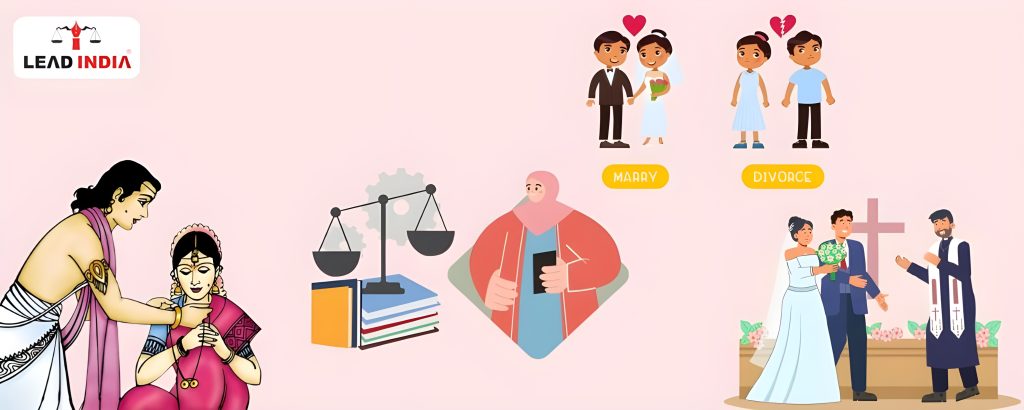
Are you unsure about your rights under either Hindu or Muslim laws, whether it’s registering your marriage, getting a divorce, or claiming maintenance? In India, personal laws vary by religion and understanding them is essential when dealing with any legal family issue.
This article compares the key aspects of marriage, divorce, and maintenance under the Hindu Marriage Act, 1955 and the Muslim Personal Law, including recent court rulings and statutes with clear examples and landmark judgments, we’ll break down what the law says, and how courts interpret it.
Need A Legal Advice
The internet is not a lawyer and neither are you. Talk to a real lawyer about your legal issue

Marriage Laws The Foundation of Your Legal Rights
Hindu Law: A Sacred Bond, But with Legal Conditions
Most of the couples do not realize that their marriage can be declared void if at all the legal conditions as per Section 5 of the Hindu Marriage Act are not met.
The key conditions include:
- No existing spouse during the time of marriage (bigamy is declared as illegal)
- Both parties mentally sound and capable of giving consent
- Legal age (18 for women, 21 for men)
- No prohibited relationships unless custom permits
Case in point: In a case where a woman found out after marriage that her husband was already married. She was able to have the second marriage ruled null and void and to pursue any kind of criminal charges for bigamy according to the Supreme Court’s decision in Anurag Mittal v. Shaily Mishra Mittal (2018).
Muslim Law: A Contract That Protects Rights
Marriage (Nikah) constitutes more of a civil contract according to Muslim law, and both husband and wife are protected by a few fundamentals:
- Offer and acceptance (Ijab and Qubul) in front of witnesses
- Free consent
- Mahr (dower) payment to the wife
Practical insight: In one client’s case, the absence of witnesses during Nikah became a dispute later when the husband denied the marriage. A registered Nikah Nama and witnesses could have avoided the lengthy court battle.
Christian Law: Solemnized by Faith, Recognized by Law
According to the Indian Christian Marriage Act, 1872, marriage is primarily solemnized by a priest or minister, but it also has legal implications.
Basic requirements:
- Either party must profess Christianity
- Must be solemnized by a licensed person or registered under the Act
- Minimum age: 21 (male), 18 (female)
- Consent must be free and valid
Important Note: Registration of the marriage under the Indian Christian Marriage Rules is mandatory for it to be legally recognised, and a marriage certificate must be provided.
Divorce: How It Really Works When Marriage Breaks Down?
Hindu Law: Two Main Paths
- Contested Divorce: You can apply for divorce against cruelty, adultery, desertion, mental disorder, conversion, or presumed death.
- Mutual Consent Divorce: The two parties agree to separate amicably. Now, courts have the power to waive the requirement of a six-month waiting period (Amardeep Singh v. Harveen Kaur, 2017) if there is no chance of reconciliation.
First-hand note: Couples drag cases for years simply because they were unaware of mutual divorce options. A proper petition under Section 13B saves time, money, and emotional distress.
Muslim Law: More Than Just ‘Talaq’
While many assume men alone have the right to divorce, women also have options:
- Talaq-e-Ahsan or Talaq-e-Hasan by husband
- Talaq-e-Biddat (Triple Talaq) now illegal after Shayara Bano v. Union of India (2017)
- Khula where wife initiates divorce with husband’s consent
- Mubarat (mutual agreement)
- Faskh (judicial divorce) under Dissolution of Muslim Marriages Act, 1939
Client experience: A female client couldn’t get her husband’s consent for Khula. We assisted her file according to Section 2 of the 1939 Act on grounds of cruelty as well as neglect, and the court granted her divorce.
Christian Law: Grounds for Divorce Under the Indian Divorce Act, 1869
The Indian Divorce Act, 1869 regulates divorce for Christians, and was amended in 2001 by allowing for mutual divorce.
The grounds on which divorce can be granted include:
- Adultery
- Cruelty
- Desertion for more than 2 years
- Unsoundness of mind by the respondent
- Conversion by the respondent to another religion
- Mutual Consent (section 10A)
Case Example: In Ammini E.J. v. Union of India (1995), the court noted the necessity to reform of personal laws for Christians and provide greater parity between genders.
Maintenance Don’t Assume You’re on Your Own
Hindu Law: Financial Support Is a Legal Right
- Section 24 HMA: Interim maintenance during the case
- Section 25 HMA: Permanent alimony after divorce
- Section 125 CrPC/Section 144 BNSS: Universal right for wives, children, and dependent parents
Example: In one case (Kanchan v. Kamalendra, 1992), a woman earning a small salary still got maintenance because her income couldn’t sustain her living expenses.
Muslim Law: Mahr and Beyond
- Mahr: A promised payment due to wife, even if divorced immediately
- Iddat Maintenance: Lasts around 3 months post-divorce
- Post-Iddat Support: Courts have expanded this after Shah Bano (1985) and Daniel Latifi (2001) rulings, ensuring women aren’t left destitute
Real-life insight: A Muslim woman secured a lump-sum settlement for future livelihood under Daniel Latifi principles, despite her husband’s claim that his duty ended after iddat.
Christian Law: Maintenance Under Divorce Act and Criminal Procedure Code
Provision for maintenance to wife under Section 37 of Indian Divorce Act, Court may grant alimony to wife
Claiming maintenance under Criminal Procedure Code Section 125 / BNSS Section 144, provides a secular process to claim maintenance
Insight: Maintenance cannot be denied based on religion – even Christian spouses can claim interim or permanent financial support if they have no means.
Practical Takeaways Before You Step into Court
- Always document your marriage (registered marriage/Nikah Nama)
- Don’t rely on verbal promises, especially for Mahr or settlement terms
- Seek mutual divorce, as it is faster and less painful
- Maintenance is your right, not charity. Courts prioritize a woman’s financial security post-divorce
- Legal advice early on saves years of litigation
Conclusion
The marriage laws in India are founded on religious customs, but contemporary courts are trying their best to render justice, particularly for women. Whether you are a Hindu, Muslim or Christian, it becomes imperative to know your rights relating to marriage, divorce and maintenance, in order to deal with family law matters with clarity and confidence.
In case you have problems with your spouse, or are contemplating separation, do not delay in seeking family law counsel. Many of my clients often admit that they wished they had reached out to an attorney years before and could have saved themselves years of suffering.
One can talk to lawyer from Lead India for any kind of legal support. In India, free legal advice online can be obtained at Lead India. Along with receiving free legal advice online, one can also ask questions to the experts online free through Lead India.
FAQs
1. Is it legal for a Hindu man to take a second wife when his first marriage is still going strong?
No, bigamy is prohibited under Section 5(i) of the Hindu Marriage Act. A second marriage during the existence of the first marriage is void as well as punishable as per Section 494 IPC/Section 82 BNS.
2. Is triple talaq still valid in India?
No, In Shayara Bano v. Union of India (2017), the Supreme Court of India upheld that instant triple talaq is considered to be unconstitutional. The practice has been declared void and punishable under the Muslim Women (Protection of Rights on Marriage) Act, 2019.
3. Even if a Hindu woman earns money, is she still eligible for maintenance?
Yes, as held in Kanchan v. Kamalendra (1992), a wife can claim maintenance if her income is insufficient to maintain the same standard of living, she had in her matrimonial home.


 Talk to a Lawyer