
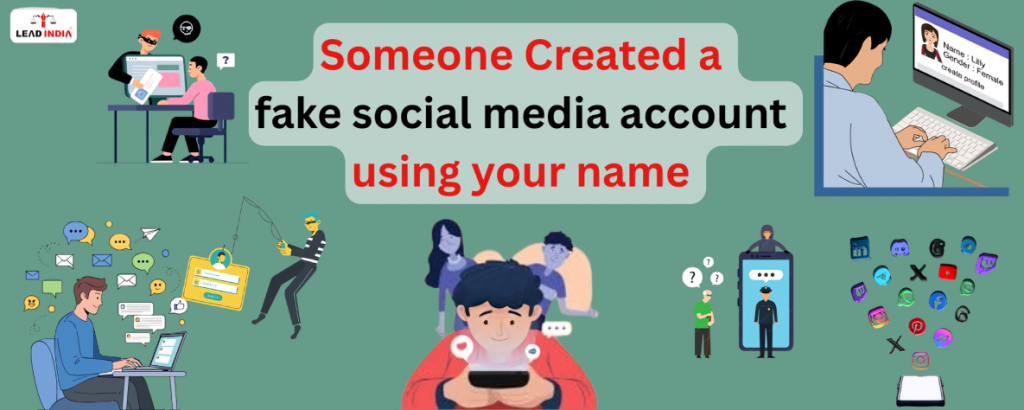
When a person discovers that someone has created fake Instagram, Facebook, or any other social media account by using their name or their photographs, the first confusion is:
- “Is this a crime?”
- “Can I file an FIR?”
- “Will the police actually take action in such cases?”
This confusion is very natural.
Understanding as to what exactly the fake social media account means legally, when you need to take action, as well as what are the steps you need to follow immediately that helps you avoid any serious financial loss and reputational damage.
What a Fake Social Media Account Is and What It Is Not
A fake social media account is any profile created that uses someone else’s identity without their authorization. A fake account can be created with the person’s first and last name or even with their photo. Fake accounts can also be set up in someone else’s name and communicate with other people as if the person is communicating with someone they don’t know.
Most people falsely believe that if there is no financial gain involved, there are no legal rights to pursue. This is completely incorrect. Even simple impersonation is a punishable offence under Indian law.
Another important point to understand is that this is not just a “social media problem.” It is a cyber offence that can lead to criminal prosecution as well as civil liability. The seriousness depends on how the fake account is used.
What Fake Account Misuse Really Means in Practice
Fake accounts in the real world occur more often than not with harmful or negative effects. Commonly found misuse of these accounts include:
- Soliciting money or gifts from your contacts;
- Sending inappropriate or unwanted messages to others;
- Distributing false or inaccurate information;
- Damaging your reputation either personally or professionally.
Numerous real-world examples exist for individuals who learned they were the subject of a fake account only after their friends were solicited for money or after their images were posted or misused publicly. Once these individuals took action, the social harm had been done.
From a legal perspective, these actions constitute identity theft, impersonation, fraud, and in some instances, defamation or harassment based on how the account is being used.
Is Creating a Fake Social Media Account Illegal in India?
This subject has important questions, from which a clear guideline can be taken into consideration. In the Indian law, making a false profile or a replica account using someone else’s name, is a crime.
The Information Technology Act characterizes using another individual’s name or person without consent, as identity theft. If such an account has been used to cheat or deceive other people, it is classified as fraud by impersonation.
The Indian Penal Code/Bhartiya Nyaya Sanhita also classifies impersonation, fraud and defamation as criminal activities. Therefore, regardless of whether there has been a financial loss resulting from the impersonation, the mere act of committing an impersonation offence is criminal.
Immediate Steps You Should Take
Step 1: Collect Proper Evidence
Before taking action, you need to collect as well as preserve evidence. This is very important because the fake accounts can be deleted at any particular time.
You need to take screenshots of profile, posts, messages, as well as the account link. You need to ensure that the username as well as the content are clearly visible. These records will then be required for filing of the complaints as well as legal proceedings.
Step 2: Report the Account to the Platform
The social media platforms provide the options to report the impersonation.
You should report the fake account using the impersonation option and submit your identity proof if required. In most genuine cases, the platform takes action within a short time.
However, relying only on platform action is not sufficient. The legal remedies should also get initiated simultaneously.
Step 3: Inform Your Contacts
To prevent further misuse, you should inform all your friends, relatives, as well as colleagues about the fake account.
You should clearly warn them not to mostly respond to any type of messages from that account as well as request them to report it. This step helps to reduce the chances of fraud and it limits the reputational harm.
Step 4: File a Cyber Crime Complaint
You can file your cyber crime complaint through the National Cyber Crime Reporting Portal or you can visit your local police station or cyber cell to file your complaint.
You must provide your identification documents along with any evidence related to the incident and provide a complete description of what happened during the incident.
Police officers use digital footprint information which includes IP address data and Login history records to identify cybercrime suspects.
If the police refuse to register your complaint, you may apply to the Magistrate for directions to be issued enabling you to lodge your complaint.
Step 5: Send a Legal Notice
By sending a legal notice you are providing a strong basis from which to pursue your case, and legally notifying the perpetrator of the existence of an issue.
A legal notice indicates that you are pursuing your rights, details your issues and gives you a stronger case should you proceed with legal action. Many cases are resolved at this stage without any further action being required.
Legal Provisions Applicable in India
- Identity theft and impersonation have several punishable offences under the Information Technology Act, which can impose imprisonment and/or a fine.
- If identity theft has occurred, then the impersonation will be charged in accordance with the various provisions of the Indian Penal Code/Bhartiya Nyaya Sanhita that address dishonest or fraudulent behaviour (cheating by personation, fraud, etc). In addition to the provisions of the Indian Penal Code/Bhartiya Nyaya Sanhita, if the fake account is used to harass the victim, the provisions of the respective state crime codes will also apply, depending on the specific facts of that case.
- The penalty for these offences varies depending on the manner in which the fake account was used and what damage was done, if any.
Civil Remedies You Can Seek
- Apart from the criminal action, you can also approach the civil courts for the relief.
- You can file the case for compensation for mental harassment as well as the reputational loss. You can also seek the injunction from court to restrain the accused from the further misuse.
- In most of the urgent cases, the courts can pass the immediate orders to prevent the further damage.
Important Legal Position in Courts
- The Indian judiciary shows no signs of taking lightly the crime of using another person’s online identity for personal gain or benefit.
- It is considered a violation of an individual’s fundamental right to privacy when a person uses the identity of another individual without their explicit permission.
- Courts have, likewise, recognized the legality of electronic evidence, including photographs, screen captures and digital evidence of any form, provided those documents and of documentary evidence are kept in acceptable condition in court.
Can the Person Be Traced?
Yes, in most of the cases, the accused can get traced. The authorities can track the IP addresses, device details, login records, as well as other digital footprints. Even if the fake names are used, the technical investigation often leads to the identification.
However, the procedure may take much time depending on the complexity of the case.
Preventive Measures You Should Follow
Do not give out personal/private info on the internet to others or make it public. Also, make sure that you have very strong privacy settings for your social media accounts & websites that use similar features.
Two-Factor Authentication will help out with adding more security to your accounts. If you check up on the internet frequently you can use reverse image search to look up if someone is impersonating you.
Public personas may want to consider getting verified via twitter and/or Facebook to limit potential impersonations.
What You Should Practically Do Right Now
If you are facing this issue:
- Do not ignore the fake account
- Collect evidence immediately
- Report the account on the platform
- File a cyber complaint without delay
- Seek proper legal advice
The delay in taking the action often leads to the increased damage as well as difficulty in tracing the offender.
How We Help in Such Cases
Our legal services offer full support to combat social media fake accounts through our complete service which includes complaint drafting, police FIR filing, legal notice delivery to offenders and court representation.
Our team concentrates on performing immediate tasks which include verifying correct document procedures and enforcing legal penalties against offenders.
One can talk to lawyer from Lead India for any kind of legal support. In India, free legal advice online can be obtained at Lead India. Along with receiving free legal advice online, one can also ask questions to the experts online free through Lead India.
FAQs
1. Is creating fake social media accounts illegal in India?
Yes, it is a totally punishable offence as per the IT Act and the IPC/BNS.
2. Can I file the FIR for the fake Instagram or the Facebook account?
Yes, you can file the FIR or the cyber complaint with the proper evidence.
3. How long does it take to mostly remove the fake account?
The platforms may remove it within a few days, but the legal action may take longer.
4. Can I claim compensation for such a type of misuse?
Yes, you can file the civil case for the damages as well as for the mental harassment.


 Talk to a Lawyer