
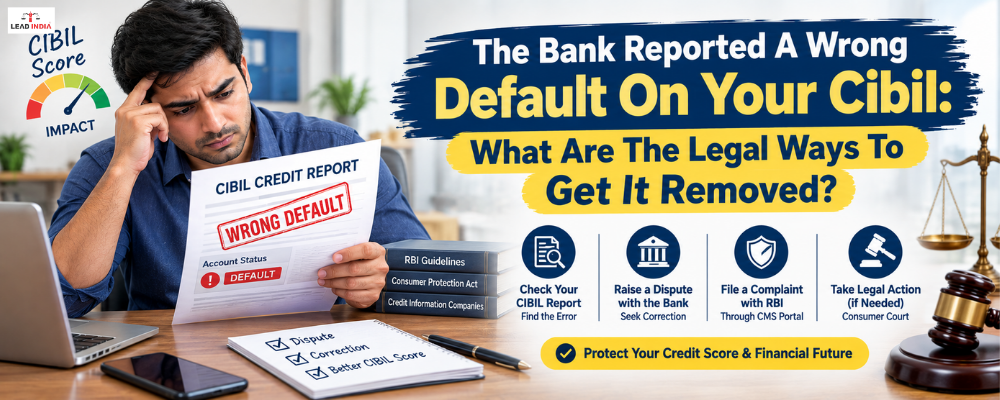
When the borrowers check their credit reports for the very first time, then the biggest confusion they face is: “Why does my CIBIL show a default even though I have repaid my loan?”
This is particularly a very common situation. Most people come to us after:
- A bank rejects their loan application citing a default.
- A financial institution refuses to approve a credit card.
- They notice a “written-off” or overdue status on their report without any explanation.
Understanding what a CIBIL default means, when it is incorrect, and how to get it removed helps you avoid financial losses, mental stress, and rejection of future credit applications.
What a CIBIL Default Is and What It Is Not
TransUnion CIBIL is a credit history company that gathers and keeps your credit and loan history. They will use this information to develop a credit report and will assign you a score, which reflects your reliability as a borrower; these scores are generally in the 300 to 900 range. If you have a higher score, it indicates more reliable finances.
A wrong default does not always mean you are in debt. Errors can happen due to:
- Banks failing to update repayment records.
- Duplicate loan entries.
- Fraudulent loans taken using the stolen identity.
- Technical glitches or the clerical mistakes.
It is very much important to note that the wrong default does not imply the legal liability but it can impact all of your reputation, borrowing ability, as well as the financial opportunities.
Why Wrong Defaults Happen
In India, it is not uncommon for CIBIL to have incorrect entries. This occurs for several reasons, including:
- Loans that have been paid off are still showing as unpaid: Occasionally banks do not update the payment status of customers’ loans with CIBIL.
- Accounts that have been “written off” inaccurately: An account that has been fully paid for will sometimes still appear as “written off.” This can negatively impact a consumer’s credit rating.
- Loans taken fraudulently or through identity theft: The stolen identities or the forged documents can be used to create the loans for consumers that will appear on their report.
- Duplicate accounts: Some of the consumers may have inadvertently created more than one account for the same loan. Then this will create an inflated liability for the consumer.
- Reporting delays: Oftentimes loans will be reported to CIBIL after they have already been repaid due to delays in processing.
These types of errors can have severe impacts on a consumer’s ability to secure a loan, the rate of interest on that loan and, in turn, any business opportunities that they might have.
Is Removing a Wrong CIBIL Default Possible?
Yes. The Indian law provides for several remedies to challenge the inaccurate credit reporting. The framework mostly involves:
The Credit Information Companies (Regulation) Act, 2005 (CICRA) says that Banks have to share correct data with their Credit Bureau and also it gives borrowers the chance to dispute any inaccuracy, according to Section 21 of the CICRA.
Also, the Reserve Bank of India is very clear that Banks and Non-Banking Financial Companies (NBFCs) are supposed to update their borrower records, and fix mistakes fast after they get a request from the complainant.
Then the Consumer Protection Act, 2019 goes on to say that if Banks or NBFCs report something wrong, it counts as a deficiency in service, a negligent act or an unfair trade practice.
Further still, Indian Courts have often repeated that every borrower has a right to amend the incorrect entries on their Reports, as well as to seek compensation for any monetary loss and/or mental unease that happens because of the wrong reporting.
Practical Steps to Remove a Wrong Default
Here’s what a borrower should do immediately:
1. Obtain Your Credit Report
Check all of your loan accounts, outstanding amounts, repayment status, as well as the personal details. Document any discrepancies that are found.
2. Raise the Dispute with CIBIL
CIBIL offers an online mechanism. Submit your claim for: incorrect accounts, wrong payment status, duplicate entries, or ownership issues. CIBIL will forward the dispute to the concerned bank.
3. Send the Written Representation to the Bank
Include the loan account details, proof of the repayment, NOCs, bank statements, or the closure certificates. Retain the proof of sending.
4. Approach the RBI Integrated Ombudsman
File complaints if the bank fails to resolve your issue. The Ombudsman can direct the banks to correct the records and compensate the customers.
5. File a Consumer Complaint
The District Consumer Disputes Redressal Commissions can provide relief for the:
- Credit record correction
- Mental harassment
- Financial loss
- Litigation costs
6. File the Civil Suit for Damages
For any reputational or financial harm, the civil suit may be very necessary. Useful when loan rejections, lost business opportunities, or any professional damage occurs.
7. Writ Petition Before High Court
If at all a public sector bank or the statutory authority is involved, then a writ petition as per Article 226 can compel for the correction of the arbitrary reporting practices.
Important Documents to Keep
The proper documentation mostly strengthens your case. Keep:
- Loan closure certificates
- No Objection Certificates (NOC)
- Bank statements and the EMI receipts
- Settlement letters
- Correspondence with the bank
- Copy of your credit report
- Any legal notices issued
Without evidence, legal remedies may be delayed or ineffective.
Compensation You May Claim
Wrongful reporting can justify compensation for:
- Emotional abuse: Stress, anxiety and having to go back to the bank several times.
- Financial loss: Having loans turned down; having to pay higher interest rates; if your business fails or you lose an opportunity.
- Loss of reputation: A poor credit score can severely impact your reputation in the financial world.
- Legal fees: When banks act recklessly, the courts usually award litigation fees to the borrower.
Can Wrongful Reporting Be Treated as Defamation?
In most of the rare cases, if the bank knowingly reports any false information, causing any serious reputational harm, then a defamation claim may be filed.
Conditions for stronger claims:
- Bank was aware the information was false
- Borrower repeatedly provided proof of repayment
- Severe financial or reputational impact
However, consumer protection and civil remedies are usually preferred.
How Long Does It Take to Correct a Wrong Default?
- CIBIL dispute: ~30 days
- Bank grievance resolution: 30–60 days
- Consumer forum litigation: Several months
The exact timeline mainly depends on the cooperation from the bank as well as from the complexity of the dispute.
Preventive Measures for Borrowers
- Check the credit reports regularly: The early detection prevents future issues.
- Retain loan closure documents: NOCs and certificates are critical.
- Avoid informal settlements: Always get written proof.
- Follow up after closure: Ensure accounts are updated as “closed” in reports.
Role of RBI and Consumer Protection
The RBI ensures for the fair treatment of the borrowers and it mandates the grievance redressal mechanisms. The Integrated Ombudsman Scheme simplifies the complaints and allows for online filing.
The courts increasingly recognize the:
- Credit scores as critical financial assets
- Compensation for wrongful reporting
- Mental harassment claims
- Banks must act responsibly; technological glitches are not excuses
Judicial Precedents Strengthening Borrower Rights
- K.J. Doraisamy v. SBI: Bank liable for not updating closure; compensation awarded.
- Shailendra Singh v. ICICI Bank Ltd.: Default wrongly reflected; records corrected.
- Rajesh Mehta v. Standard Chartered Bank: Credit card wrongly overdue; deficiency in service recognized.
- S. Ramesh v. HDFC Bank Ltd.: Loan appeared unpaid post-repayment; bank compensated.
- State Bank of India v. Consumer Disputes Redressal Proceedings: Wrongful reporting is actionable negligence.
Practical Advice Right Now
If you notice a wrong default:
- Do not ignore it
- Do not blindly believe verbal assurances
- Obtain your report immediately
- Document all communications and proofs
- Follow the proper legal remedies
Ignoring a wrong default can harm your financial future for years.
How Lead India Can Help
Lead India provides guidance to:
- Review credit reports for errors
- Identify wrong defaults
- File disputes with CIBIL and banks
- Approach the RBI Ombudsman and the consumer forums
- Obtain compensation where applicable
You can also receive free legal advice online through Lead India and consult experts for tailored support.
Takeaway
If you have wrongfully been given a default on your CIBIL report, this can damage your financial reputation. You should take action immediately by assembling all of the required paperwork, using the grievance procedures provided by the RBI and/or filing a complaint with a consumer forum or court to get the error corrected and help restore your future financial security.
For legal assistance or advice on the matter, please contact an attorney at Lead India or access free legal advice through the internet.
One can talk to lawyer from Lead India for any kind of legal support. In India, free legal advice online can be obtained at Lead India. Along with receiving free legal advice online, one can also ask questions to the experts online free through Lead India.
FAQs
1. Is the CIBIL default legally binding if at all it is incorrect?
No, but it can affect the loans, credit cards, as well as the business opportunities.
2. Can banks refuse loans due to a wrong default?
Yes, until it is corrected officially.
3. Can I claim for the compensation for wrong default?
Yes, as per the Consumer Protection Act of 2019, and the judicial precedents.
4. How much time does it take to correct the wrong entry?
It takes 30–60 days through the CIBIL and bank, and much longer via consumer litigation.
5. Can anyone file the dispute with the CIBIL?
Yes, any of the borrower whose report contains the errors can initiate the dispute.
6. What are the documents that are essential for the dispute resolution?
The NOC, loan closure certificate, bank statements, EMI receipts, correspondence with the bank, credit report copy.


 Talk to a Lawyer