
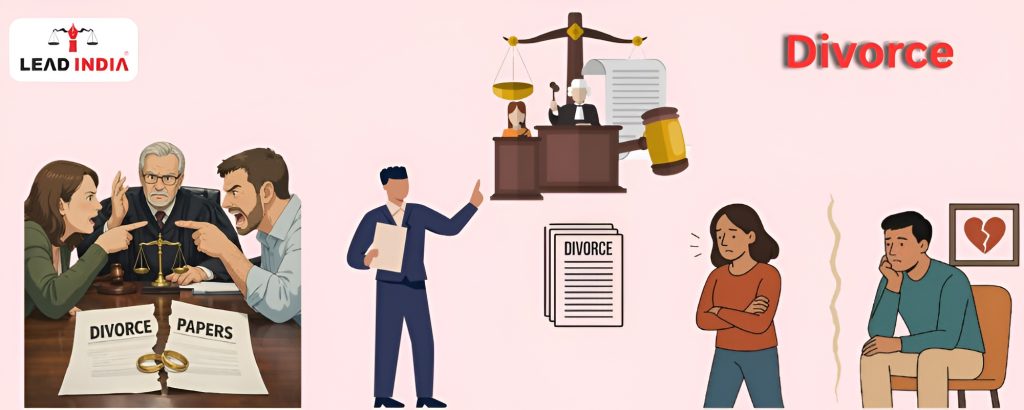
Divorce in India has undergone a transformation from being a taboo to a common civil matter, and in most cases, it is now getting the place of a civil matter in the courts. Before taking up this major step, it is imperative that the individuals involved know their legal rights, financial responsibilities and sources of emotional support.
This article gives an overview of the legal rights, the financial aspects, and ways to ensure that the mental-well-being of the person going through the divorce (dissolution of marriage) in 2026 is maintained through case-law, innovations in the law, and the family law practice in India.
The Legal Road Ahead Understanding Divorce in India
Mutual or Contested: Which Divorce Path Is Right for You?
- When the spouses agree that the marriage cannot be solved, mutual consent (Section 13B, HMA; Section 28, SMA) can be a friendly as well as a quick way out of marriage.
- However, if one of the spouse do not agree, a contested divorce.
- Mutual consent divorce saves time but it does not save emotional energy. Couples often move out from the court with respect.
The Year Divorce Became Digital
- The Bharatiya Nyaya Sanhita (BNS), Bharatiya Nagarik Suraksha Sanhita (BNSS), and the Bharatiya Sakshya Adhiniyam (BSA) have improved the efficiency of the system.
- Now you can submit petitions electronically, attend remote hearings, and get court-mandated therapy which could make the divorce process less intimidating for many people.
Before You File Know Your Legal Rights
You Have the Right to Legal Support
The Legal Services Authorities Act, 1987 provides legal representation for women, children and people living in poverty at no cost to the client. You should not hesitate to advise the court, or a member of the legal aid cell, you would like help, it is your right.
Your Right to Maintenance and Alimony
Divorce can create financial uncertainty. The law provides protection:
- Section 24, HMA: Interim maintenance while the case is ongoing
- Section 25, HMA: Permanent alimony after divorce
- Section 144, BNSS (previously 125 CrPC): Maintenance applicable to all religions
Case Insight: In Kalyan Dey Chowdhury v. Rita Dey Chowdhury (2017), the Supreme Court guided that maintenance shouldn’t exceed 25% of the husband’s income, though courts adjust it case-to-case.
Clients often ask, “What if my spouse hides income?”
Courts now demand income affidavits, making financial concealment far more difficult.
Right to Stay in the Matrimonial Home
- Even if a property is not titled in your name, you cannot be thrown out immediately. Under the Protection of Women from Domestic Violence Act, 2005, you have a right to residence.
- Case Insight: In Satish Chander Ahuja v. Sneha Ahuja (2020), the Supreme Court ruled that a family home, even a shared family property fell under this statute’s protection.
Child Custody The Court Looks at the Child, Not the Conflict
- In custody battles, the focus is not on who’s the “better” parent but what’s best for the child.
- Courts often encourage shared parenting or joint decisions on schooling and health.
- Case Insight: Roxann Sharma v. Arun Sharma (2015) reinforced that the child’s welfare overrides parental rights.
Right to Your Streedhan and Personal Property
- Your jewellery, gifts, and savings are legally yours, even after divorce. Refusal to return them can amount to criminal breach of trust (Pratibha Rani v. Suraj Kumar, 1985).
- It is seen women regain not just assets but confidence once their Streedhan was rightfully restored.
Protecting Your Finances Because Money Is Power
How Alimony Is Calculated
Judges evaluate:
- Duration of marriage
- Standard of living
- Age and health
- Financial status of both partners
Courts now prefer one-time settlements with escrow-based digital transfers, reducing harassment and delays.
What About Property Division?
- India doesn’t automatically split assets after marriage. Ownership depends on whose name is on the title. But recent judgments recognize non-financial contributions like homemaking as valuable.
- Case Insight: B.P. Achala Anand v. S. Appi Reddy (2005) acknowledged homemakers’ unpaid labor as a valid factor in maintenance.
- It is advised to clients to maintain simple proof of contribution, renovation bills, loan payments, or family expense records, they carry weight in court.
Child Support: A Shared Responsibility
- Both parents must contribute based on income.
- Case: Gaurav Nagpal v. Sumedha Nagpal (2009): The court said child support continues until the child becomes self-reliant.
Financial Planning After Divorce
- Lump-sum alimony is non-taxable
- Periodic payments may be taxable income
- Update bank accounts, nominations, and insurance
Financial planning after divorce is freedom planning, it’s how you rebuild stability.
Healing the Mind Not Just Winning the Case
The Emotional Toll
- Each divorce will incorporate silent sufferings, sleepless nights, guilt, and anxiety.
- Recognizing these feelings early on, and accessing support through therapy, is not weakness, it is wisdom.
Legal Safeguards for Mental Health
- The Mental Healthcare Act, 2017 is a strong representation of an obligation to provide access to psychological support and counselling at the court proceedings.
- Family courts also have incorporated sessions for therapy, to enable individuals to process trauma, while continuing with their legal action.
Mediation: A Bridge Between Law and Peace
- Courts encourage mediation as well as pre-litigation counselling to help most of the couples to get separate with dignity.
- There was a mediation case in which both the partners decided to part ways, and when they decided to get apart, they both thanked one another.
Staying Strong and Legally Safe
Collect Every Paper That Matters
Before filing, organize:
- Marriage certificate
- Financial records and income proofs
- Evidence of communication or abuse (if relevant)
Good documentation shortens court time and strengthens your position.
Avoid Social Media Wars
Public posts or emotional rants can backfire legally. Under Section 67 IT Act 2000, online defamation or harassment invites penalties.
Shielding Your Children’s Hearts
Children feel divorce the most. Courts now mostly appoint the child psychologists as well as encourage joint parenting to protect them in emotional terms.
Landmark Judgments You Should Know
| Case Name | Year | Principle Established |
| Amardeep Singh v. Harveen Kaur | 2017 | Cooling-off period can be waived |
| Kalyan Dey Chowdhury v. Rita Dey Chowdhury | 2017 | Maintenance capped at 25% of income |
| Pratibha Rani v. Suraj Kumar | 1985 | Streedhan remains woman’s property |
| Satish Chander Ahuja v. Sneha Ahuja | 2020 | Right to residence in joint family homes |
| Gaurav Nagpal v. Sumedha Nagpal | 2009 | Welfare of the child paramount |
| B.P. Achala Anand v. S. Appi Reddy | 2005 | Homemaker’s contribution recognized |
| Lata Yadav v. Shivakriti | 2025 | Right of residence upheld under BNS |
Closing with Peace, Not Pain
Here’s what it is learned after years of handling divorce cases:
- Consult both a lawyer and a counsellor, law handles facts, therapy handles healing.
- Choose mediation, when possible, it saves dignity and time.
- Protect your financial independence early.
- Focus on your child’s emotional world, not your spouse’s legal words.
- Seek closure, not victory.
- Divorce doesn’t define you, how you handle it does.
Conclusion
The divorce in 2026 is about finding direction. The new legislation as well as the courts in India are geared towards respect, equality, and emotional well-being instead of fighting.
If you are thinking about a divorce, with proper guidance, divorce can be an opportunity to regain peace as well as freedom.
One can talk to lawyer from Lead India for any kind of legal support. In India, free legal advice online can be obtained at Lead India. Along with receiving free legal advice online, one can also ask questions to the experts online free through Lead India.
FAQs
1. Is it mandatory to go through counseling before the divorce process?
In fact, counselling is highly recommended and even required in most family courts for mutual consent divorce cases as the courts almost always recommend pre-litigation counselling or mediation. The aspect of counselling aimed at reconciliation is not maintained, but the process helps to ensure that both the parties are made aware of the emotional and legal implications of divorce.
2. Do I have mental health rights during divorce proceedings?
You have certain rights under the Mental Healthcare Act, 2017 that allows you to assess counselling and psychiatric treatment in a confidential and non-discriminatory manner. Family courts may recommend you to or access the services of court-affiliated, impartial professionals to assist parties in processing emotional distress and respond accordingly.


 Talk to a Lawyer